


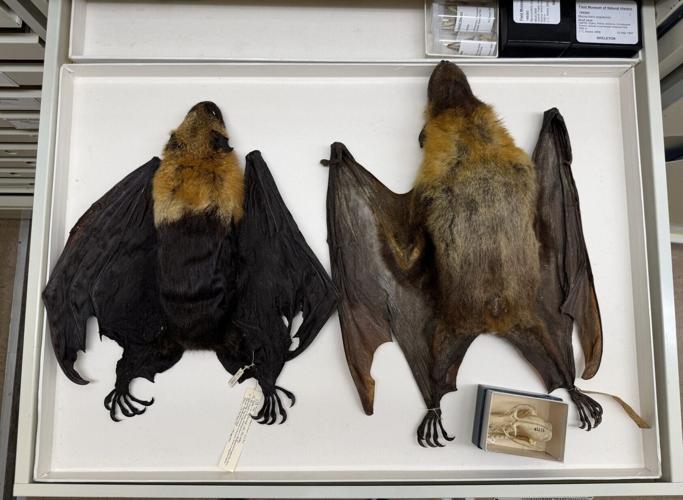

To help exemplify the overall phenomenon of flying foxes shrinking, two specimens from the Field Museum's collections. The smaller specimen on the left is from 1995; the larger specimen on the right is from 1948. (Field Museum via SWNS)
By Stephen Beech
The world’s biggest bats are shrinking, reveals new research.
Flying fox fruit bats are getting smaller — and it may be down to human hunters, according to the study.
Comparisons of the bats with 5-foot wingspans collected over time in Madagascar suggests that the biggest ones are selectively hunted, say scientists.
Their findings, published in the Journal of Mammalogy, show that the giant fruit bats have been getting smaller over several decades.
The research team, from Chicago’s Field Museum in the United States, suspects the trend is related to an increase in large-scale commercial hunting.
They had noticed that flying fox skulls and skins preserved in the museum’s collections seemed to be larger than members of the same species they encountered while doing recent fieldwork in Madagascar.
The researchers wondered why the modern bats were smaller than the older ones collected decades earlier.
Study lead author Emily Ruhs said: “I was thinking about a million different angles to explain why the bats were getting smaller.
“I wondered if it was related to changes in temperature or habitat.”

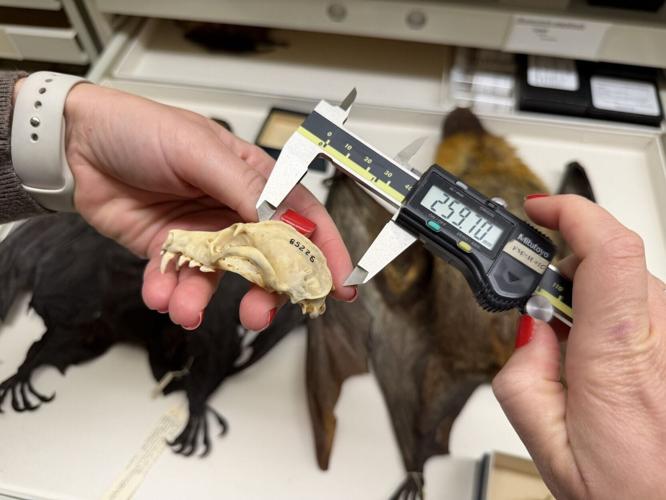
Emily Cornelius Ruhs measuring the skull of a Madagascar flying fox in the Field Museum's collections. (Field Museum via SWNS)
But when she spoke to her colleague Steve Goodman about it, he had a different hypothesis.
On the basis of national legislation of Madagascar, the fruit bats are considered “vermin” associated with their consumption of commercially important fruits.
And flying foxes as a game species are currently hunted for food at a large scale in certain parts of the island nation.
Goodman, the Field Museum’s only full-time field biologist, has been living and working in Madagascar for nearly 40 years.
He noticed something significant after looking at late 18th and 19th century museum specimens.
Goodman said: “Many of these animals were of monster size compared to animals we handle today.
“Hence, the idea was formed that they have diminished in body size as a result of recent heavy hunting pressure and they are not living as long as they did in decades past.
“This underlines the importance of historical museum material in helping scientists to understand change through time.”

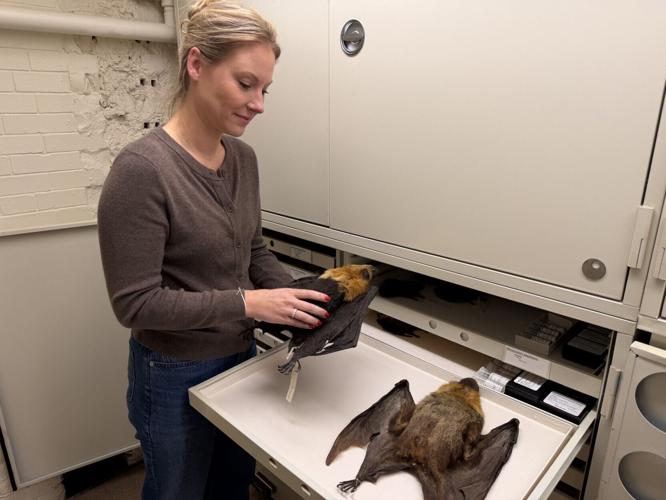
Emily Cornelius Ruhs with Madagascar flying fox specimens in the Field Museum's collections. (Field Museum via SWNS)


Goodman visited the collections of nine natural history museums across the U.S. and Europe, where he examined 121 Madagascar flying fox specimens that were collected over the course of the past 150 years.
He took measurements of the bats’ skulls and teeth, and then Ruhs performed statistical analysis of the data to look for overall trends in size.
She said: “We took all those measurements and put them together, and we looked at how they changed over time.
“We saw a clear drop in size starting around 1980, when we believe bat hunting became more commercialized.”
The change was so drastic that at first, Ruhs believed it must have been a mistake.
She said: “I thought that there must be something wrong with the analysis, there was no way that the rough estimate we had was correct, but it was.”
Ruhs noted that while the study establishes a correlation between the bats shrinking and the commercialization of hunting, the project so far does not explicitly show that the commercialized hunting caused the bats to shrink.
However, she suspects that it’s no coincidence that the biggest bats were the ones that were disappearing.

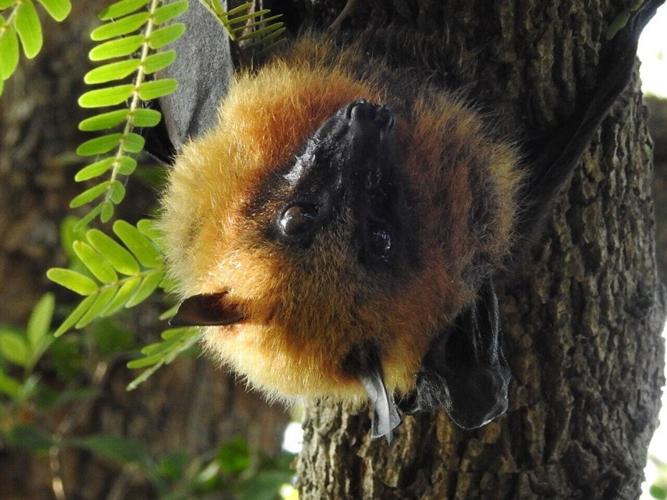
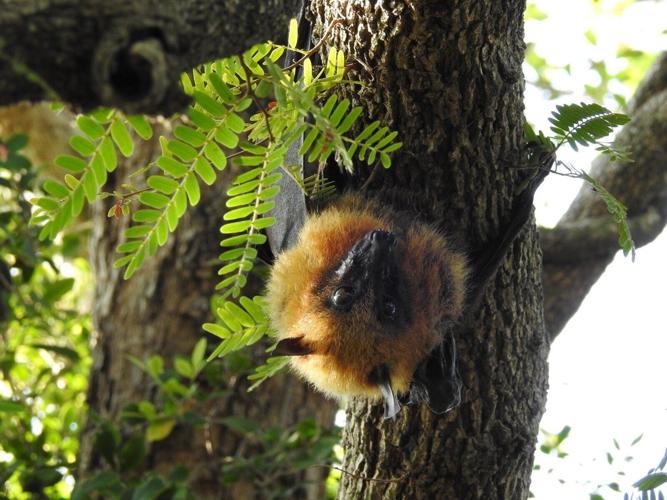
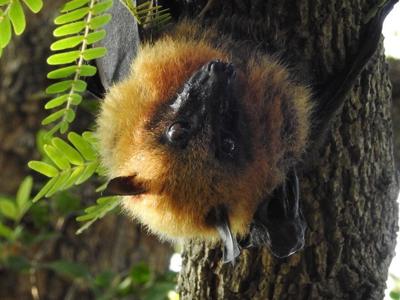
A flying fox fruit bat in Madagascar. (Angelo Andrianiaina via SWNS)
Ruhs said: “If you’re the biggest bat in the sky, you might be the easiest target.
“You’re also going to provide a hunter with the most meat.”
Many of the largest flying foxes identified in this study were also older individuals.
If bigger, more mature bats of breeding age are being targeted by hunters, the researchers fear that could affect flying fox populations overall.
However, the tea say larger bats being targeted by hunters might not be the only factor in the trend toward smaller bats.
Ruhs said: “Things like deforestation, climate change, inadequate or shifting timing of the fruit season could all be playing a role in making flying foxes smaller than they were 40, 50 years ago.
“I don’t think there’s any one cause that explains it all.”
But the study’s findings suggest that Madagascar’s flying fox populations are shrinking in size largely due to human-driven pressure.
Ruhs said: “These bats are an important food source in certain portions of the island for people to feed their families or on the menu in some roadside restaurants, so it is critical to figure out ways to protect the bat populations.
“This needs to involve higher levels of protection following new national laws, particularly at breeding sites, so that the populations don’t collapse.”
She said the study also highlights the value of museum collections, adding: “We can still get a lot of information from these bat specimens that were collected in the 1800s.”


(0) comments
Welcome to the discussion.
Log In
Keep it Clean. Please avoid obscene, vulgar, lewd, racist or sexually-oriented language.
PLEASE TURN OFF YOUR CAPS LOCK.
Don't Threaten. Threats of harming another person will not be tolerated.
Be Truthful. Don't knowingly lie about anyone or anything.
Be Nice. No racism, sexism or any sort of -ism that is degrading to another person.
Be Proactive. Use the 'Report' link on each comment to let us know of abusive posts.
Share with Us. We'd love to hear eyewitness accounts, the history behind an article.