


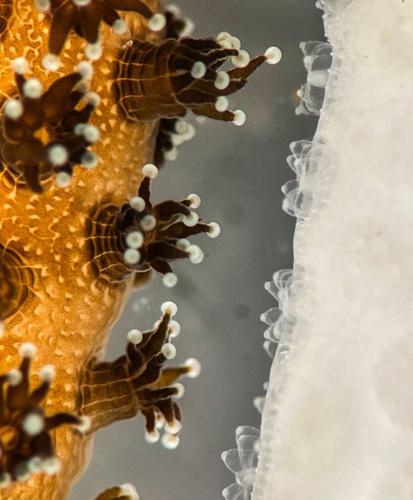

By fusing tissues, healthy corals send enough life-giving algae and nutrients to their bleached counterparts to kickstart the recovery process in three days. (Dan Griffin / GG Films via SWNS)
By Stephen Beech
Coral bleaching has been reversed at record speed using a new method.
Ghostly white corals returned to full health in a laboratory setting within seven weeks — the fastest documented recovery to date.
It is the first time scientists have observed bleached corals on the brink of death fully recover through brief contact with healthy clones.
They say the breakthrough, published in the journal Science Advances, opens new possibilities for restoring coral reefs damaged by global warming.
Some estimates suggest coral could disappear within a few decades as climate change drives more frequent and intense marine heatwaves.
Coral reefs provide habitat for a third of all known marine species, and protect coastlines and communities from storms and flooding.
But when ocean waters warm, corals expel beneficial algae living within their tissues.
The loss of their algae partners leaves corals pale, starving and vulnerable to the invasion of harmful algae.

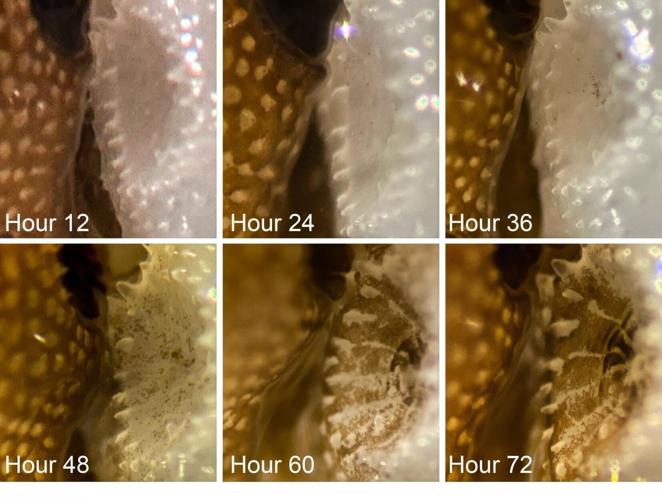
In just a few days, life-giving algae flow from healthy corals to bleached corals, kickstarting the recovery process. (Danny Collins via SWNS)
That stress response — known as “bleaching” — is often lethal and threatens reefs worldwide.
Now, American researchers have shown in a lab setting that corals can fully recover from bleaching within weeks through brief contact with healthy corals.
The explained that, by fusing tissues, healthy corals send enough life-giving algae and nutrients to their bleached counterparts to kick-start the recovery process in three days.
Study lead author Danny Collins said: “While bleached corals may be dying, they are not dead yet.
“The question we wanted to answer is, once a coral has bleached, what can we do?”
Collins, a Ph.D. student at Stanford University’sDoerr School of Sustainability, explained that all corals are animals.
Across most species, individual corals multiply by producing clones that grow together to form vast, reef-building colonies of the same genetic makeup.
In 2025, study co-author professor Steve Palumbi observed something curious about coral biology in his research lab.
Two coral fragments — one bleached, one healthy — sampled from the same colony had tipped over in a tank and were now touching.

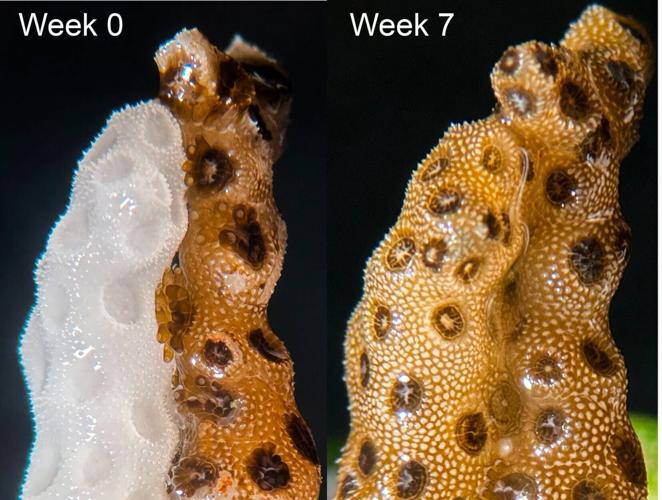
In a laboratory setting, researchers have shown that corals can fully recover from bleaching within seven weeks through brief contact with healthy corals. (Danny Collins via SWNS)
Where they made contact, color returned to the bleached fragment, signaling the return of beneficial algae.
Around the time of the observation, Collins was considering the origins of coral disease, particularly the transmission of bacteria lurking on plastic debris that settles onto corals.
He said: “Harmful bacteria enter corals through physical contact.
“We were curious about what would happen if we used contact to reintroduce something good — the beneficial algae from healthy corals.”
Collins assembled 10 pairs of coral fragments — one bleached, one healthy — from the same animal.
He arranged five pairs close enough to touch, and left gaps of just a few millimeters between the remaining pairs.


The bleached fragments in touching pairs fully recovered within seven weeks, while those without contact died.
Palumbi, from the Doerr School of Sustainability, said: “Genetically identical corals recognize one another when they come into contact.
“Their tissues fuse if they are from the same clone.

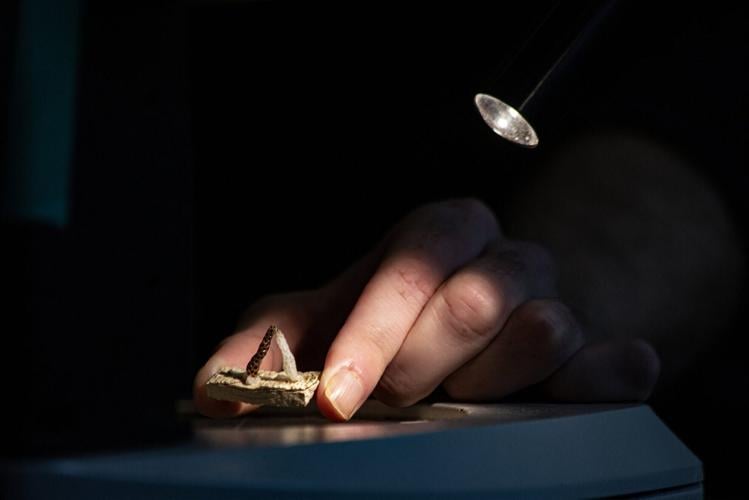
Danny Collins examines two coral fragments – one bleached, one touching – that have fused tissues. (Dan Griffin / GG Films via SWNS)
“We see something similar in humans. Organ transplants are often successful if the donor is your identical twin.”
The research team used a powerful microscope to discover that microscopic channels in coral tissues align shortly after contact, creating a pathway for transport between corals.
Beneficial algae and the nutrients they produce then flow through those channels.
The team observed that beneficial algae moved from healthy to bleached fragments within three days of contact.
They also tested how different contact durations influenced recovery rates.
Researchers separated coral pairs at varying time intervals and found that after one week of contact, and in some cases after just five days, bleached fragments received enough beneficial algae to complete recovery on their own.

In the experiment, gaps of just a few millimeters between pairs of coral fragments – one bleached, one healthy – prevented the bleached fragments from recovering. (Danny Collins via SWNS)
After separation, recovery took just seven weeks — matching the recovery time of coral pairs left in continuous contact.
That led the team to realize that algae replicating within the bleached fragment, rather than traveling from the healthy fragment, primarily drove continued recovery.
Palumbi said: “Once beneficial algae enter bleached corals, they don’t just spread out.
“They flood in and start dividing at the fastest rates seen in corals.”
During the second week of contact with healthy corals, algae within bleached fragments doubled every four days, about 10 times quicker than the rate observed in wild corals.
Researchers have been trying for years to develop tools and approaches that can protect corals from bleaching, disease outbreaks and increasingly acidic waters.
Solutions include selectively breeding heat-tolerant corals, cultivating coral nurseries to restore degraded reefs and even transplanting coral microbiomes.

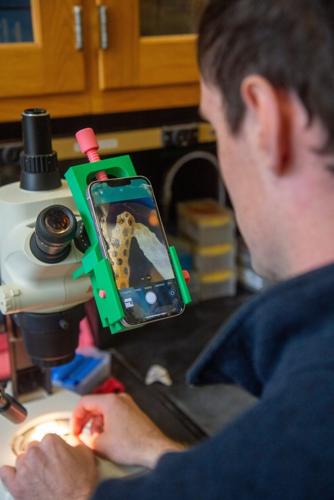
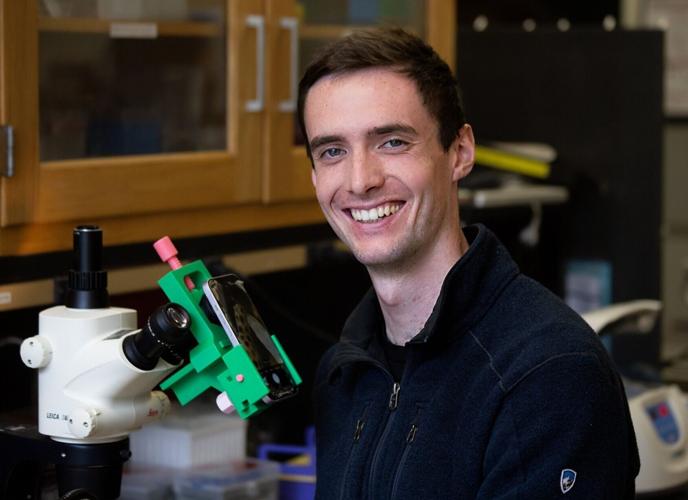
Lead author Danny Collins attached his phone to a microscope with a 3D-printed holder custom-designed by Tom Rolander, a research engineer in the Fabrication Lab at Hopkins Marine Station's Harold A. Miller Library. (Dan Griffin / GG Films via SWNS)
Fiorenza Micheli, a faculty advisor for Collins, said: “Bleached corals are often considered a lost cause because recovery after a heatwave is very slow, if it happens at all.
“We hope this new research will inspire solutions that keep corals healthy long enough to enable full recovery after heatwaves through slower processes such as growth, reproduction, and recruitment of new colonies.”
The research team warned that while the healing potential of physical contact is promising, many questions still remain.
The approach requires a genetically identical, healthy copy of every bleached coral, which is not feasible at the scale needed to restore reefs.
In the coming months, the researchers plan to explore alternative ways of delivering beneficial algae to bleached corals that don’t require continuous contact.
Micheli added: “These new insights into how corals can naturally recover give us hope for the future.
“They open the door to what’s possible and may lead to the breakthrough we need to accelerate reef restoration.”


(0) comments
Welcome to the discussion.
Log In
Keep it Clean. Please avoid obscene, vulgar, lewd, racist or sexually-oriented language.
PLEASE TURN OFF YOUR CAPS LOCK.
Don't Threaten. Threats of harming another person will not be tolerated.
Be Truthful. Don't knowingly lie about anyone or anything.
Be Nice. No racism, sexism or any sort of -ism that is degrading to another person.
Be Proactive. Use the 'Report' link on each comment to let us know of abusive posts.
Share with Us. We'd love to hear eyewitness accounts, the history behind an article.