





Pits and Channels of Hebrus Valles region on Mars. (NASA / JPL-Caltech / University of Arizona via SWNS)
By Dean Murray
Researchers say life on Mars may be hidden in caves.
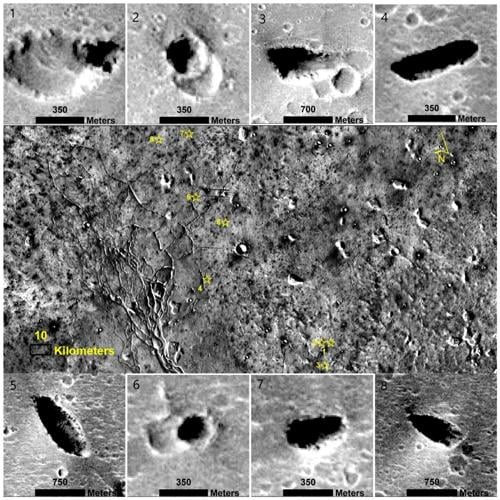
A new study suggests eight "skylights" may be entrances to underground spaces where evidence of ancient microbial organisms could be found.
Previously highlighted caves were likely formed by flowing molten lava, but the caves located in the Hebrus Valles (HV) region were carved by water and may have offered life-sustaining conditions.

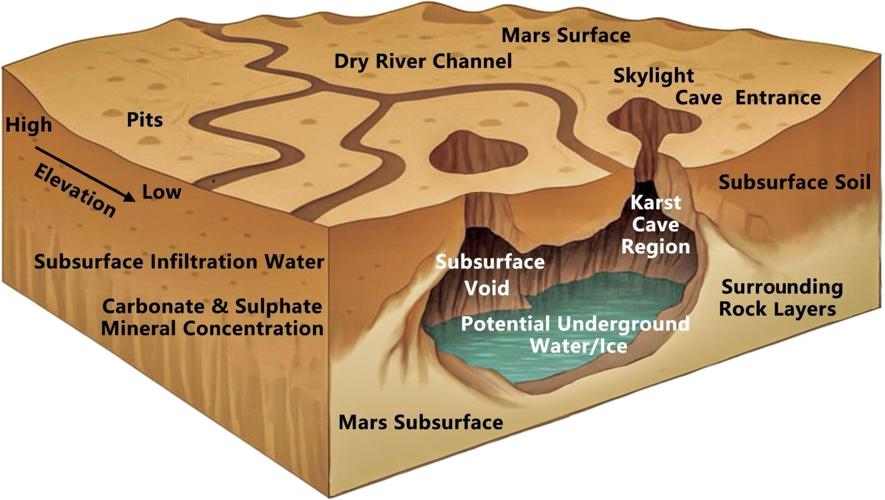
Conceptual model illustrating water-driven karstic cave development and subsurface habitability potential in Hebrus Valles on Mars. (Sharma et al./CC BY 4.0 via SWNS)
The discovery is significant because these "karstic" caves could have held stable, watery micro-environments protected from Mars' harsh radiation and temperature extremes, conditions favorable to life or the preservation of biosignatures.


The study, published in The Astrophysical Journal Letters, suggests the evidence might point to "subsurface void evolution" and HV would be a compelling candidate for future robotic and human missions.

'Skylight' candidates from the new study in Hebrus Valles region on Mars. They could lead to underground caves. (Sharma et al. / CC BY 4.0 via SWNS)
It reads: "The combination of geomorphic, mineralogical, and geochemical findings converge to support the interpretation of these skylights as water-mediated karstic caves.
"The accessible geometry, preserved structure, and favorable geochemical setting of these skylights present promising entry points into shielded environments that may retain evidence of past aqueous activity and potential biosignature preservation.

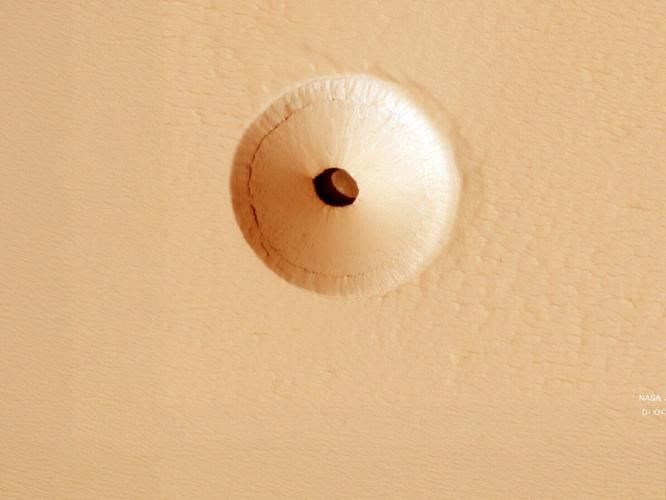
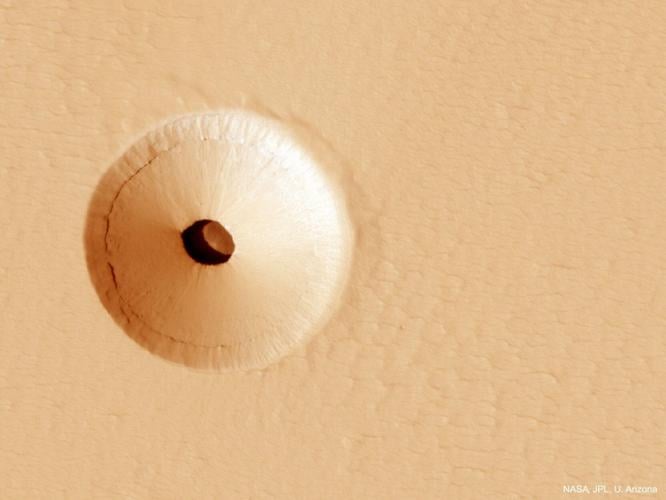
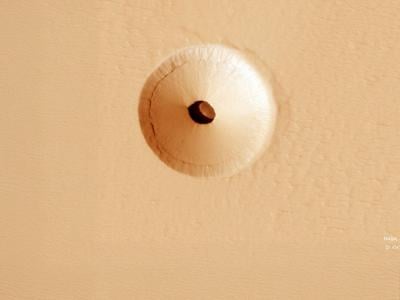
An example of a hole on Mars possibly created by molten lava flow. (NASA / JPL-Caltech / University of Arizona via SWNS)
"As such, the Hebrus skylights emerge as prime targets for future human missions, long-term habitation studies, robotic surveys, advanced robotic dog–based investigations, and high-resolution radar probing of their internal architecture.
"Such efforts could deliver the first detailed images and 3D maps of extraterrestrial caves, opening unprecedented opportunities for science, exploration, and the search for life beyond Earth."


(0) comments
Welcome to the discussion.
Log In
Keep it Clean. Please avoid obscene, vulgar, lewd, racist or sexually-oriented language.
PLEASE TURN OFF YOUR CAPS LOCK.
Don't Threaten. Threats of harming another person will not be tolerated.
Be Truthful. Don't knowingly lie about anyone or anything.
Be Nice. No racism, sexism or any sort of -ism that is degrading to another person.
Be Proactive. Use the 'Report' link on each comment to let us know of abusive posts.
Share with Us. We'd love to hear eyewitness accounts, the history behind an article.