


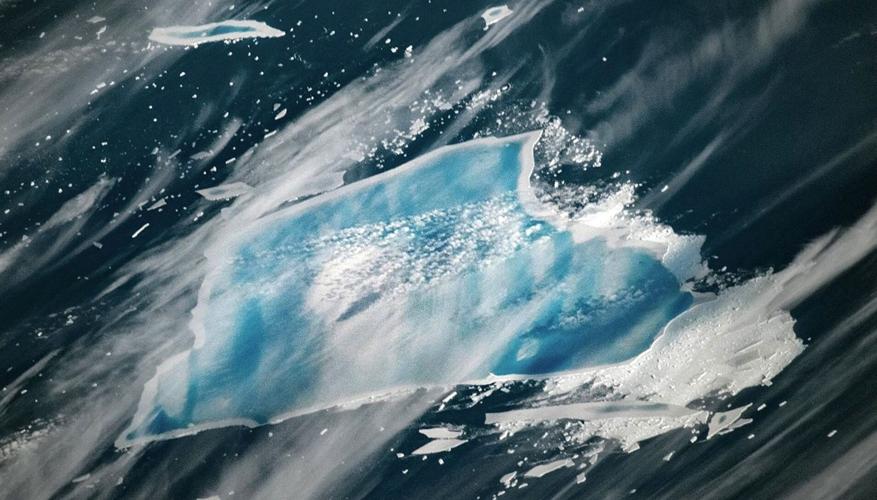

An astronaut aboard the International Space Station captured a photograph showing a closer view (below) of the iceberg on December 27, 2025, with an even more extensive melt than the day before. (ISS/NASA via SWNS)
By Dean Murray
An iceberg, until recently the world's largest, has turned blue as it nears complete disintegration.
A-23A first broke away from Antarctica's Filchner Ice Shelf in 1986, but is now displaying a hue indicating massive meltwaters as it starts to disappear.
When it first detached, the iceberg was nearly twice the size of US state Rhode Island—about 4,000 sq kms.

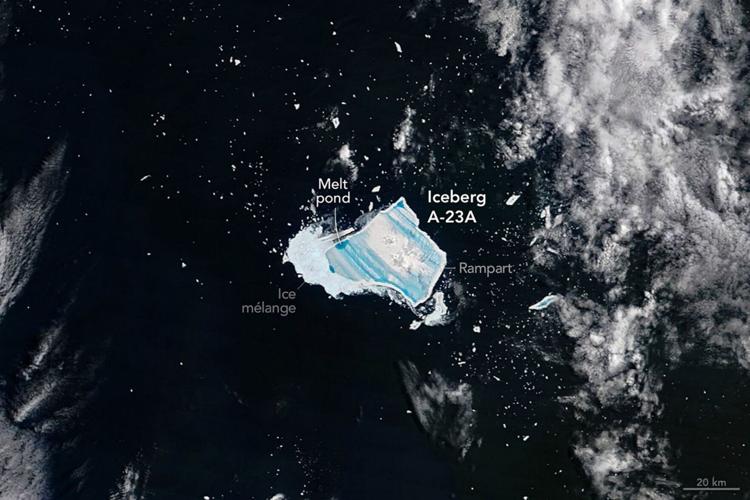
When the MODIS (Moderate Resolution Imaging Spectroradiometer) on NASA's Terra satellite captured this image of what remained of the waterlogged berg on December 26, 2025, extensive pools of blue meltwater were visible on its surface. (NASA Terra satellite/MODIS via SWNS)
Estimates from the U.S. National Ice Center now put A-23A's area at 1,182 sq kms in early January 2026.
This follows the breakup of several sizable pieces in July, August, and September of 2025 as it moved into relatively warm summer conditions by December.


It is believed that iceberg D15a, currently located near Australia's Davis research station in Antarctica, is the current world's largest. It measures around 3,000 sq km.
NASA Earth Observatory said: "After a four-decade run, the massive, waterlogged berg is leaking meltwater and on the verge of disintegrating.

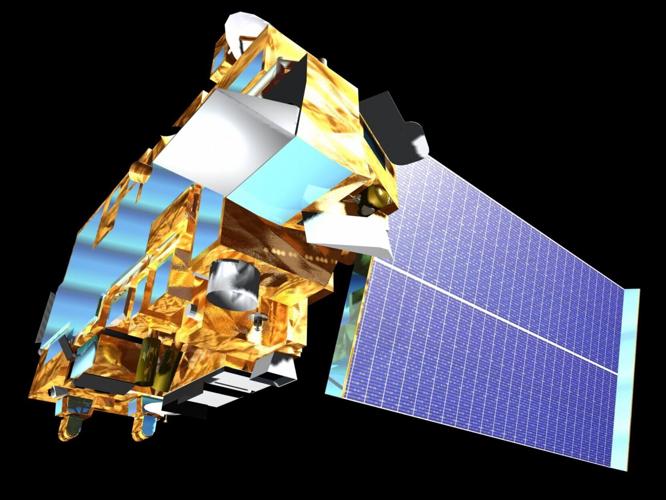
Artist impression of NASA Terra satellite. (NASA Earth Observatory/Reto Stockli via SWNS)
"One of the largest and longest-lived bergs ever tracked by scientists is sopping with blue meltwater and on the verge of complete disintegration as it drifts in the South Atlantic between the eastern tip of South America and South Georgia island."
Scientists say these signs indicate the iceberg could be just days or weeks from disintegrating completely.
NASA quoted retired University of Maryland Baltimore County scientist Chris Shuman as saying: "I certainly don't expect A-23A to last through the austral summer.
"A-23A faces the same fate as other Antarctic bergs, but its path has been remarkably long and eventful. It's hard to believe it won't be with us much longer."





(0) comments
Welcome to the discussion.
Log In
Keep it Clean. Please avoid obscene, vulgar, lewd, racist or sexually-oriented language.
PLEASE TURN OFF YOUR CAPS LOCK.
Don't Threaten. Threats of harming another person will not be tolerated.
Be Truthful. Don't knowingly lie about anyone or anything.
Be Nice. No racism, sexism or any sort of -ism that is degrading to another person.
Be Proactive. Use the 'Report' link on each comment to let us know of abusive posts.
Share with Us. We'd love to hear eyewitness accounts, the history behind an article.