



(NASA/ESA/AU/STScI via SWNS)
By Dean Murray
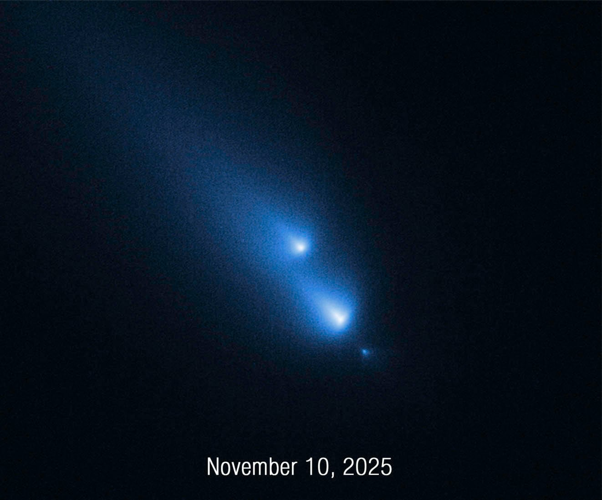
Space scientists have captured a comet breaking into pieces by accident.
NASA’s Hubble Space Telescope witnessed the incredibly rare event while searching for another cosmic target.
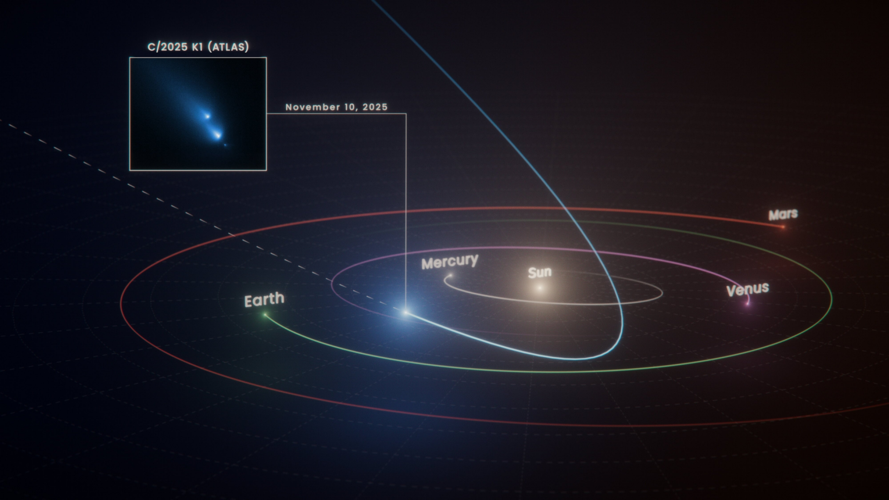
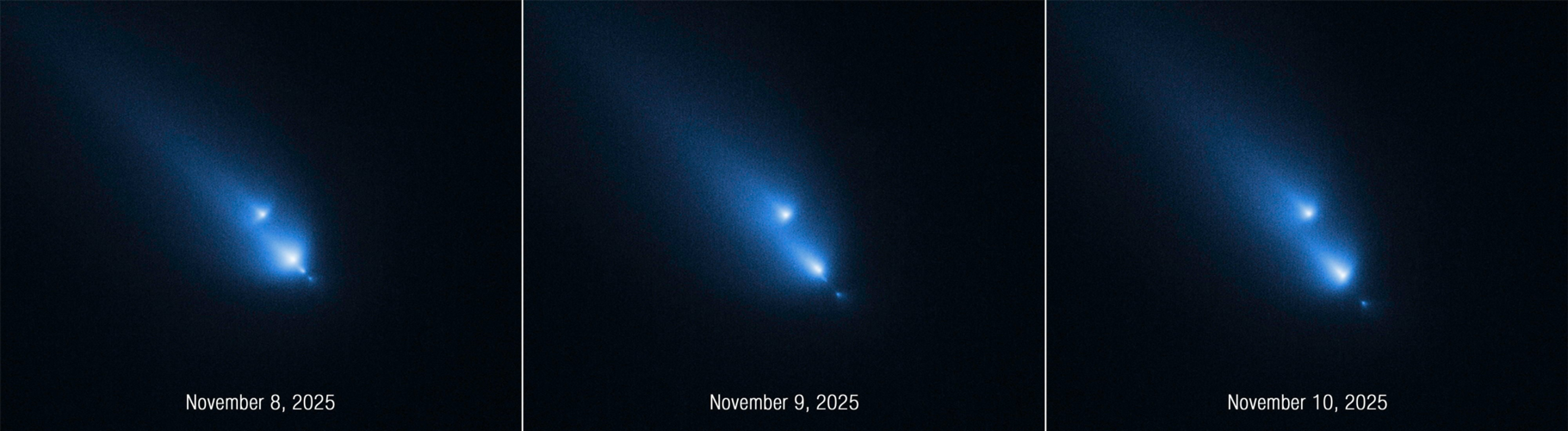
The comet K1, whose full name is C/2025 K1 (ATLAS), was seen disintegrating over a period of three days.
NASA Hubble Mission Team said: "In a happy twist of fate, NASA’s Hubble Space Telescope just witnessed a comet in the act of breaking apart. The chance of that happening while Hubble watched is extraordinarily minuscule."
The findings have been published in the journal Icarus.

(NASA/ESA/STScI via SWNS)
“Sometimes the best science happens by accident,” said co-investigator John Noonan, a research professor in the Department of Physics at Auburn University in Alabama. “This comet got observed because our original comet was not viewable due to some new technical constraints after we won our proposal. We had to find a new target—and right when we observed it, it happened to break apart, which is the slimmest of slim chances.”


NASA explained that this is an experiment the researchers have always wanted to do with Hubble.
They said: "They had proposed many Hubble observations to catch a comet breaking up. Unfortunately, these are very difficult to schedule, and they were never successful."
“The irony is now we're just studying a regular comet and it crumbles in front of our eyes,” said principal investigator Dennis Bodewits, also a professor in Auburn University’s Department of Physics.

(NASA/ESA/STScI via SWNS)
Hubble’s images were taken just a month after K1’s closest approach to the Sun, called perihelion. The comet’s perihelion was inside Mercury’s orbit, about one-third the distance of the Earth from the Sun.
During perihelion, a comet experiences its most intense heating and maximum stress. Just past perihelion is when some long-period comets like K1 tend to fall apart.
The comet K1 is now a collection of fragments about 250 million miles from Earth. Located in the constellation Pisces, it is heading out of the solar system, not likely to ever return.
“Never before has Hubble caught a fragmenting comet this close to when it actually fell apart. Most of the time, it's a few weeks to a month later. And in this case, we were able to see it just days after,” said Noonan. “This is telling us something very important about the physics of what's happening at the comet’s surface. We may be seeing the timescale it takes to form a substantial dust layer that can then be ejected by the gas.”
Comet K1 is now a collection of fragments about 250 million miles from Earth. Located in the constellation Pisces, it is heading out of the solar system, not likely to ever return.





(0) comments
Welcome to the discussion.
Log In
Keep it Clean. Please avoid obscene, vulgar, lewd, racist or sexually-oriented language.
PLEASE TURN OFF YOUR CAPS LOCK.
Don't Threaten. Threats of harming another person will not be tolerated.
Be Truthful. Don't knowingly lie about anyone or anything.
Be Nice. No racism, sexism or any sort of -ism that is degrading to another person.
Be Proactive. Use the 'Report' link on each comment to let us know of abusive posts.
Share with Us. We'd love to hear eyewitness accounts, the history behind an article.