







Sean S
By Stephen Beech
A beer belly is a key warning sign of increased heart failure risk, according to new research.
Excess fat stored around the waist is more strongly associated with the potentially deadly condition than body mass index (BMI), say scientists.
The study suggests that where fat is stored in the body may matter more than weight when it comes to the risk of heart failure.
The findings hint that excess weight around the waist - known as central obesity or visceral fat - may increase the risk of heart failure primarily due to inflammation.
Researchers discovered that measurements of higher levels of visceral fat were more strongly linked to heart failure risk than overall body weight.
Higher waist measurements also identified higher risk even when BMI appeared normal.
The study found that inflammation may help explain why belly fat is especially harmful to heart health,
Researchers say their findings may help identify people at higher risk of heart failure using waist measurements rather than relying only on BMI.
Study lead author Szu-Han Chen said: “This research helps us understand why some people develop heart failure despite having a body weight that seems healthy."

Szu-Han Chen, medical student, of National Yang Ming Chiao Tung University in Taiwan. (T.W. Huang via SWNS)
Chen, a medical student at National Yang Ming Chiao Tung University in Taiwan, added: “By monitoring waist size and inflammation, clinicians may be able to identify people with higher risk earlier and focus on prevention strategies that could reduce the chance of heart failure before symptoms begin.”
Previous research has shown that that higher levels of inflammation in the body are linked to an increased risk of heart disease, even in adults with normal cholesterol levels.
The new study involved analysis of health data from 1,998 African American adults in three counties in urban and rural Jackson, Mississippi.


The participants did not have heart failure and were aged 35 to 84 at the outset, with an average age of 58.
Researchers assessed the participants’ body fat levels for around seven years using measures including weight, BMI, waist circumference and waist-to-height ratio.
Blood samples were tested to measure high-sensitivity C-reactive protein, a commonly used marker of inflammation in the body.
This study was conducted under the guidance of Professor Hao-Min Cheng of the National Yang Ming Chiao Tung University.
The study found that 112 adults developed heart failure during the follow-up period.

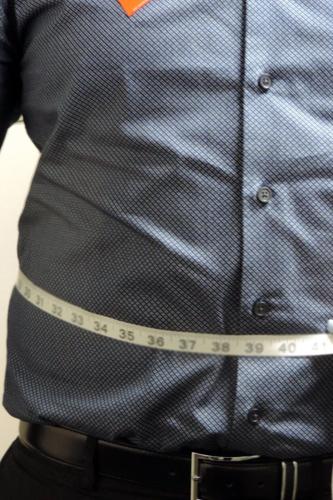
Waist measurement - man. (American Heart Association via SWNS)
Elevated measurements of excess weight around the waist were associated with increased heart failure risk, but high BMI was not.
Higher waist circumference and waist-to-height ratio were each associated with increased heart failure risk;.
Participants with higher inflammation levels, as measured by blood tests, were more likely to experience heart failure during the study period.
Inflammation accounted for around a quarter to one-third of the link between measures of fat stored around the waist and heart failure risk.
The findings are due to be presented at the American Heart Association’s EPI|Lifestyle Scientific Sessions in Boston, Massachusetts.
Professor Sadiya Khan, of the American Heart Association (AHA), welcomed the findings.
She said: “This study highlights the importance of integrating measures of central adiposity such as waist circumference into routine preventive care.
"Understanding upstream drivers of heart failure risk including central adiposity is key to recognizing and modifying risk."
Khan, who was not involved in the study, added: "Future research should identify if central adiposity has greater predictive utility beyond strength of association."


(0) comments
Welcome to the discussion.
Log In
Keep it Clean. Please avoid obscene, vulgar, lewd, racist or sexually-oriented language.
PLEASE TURN OFF YOUR CAPS LOCK.
Don't Threaten. Threats of harming another person will not be tolerated.
Be Truthful. Don't knowingly lie about anyone or anything.
Be Nice. No racism, sexism or any sort of -ism that is degrading to another person.
Be Proactive. Use the 'Report' link on each comment to let us know of abusive posts.
Share with Us. We'd love to hear eyewitness accounts, the history behind an article.