


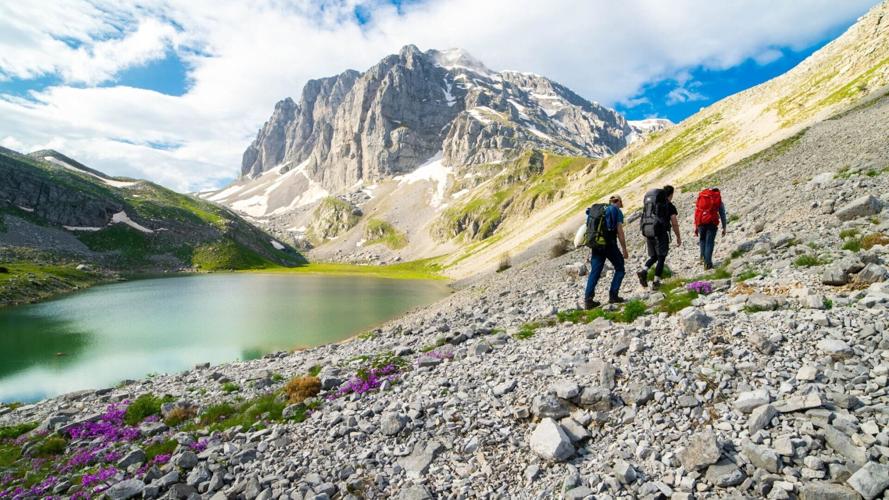
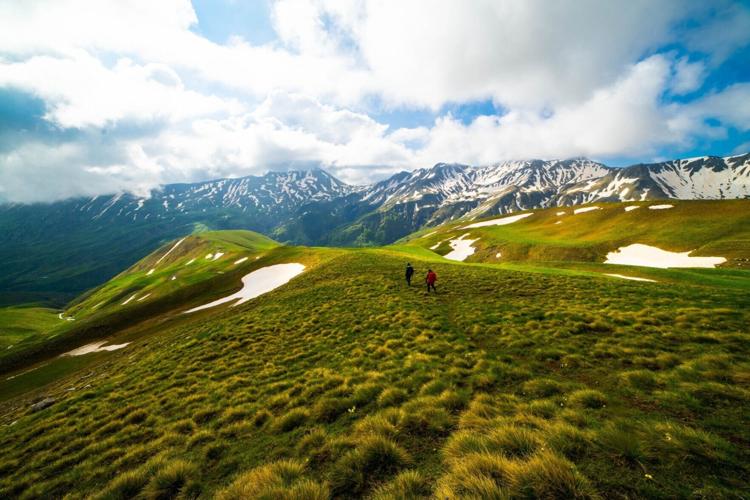
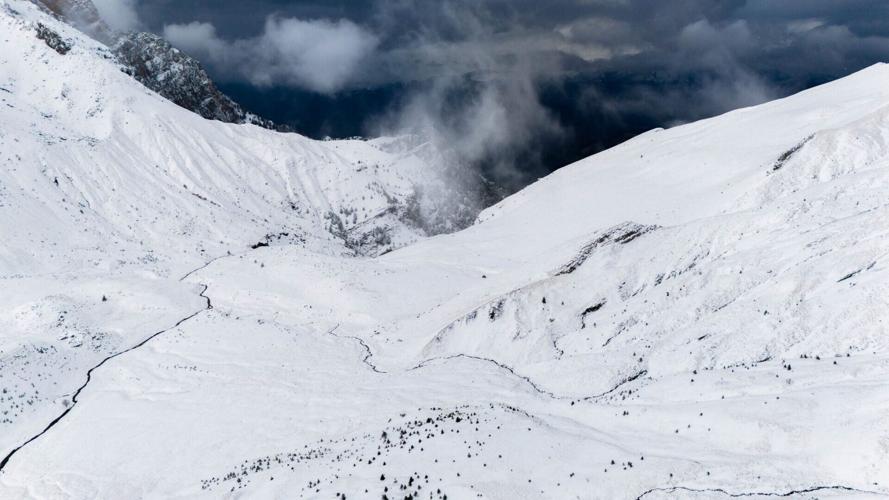
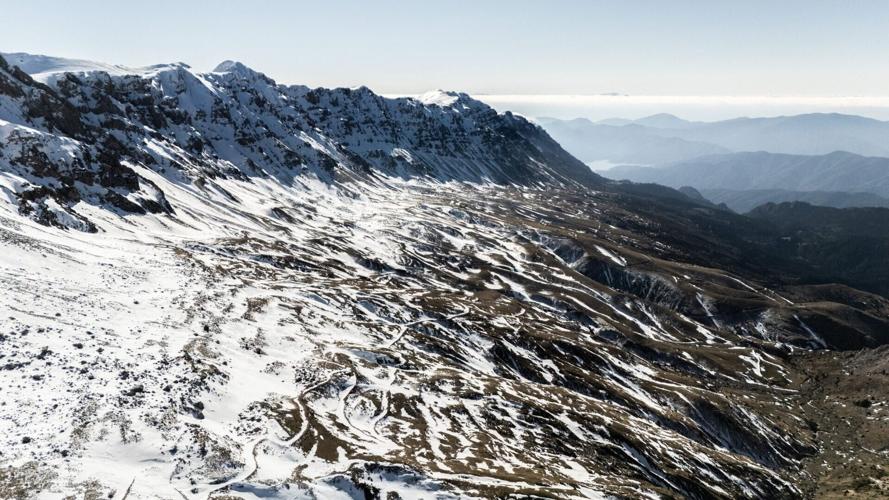

Mount Tymfi is one of the mountains in Greece that has seen significantly less snow cover over time. (Konstantis Alexopoulos via SWNS)
By Stephen Beech
Snow cover on mountains in Greece has more than halved in just four decades, reveals new research.
Researchers found that the important water source for communities, agriculture and natural ecosystems during the dry summer months has declined by 58% over the last 40 years.
The scale of decline has accelerated since 2000 — and the snow season is both starting later and ending sooner, according to the findings published in The Cryosphere journal.
An international research team, led by University of Cambridge scientists, used a combination of satellite imagery, climate data, terrain maps and artificial intelligence to analyze how rising temperatures in the Mediterranean region have affected snow cover in Greece.
The region has been far less studied than other European mountain ranges, including the Alps or Pyrenees.

Less snow has fallen over the last 40 years at Mount Grammos in Greece. (Konstantis Alexopoulos via SWNS)
Using the tool they developed, called snowMapper, the researchers found that snow cover has declined by more than half in four decades.
The research team say their findings suggest that the loss of snow cover is driven by an increase in temperature, not a change in the amount of precipitation.
They explained that warmer air means that more precipitation falls as rain instead of snow at high altitudes, depriving downstream rivers of the "slow release" water supply that snow provides.
Study first author Konstantis Alexopoulos, a doctoral candidate at Cambridge's Scott Polar Research Institute (SPRI), said: "Snow is like a natural reservoir.
"It's sort of like putting money in your savings account versus spending it right away.
"If you store that money away for a while, it collects interest and is worth more when you need it.
"And because snow slowly melts instead of washing away like rain, it's very valuable — for irrigation, hydropower generation, and household water needs — during the hot and dry summer months, as it keeps rivers, lakes, and groundwater topped up."
To quantify the degree of snow cover loss, the researchers used satellite imagery from NASA and ESA missions to show where snow was or wasn't on clear days between 1984 and 2025.


Snow covers Mount Tymfi in Greece. (Konstantis Alexopoulos via SWNS)
But as cloud cover or shadows often obscure a clear view, the researchers employed an AI technique called machine learning to help fill in the many gaps.
They used European climate and digital terrain datasets to help simulate what snow cover was likely to have been on a given cloudy day, based on temperature, precipitation data, elevation, and whether snow was previously present.
Their machine learning algorithm was trained on thousands of ground-based snow observations collected from weather stations across the Alps and Pyrenees.
The result is a tool that provides daily, 100-meter resolution snow cover maps for ten of Greece's highest massifs from 1984 to 2025.
The researchers say that even though part of the data for snowMapper originated from elsewhere in Europe, the tool worked accurately in Greece, suggesting that snowMapper could be useful in other mountain ranges worldwide where data is sparse.
Alexopoulos, who is also affiliated with the National Observatory of Athens, said: "It's vital to understand how snow processes are changing, yet most mountain ranges around the world don't have much ground-based monitoring.
"Our model is here to solve that problem, since it can work accurately for regions without any local ground-based information at all."

The Vardousia Mountains are another place in Greece where less snow has fallen over time. (Konstantis Alexopoulos via SWNS)
The results showed that Greece is losing winter snow cover faster than most other mountain ranges, which the research team say could have serious implications for communities, agriculture and nature.
The degree of observed snow loss and the rise in temperature fall outside the realm of normal climate variability.
Study co-author Ian Willis, also of SPRI, said: "Temperature controls how much of the precipitation will fall as snow rather than as rain, and how long-lived that snow will be once on the ground.
"So as temperatures continue to rise, less snow will build up on the ground to begin with, and what does accumulate will melt faster too."
He added that the loss of snow cover from the world's mountains is another "key" indicator of how climate change is continuing to stress the natural world, especially in places such as Greece, where watersheds are small.
The team, which also included researchers from the British Antarctic Survey, is now working to translate their results on snow cover into an analysis of volume changes in the water system, and project what could happen to water availability in the future.


(0) comments
Welcome to the discussion.
Log In
Keep it Clean. Please avoid obscene, vulgar, lewd, racist or sexually-oriented language.
PLEASE TURN OFF YOUR CAPS LOCK.
Don't Threaten. Threats of harming another person will not be tolerated.
Be Truthful. Don't knowingly lie about anyone or anything.
Be Nice. No racism, sexism or any sort of -ism that is degrading to another person.
Be Proactive. Use the 'Report' link on each comment to let us know of abusive posts.
Share with Us. We'd love to hear eyewitness accounts, the history behind an article.