





Northern Wheatear in a tree. (Jani Närhi via SWNS)
By Stephen Beech
Birds are moving higher up mountains due to climate change, reveals new research.
Many species have moved toward colder areas in mountain ranges across Europe as temperatures have risen over the last two decades, say scientists.
Sunny southern slopes attract birds to live at higher elevations than shadier northern slopes, according to a study published in the journal Global Ecology and Biogeography.
Researchers examined 177 bird species in four large mountain ranges: the Alps, the Pyrenees, the Scandinavian Mountains, and the British Highlands.
Of those species, almost two-thirds (63%) moved uphill.
The uphill movement has averaged about half a meter (19.6 inches) per year in the 2000s.
The fastest change happened in Scandinavia and the Alps, according to the study based on bird monitoring data from eight European countries between 2001 and 2021.
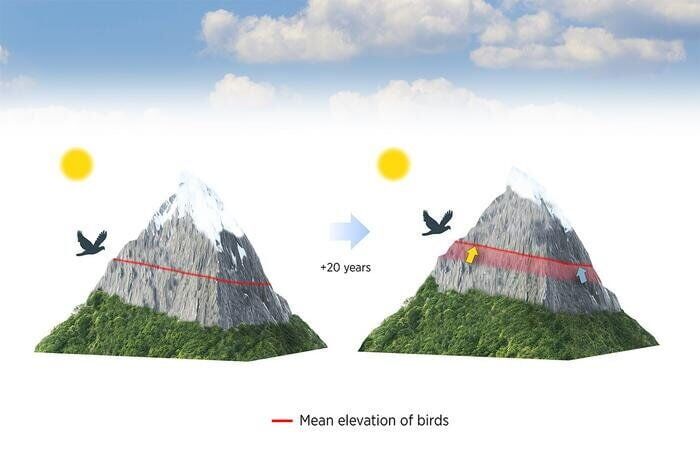
Bird species are shifting to higher elevations over time, likely in response to climate change. The red line represents the mean elevation of birds, which has moved uphill after 20 years. (Jani Närhi via SWNS)
For example, the northern wheatear has shifted an average of 33 meters (108 feet) uphill in the Scandinavian mountains since 2001.
But no significant uphill shift was observed in Britain or the Pyrenees.


Scientists say that indicates that the causes behind range shifts, such as the intensity of climate change and human land use, vary from region to region.
In mountainous areas, local climatic conditions, or microclimates, can vary considerably even over short distances.
For instance, the northern mountain sides receive less sunlight than the southern sides, resulting in cooler and wetter conditions.
The differences affect the habitats of species, according to the research team.

(Photo by INDU BIKASH SARKER via Pexels)
Joséphine Couet, a PhD student at the University of Helsinki in Finland, said: "Sunny slopes attract birds to higher elevations because vegetation zones and food resources are located higher up.
"However, birds are also moving uphill at the same rate on shady slopes, which suggests that warming temperatures are affecting the entire mountain landscape",
She says the results show that broader climatic trends are driving birds to move uphill in the mountains across Europe.
Slopes that are less exposed to solar radiation could serve as refuges, but the small-scale advantages are not enough to counteract large-scale uphill movements.â¯â¯
Couet added: "Mountain areas are not only majestic landscapes, but also hotspots of biodiversity, home to many species that depend on specific climatic and habitat conditions.
"This information is crucial for conservation planning in complex terrains where local conditions vary greatly."


(0) comments
Welcome to the discussion.
Log In
Keep it Clean. Please avoid obscene, vulgar, lewd, racist or sexually-oriented language.
PLEASE TURN OFF YOUR CAPS LOCK.
Don't Threaten. Threats of harming another person will not be tolerated.
Be Truthful. Don't knowingly lie about anyone or anything.
Be Nice. No racism, sexism or any sort of -ism that is degrading to another person.
Be Proactive. Use the 'Report' link on each comment to let us know of abusive posts.
Share with Us. We'd love to hear eyewitness accounts, the history behind an article.