


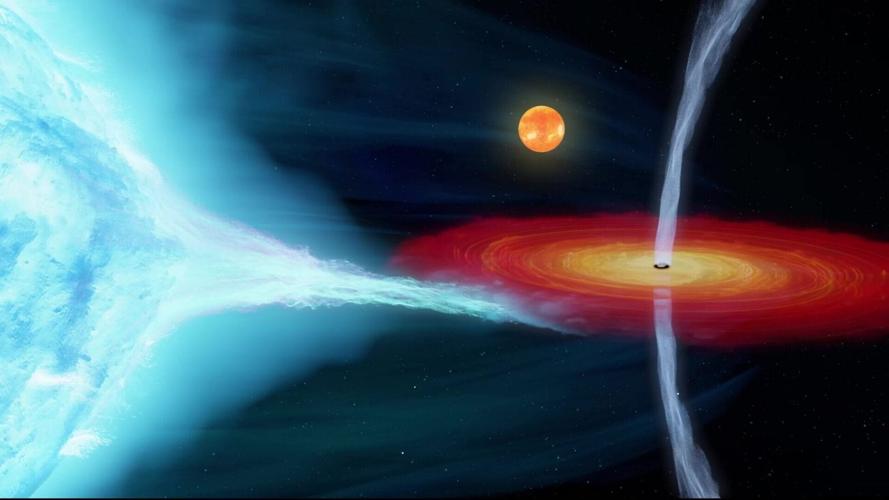
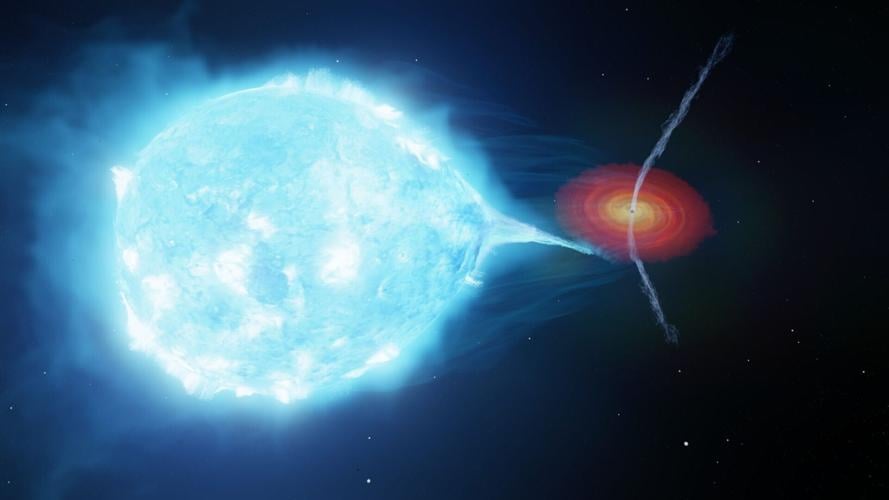
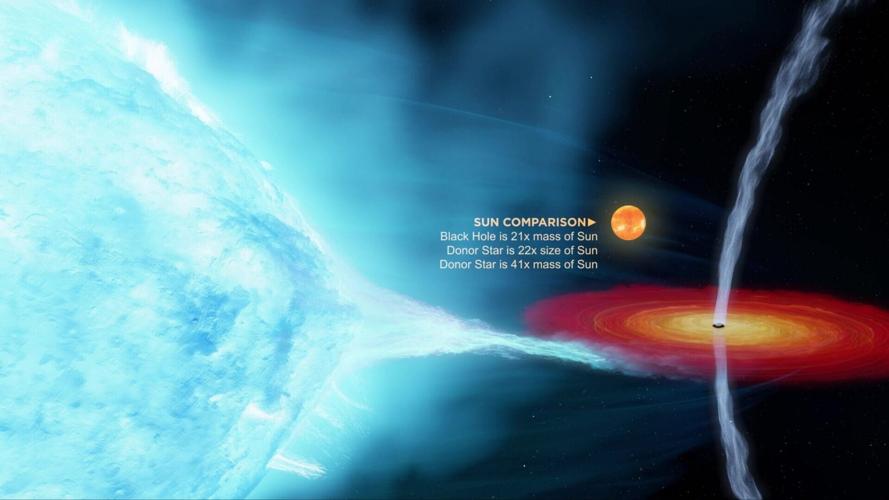
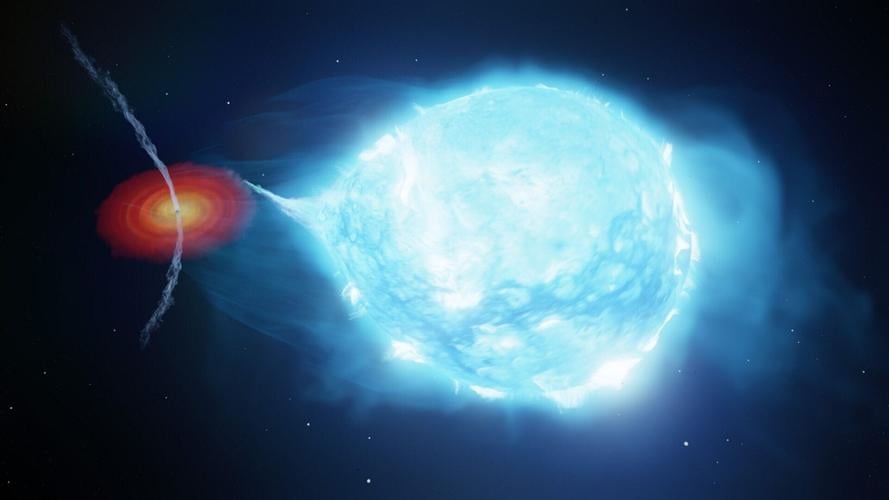
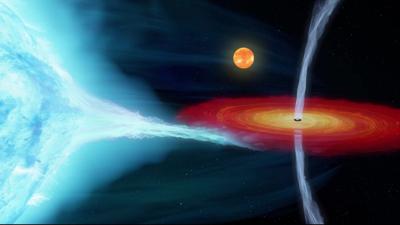

Artist's impression of the Cygnus X-1 binary system, showing how the wind of the supergiant star bends the black hole's jets away from the star as the objects move in their orbit around one another. (ICRAR via SWNS)
By Stephen Beech
Astronomers have measured the power of jets from a black hole for the first time, offering fresh insight into how these objects shape the universe.
The Curtin University-led study, in collaboration with the University of Oxford, used a global network of radio telescopes to observe "dancing jets" from Cygnus X-1 — a system containing the first confirmed black hole and a supergiant star.
Researchers found the jets produce energy equivalent to 10,000 suns.
By analyzing how the jets were bent by stellar winds as the black hole orbited its companion, scientists were able to determine their instantaneous power and speed — about half the speed of light, or 150,000 km per second.

Artist's impression of the Cygnus X-1 binary system, showing how the wind of the supergiant star bends the black hole's jets away from the star as the objects move in their orbit around one another. (ICRAR via SWNS)


Lead author Steve Prabu, now based at the University of Oxford, said the team used images of the "dancing jets" — a term he used to describe how they were repeatedly deflected by the star's powerful winds.
"A key finding from this research is that about 10 per cent of the energy released as matter falls in towards the black hole is carried away by the jets," Prabu said.
"This is what scientists usually assume in large-scale simulated models of the Universe, but it has been hard to confirm by observation until now."
Co-author James Miller-Jones said the measurement would help scientists better understand black holes across the universe.

Artist's impression of the Cygnus X-1 binary system, showing how the wind of the supergiant star bends the black hole's jets away from the star as the objects move in their orbit around one another. (ICRAR via SWNS)
"And because our theories suggest that the physics around black holes is very similar, we can now use this measurement to anchor our understanding of jets, whether they are from black holes 10 or 10 million times the mass of the Sun," he said.
The paper, 'A jet bent by a stellar wind in the black hole X-ray binary Cygnus X-1', has been published in journal Nature Astronomy.





(0) comments
Welcome to the discussion.
Log In
Keep it Clean. Please avoid obscene, vulgar, lewd, racist or sexually-oriented language.
PLEASE TURN OFF YOUR CAPS LOCK.
Don't Threaten. Threats of harming another person will not be tolerated.
Be Truthful. Don't knowingly lie about anyone or anything.
Be Nice. No racism, sexism or any sort of -ism that is degrading to another person.
Be Proactive. Use the 'Report' link on each comment to let us know of abusive posts.
Share with Us. We'd love to hear eyewitness accounts, the history behind an article.