


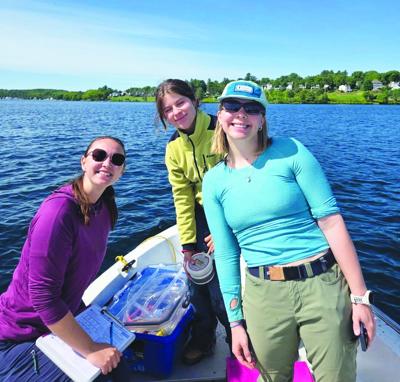
When people think about protecting Lake Winnipesaukee, they often picture shoreline restoration projects, stormwater improvements, or educational programs. What many do not see is the tremendous amount of scientific monitoring taking place behind the scenes to understand how the lake is changing and where action is needed most.
Each year, the Lake Winnipesaukee Alliance coordinates one of the most comprehensive volunteer-based water quality monitoring efforts in New Hampshire.
Throughout the summer months, more than 70 monitoring sites across Lake Winnipesaukee and its watershed are sampled by dedicated volunteers, interns, staff, and partner organizations through the UNH Extension Lakes Lay Monitoring Program.
On the lake itself, volunteers collect data from dozens of locations spanning the lake's bays and basins. These sites provide valuable information about overall lake health and help identify trends that may otherwise go unnoticed.
One of the most familiar measurements is water clarity. Using a simple black-and-white disk called a Secchi disk, monitors measure how far below the water's surface the disk remains visible. Water clarity is often one of the first indicators people notice changing and can provide important insight into conditions within the lake.
Volunteers also collect water samples that are analyzed for phosphorus, a nutrient that naturally occurs in the environment but can contribute to algae and cyanobacteria growth when present in excess. Sources of phosphorus can include stormwater runoff, erosion, failing septic systems, and other watershed activities.
Additional monitoring measures chlorophyll-a, a pigment found in algae. Chlorophyll-a helps scientists understand how productive the lake is and can provide early indications of increasing algae growth. Temperature and dissolved oxygen profiles are also collected throughout the water column at 12 deep-water locations. These measurements help us understand habitat conditions for fish and other aquatic life and provide insight into how the lake responds to seasonal changes.
Monitoring extends beyond the lake itself. Seventeen tributary streams entering Winnipesaukee are sampled throughout the year as part of the NHDES Volunteer River Assessment Program. These sites are tested for phosphorus, chloride, conductivity, dissolved oxygen, temperature, and turbidity.
In recent years, monitoring efforts have expanded to include cyanobacteria monitoring, and plankton sampling. Together, these programs provide an increasingly complete picture of lake health.
The data collected through these efforts serves a purpose far beyond filling spreadsheets. It allows us to identify emerging concerns, measure the effectiveness of projects and programs, prioritize investments, and make informed decisions about the future of the lake. Long-term monitoring is one of the most powerful tools available for understanding change.
None of this work would be possible without the dedicated volunteers who spend countless hours on the water. Their commitment provides the scientific foundation for many of the lake protection efforts underway.
Every water sample collected, every Secchi reading recorded, and every monitoring trip completed contributes to a larger story. Together, this data helps us better understand Lake Winnipesaukee today and guide the actions needed to protect this precious place.
•••
Bree Rossiter is the associate director of the Lake Winnipesaukee Alliance, the only nonprofit dedicated to protecting the water quality and natural resources of Lake Winnipesaukee and its watershed through science, education, advocacy, and collaborative solutions. Her work focuses on advancing long-term watershed protection initiatives and connecting science with practical solutions to help preserve the lake for future generations. To learn more, visit winnipesaukee.org.


(0) comments
Welcome to the discussion.
Log In
Keep it Clean. Please avoid obscene, vulgar, lewd, racist or sexually-oriented language.
PLEASE TURN OFF YOUR CAPS LOCK.
Don't Threaten. Threats of harming another person will not be tolerated.
Be Truthful. Don't knowingly lie about anyone or anything.
Be Nice. No racism, sexism or any sort of -ism that is degrading to another person.
Be Proactive. Use the 'Report' link on each comment to let us know of abusive posts.
Share with Us. We'd love to hear eyewitness accounts, the history behind an article.