


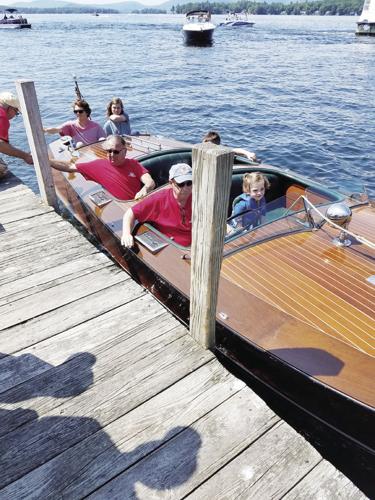
After college in the mid-1970s, Dennis Schauer moved to Minneapolis and lived near the large and lovely Lake Minnetonka, about half the size of Winnipesaukee. One afternoon, he was drawn into conversation with someone who owned a wooden boat. “He went on about how great it was,” Schauer, 74, said. “So, I went to a boat show, and it was amazing.”
Woodies – the familiar term for wooden boats – captivated Schauer with their rich history and artistic nuances. He immediately got on board as someone with an interest in preserving and collecting the gems. He joined the Land of Lakes Chapter of the Antique & Classic Boat Society in 1977. A year later, he bought his first wooden boat, a 1953 Century.
Since then, Schauer has moved several times and owned a 21-foot 1933 Chris-Craft and a 28-foot 1953 Chris-Craft, along with the only Woodie he still owns, a 28-foot, all-mahogany 1930 Gar Wood, which he docks in a boathouse in Tuftonboro Neck.
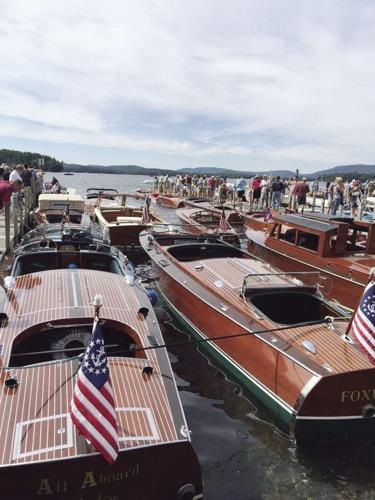
Now a longtime member of the local New England Chapter of the ACBS, as well as a past president, Schauer inspires others into wooden boat adventures. His Gar Wood, nicknamed Rag Top for its racy-looking convertible top, will be on view on Saturday, July 27 from 9 a.m. to 3 p.m. at the Wolfeboro Town Docks during the 46th Lake Winnipesaukee Antique & Classic Boat Show.
“When you see these boats together, such as in a boat show, it is amazing and beautiful,” Schauer said. “They are part useful and part historic and part art. They don’t make boats like these anymore that have that nautical flair that just is very appealing. The beaming of the hardware, the chrome, the varnish shining and reflecting in the sunlight. They are svelte.”
Come down to see Rag Top
For 29 years, the local ACBS chapter’s boat show took place at Weirs Beach, and for 13 in Meredith. The Wolfeboro Docks became the venue in 2016; this year, from 50-70 society member boats will bob there for all to admire in an event that is the highlight of the chapter’s summer season.
“It’s really the pinnacle of your labor,” said Schauer. “It’s how you can present your boat and the efforts that you put in.”
Judging of the boats will be held in 16 classes, ranging from pre-war cockpit runabouts up to 22 feet, to sail, rowboats and canoes, and reproductions. There are also three categories: preserved or restored, for wood boats built before 1976 that hold at least 60 percent of their original decks; early contemporary, built between 1976 and 1985; and late contemporary, built since 1985.
Schauer is looking forward to having Rag Top on display, and in contention. The boat has won many awards in the past, and it’s also had a good year; in May-June, it was featured in Classic Boat magazine, and, this summer, Rag Top is the featured boat on the boat show poster designed by artist Peter Ferber.
The beauty of Rag Top
Rag Top is as beautiful to Schauer as a woman. “I call the back end of my boat a hip because it’s the shape of a beautiful lady’s hip – the way it sweeps in,” Schauer said. “It’s graceful. I think that’s what these old boats are – graceful looking. They were designed by nautical architects. The craftsmen who built them were amazing. You appreciate what they did.”
In addition to the boat’s convertible top – and her hips – other highlighted features of Rag Top are its white oak bows that are part of the Dietrich convertible top – wood that is bent to shape and is covered with snug fabric – and its original 125-horsepower Chrysler engine. Rag Top tops out at about 30 miles an hour when Schauer gets it out on Winnipesaukee two or three times a month.
For over a decade, between 1986, when Schauer and his wife, Cindy, moved to Virginia, and the early 2000s, when they moved here, the boat was stored. After they settled in the region, Rag Top joined the Schauers and got afloat again.
Schauer sells real estate, and he and his wife run Topsides Bed & Breakfast.
Restoration, valuation
Back in the ’70s, Schauer said the majority of classic boat owners did all restoration work themselves, sometimes with the help of a professional. Rag Top was restored in this way; a bit by Schauer, and a bit by woodworkers whom Schauer paid about $15 per hour.
Today, two things have changed. As the values have risen as predictably as the tide, so, too, has the cost and responsibility of maintenance. A boat like Rag Top, unusual in that it is 28-feet long, could sell for $125,000 to $300,000. “One sold for $300,000 on the lake about three years ago,” Schauer said.
Because of these increased sales prices, antique boat owners tend to be wealthy people who do not maintain their pieces themselves for fear of diminishing the value, and the cost of services now runs from $65 to $100 per hour.
“That’s where we are with the hobby,” Schauer said. “The cost of a finished boat is easily going to exceed its actual market value. At least for today. You have to love the sport. You have to love the whole hobby and appreciate it for what it is.”
About the society
Schauer served as president of the local ACBS chapter from 2011-17, overseeing about six of the annual boat shows. Currently, the chapter is led by Scott Robinson. (Interestingly, Robinson took a trip to Canada in mid-July to pick up a boat and was not able to be interviewed for this article.)
The launch of the chapter came in 1976 at the Boston Boat Show, where – behind the scenes – two boat owners who had organized two successful Woodie boat shows at The Weirs circulated a petition to ACBS for a New England chapter. They gathered 40 signatures, and the new region was officially accepted on April 12, 1976. At that time, it encompassed six states – Maine, New Hampshire, Vermont, Massachusetts, Connecticut and Rhode Island.
Now the chapter’s reach is predominantly in New Hampshire with members in Massachusetts, Vermont and Maine as well.
The society’s mission is to create fellowship for people with an interest in classic boats, protect and promote the heritage of boating, inspire and support boat shows and related events, and educate members and the public about safety and protocol as it relates to antique boating.
“It’s a socialization of a group that has the same interests at heart,” Schauer said. “That might be ‘How have you been?’ to ‘A piece came off my steering wheel, do you know anyone who has one?’ There is camaraderie, a melting pot of socio-economic groups who meld into this one place and have a common interest.”
Roughly 200 boat enthusiasts keep the chapter afloat currently. “It’s well-run,” Schauer said. “We have so many good volunteers. They really know what they’re doing.”
To learn more or join the chapter, visit www.necacbs.org.
Janice Beetle is an author, editor and owner of Beetle Press, a public relations and marketing company. She can be reached at janice@beetlepress.com.


(0) comments
Welcome to the discussion.
Log In
Keep it Clean. Please avoid obscene, vulgar, lewd, racist or sexually-oriented language.
PLEASE TURN OFF YOUR CAPS LOCK.
Don't Threaten. Threats of harming another person will not be tolerated.
Be Truthful. Don't knowingly lie about anyone or anything.
Be Nice. No racism, sexism or any sort of -ism that is degrading to another person.
Be Proactive. Use the 'Report' link on each comment to let us know of abusive posts.
Share with Us. We'd love to hear eyewitness accounts, the history behind an article.