


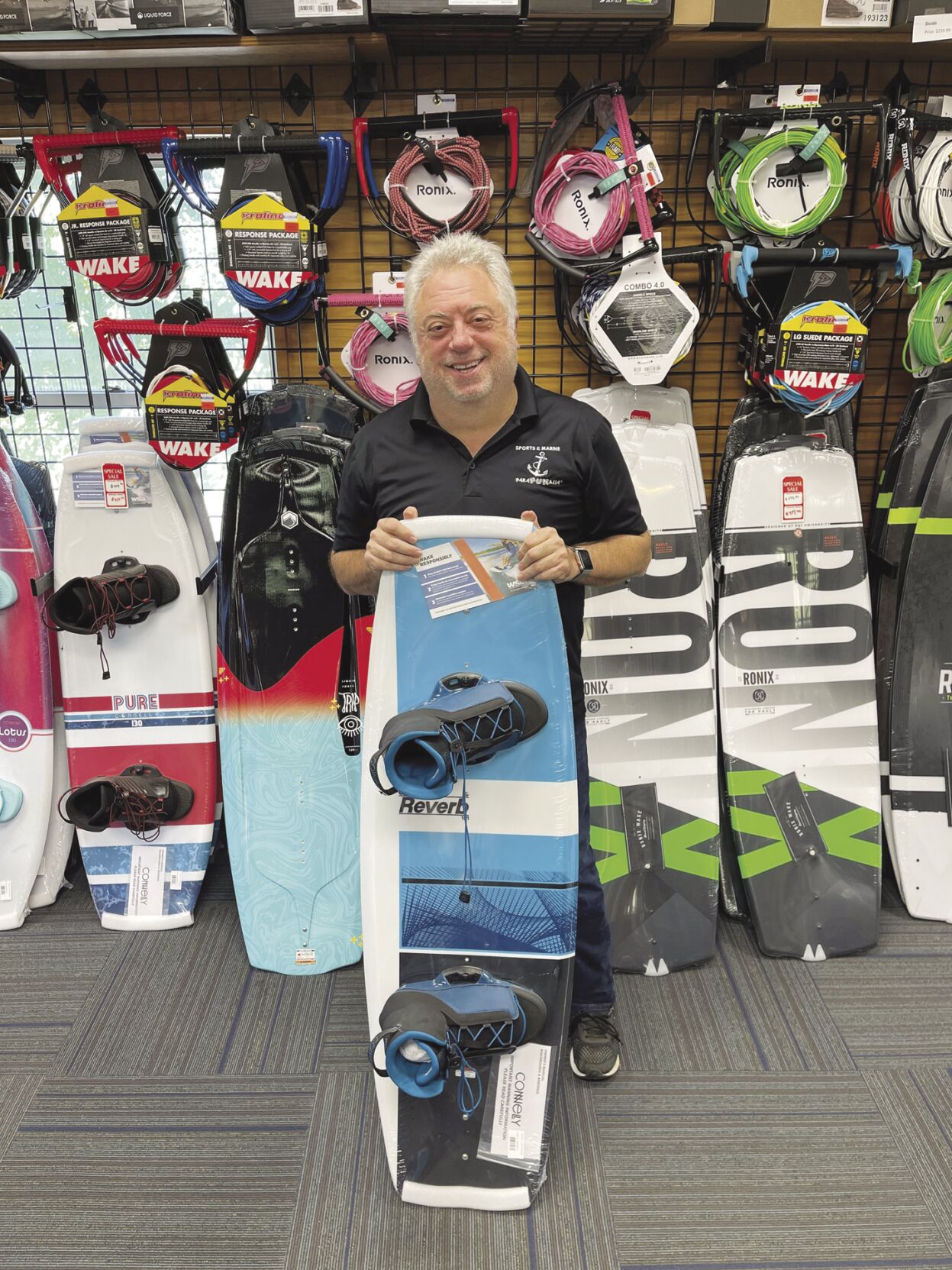
With hundreds of new boaters in the region since the start of the pandemic, Bart Jeffreys, president and CEO of Sports & Marine Parafunalia, Inc., has enjoyed pivoting to introduce the newcomers to the joy of watersports.
Recent clientele are apt to come in the store and say, “We just bought a new boat, and we need help outfitting it,” Jeffreys says.
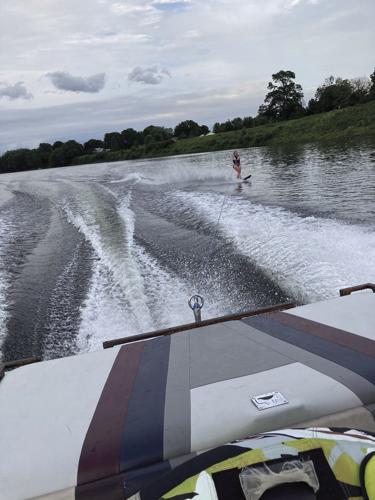
He connects folks to the basics required by law — a fire extinguisher, a Type Four throw cushion to toss out to a passenger in crisis in the water and a horn or whistle. And he introduces longtime staples such as waterskis and tubes, which you use to tow people for sport behind a boat.
Meanwhile, experienced boaters are also always asking, “What’s new?” And the answer to that is improved basics like anchors, fenders and The Boat Loop, a popular new tool that assists newer operators launching and docking boats.
Jeffreys adds, “While waterskis and towable tubes have been around for years, they have changed and improved over time, with waterskis evolving from wood to fiberglass that is now stronger, faster, lighter and better.”
Surprisingly, Jeffreys said that prices have dropped as quality has risen. A pair of Connelly waterskis, for instance, that might sell for $190 now sold for roughly $350 in the early 1980s, Jeffreys explained, and likewise, an inflatable O’Brien tow tube that is $90 today was $150 three decades ago. “It’s because most things are now made overseas” Jeffreys says.
The new stuff
Some products are sort of new in the boating and lake recreation world, Jeffreys explains, as he walks through his busy shop, with customers and staff occasionally needing to interrupt him to ask a question or be pointed in the right direction.
Water carpets are relatively innovative, arriving on the market about five years ago. These flat, floating surfaces are fun for children and adults — like the old-time Slip ’n Slide — but this one floats atop the water. You can roll it up to take it on an outing and throw it outside your boat, while stationary, for children to play on or for groups of adults to lounge on or take a nap.
“It’s become an essential thing,” Jeffreys says of the pads, which cost between $250 and $750 depending on the model. “It’s a floating mat that a 2½ year-old can climb onto. The fun is unbelievable."
Water carpets are so popular that Sports & Marine Parafunalia rents them to customers as well.
Also new to market are inflatable stand-up paddleboards, or SUPs. These boards, operated by a single person standing upright with one paddle can be deflated to take out on a boat or to a beach and then inflated to off on their adventure. “Suddenly, people are carrying these on their boats now,” Jeffreys says.
The cost of the boards was $800 or 900 when they first entered the market ten years ago but now even the high-quality inflatable SUPS are $420, including the paddle and pump.
Wakesurfing is another relatively new sport, which Jeffreys says is “huge” in the Lakes Region. In this sport, you need a particular boat—a wakesurf boat—which produces a specific wave that riders can actually surf on.
“New boat owners are coming and saying, “We just bought a wakesurf boat. What do we need?” Jeffreys says.
Jeffreys explains that there are different shaped boards for different kinds of rides — and riders. Beginners just learning to stand and surf might need one model, while advanced wakesurfers are looking for boards that they can do tricks and spins on and so are constructed and shaped differently.
“We have roughly 50 models of wakesurfers in here, from between $299 and $999, Jeffreys noted. “It’s an increasingly popular lake activity here for more than five years, but a lot of people are just getting acquainted with it.”
Outfitting new boaters
Jeffreys says many of his customers — especially during Covid-19 and since — are new boaters who come in the store and say, “We just bought a new boat, and we need help outfitting it. We want to play in the water.”
To adhere to New Hampshire state law, store staff advises customers that they need a fire extinguisher, the throw cushion and a horn or whistle.
Life jackets are also required and must be suited to the size and weight of passengers.
“A lot of people don’t know all that,” Jeffreys says. “They’re looking for information. In the last two years, there have been a lot of new boat buyers.”
Customers also need lines — to attach to docks or an anchor to moor a boat.
To get legal, Jeffreys says the cost is roughly between $50 and $100.
To get the proper life jackets — or personal flotation devices — boaters might be looking at $10 to $100 per person. “We have a massive selection of life jackets,” Jeffreys says, including dozens of options for infants.
Once a boater is equipped with the basics, then it’s time to shop for fun.
Having fun on the water
The basic equipment for the on-the-water athletics is a pair of skis — or a slalom ski for more advanced riders—towable tubes, kneeboards, wakeboards and, newer to the market, the wakesurfers. “What people want is often based upon how they grew up, Jeffreys says. “If they grew up with a tube, they get that to start. It’s good for getting children acclimated to the water, and it’s a good starter.”
“You have to listen to what people want,” Jeffreys adds. “We pride ourselves on our customer service. People come for answers, and we strive to give them. People want advice.”
Here’s a primer for newer boaters:
Waterskis. Unlike downhill skiing, waterskies are sold in pairs — for children or beginner adults — or they are sold as a single, slalom ski for advanced skiers. A pair of skis always includes one slalom ski, which has two boots, one in front and one in back. Jeffreys says he stocks pairs of skis for all levels — from very young children to adults of varying levels, and he also stocks a wide selection of slalom skis. Expect to pay about $120 for a pair of skis for children to $300 for adults, and slalom skis can go for as much as $1,200 per ski for a competition-level slalom. “It’s like buying a car,” Jeffreys says. “You could buy a car for $X, or you could buy a car for $10X.” He adds, “We have the largest selection of this stuff in New England. We stock this stuff because people asked us for it. We are a customer-driven business.”
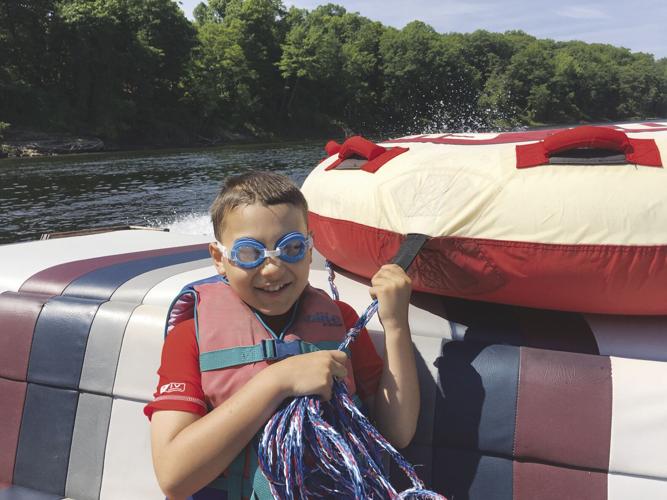
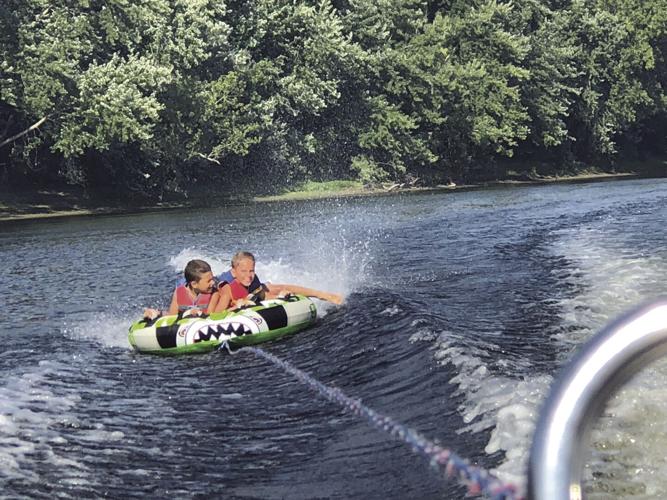
Towable tubes. Tubing is a beginner water sport that nearly anyone can take part in, from children who can swim to seniors, and you can tow a tube with a pontoon boat or a boat built for speed. Tubes come in all sizes, from those built for one person to those built for six — which is the max allowed in New Hampshire. Tubes cost from $80 for one person to $400 for the six-person special.
Kneeboards. Like tubing, kneeboarding is a good introduction to water sports for children. With a kneeboard, you are literally in a knee squat on a board, being towed behind a board. It is more difficult than tubing but is less challenging than waterskiing. Kneeboards run in the range of $99-$299
Wake boards: These boards are on the same challenge level as skis. They are wider than skis, with two bindings, or boots, one for each foot; it’s much like a snow board but instead of moving downhill with gravity, you are being towed behind a boat. Wakeboards run in the range of $299-$799And remember …
To use skis, tubes, and any kind of towable you need an essential item — the tow rope that connects the rider to the boat. Sports & Marine Parafunalia, Inc, stocks these items, which range in quality starting at $17.99.
“While many things have changed, what remains the same is the joy of being out on the water,” Jeffreys says.
•••
Janice Beetle is an author, editor and owner of Beetle Press, a public relations and marketing company. She can be reached at janice@beetlepress.com.





(0) comments
Welcome to the discussion.
Log In
Keep it Clean. Please avoid obscene, vulgar, lewd, racist or sexually-oriented language.
PLEASE TURN OFF YOUR CAPS LOCK.
Don't Threaten. Threats of harming another person will not be tolerated.
Be Truthful. Don't knowingly lie about anyone or anything.
Be Nice. No racism, sexism or any sort of -ism that is degrading to another person.
Be Proactive. Use the 'Report' link on each comment to let us know of abusive posts.
Share with Us. We'd love to hear eyewitness accounts, the history behind an article.