


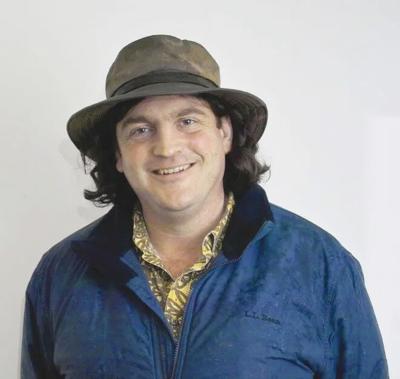
MOULTONBOROUGH — The New Hampshire Boat Museum will welcome archaeologist Robert G. Goodby, Ph.D, to its Hulls and Hops Speaker Series on Wednesday, Aug. 19. Goodby's talk, "Paddling Through Time: The Long History of Canoes in New England," will share findings from a multi-year project radiocarbon dating dugout canoes recovered from the bottoms of lakes and ponds across New Hampshire, Maine and Vermont.
"Native Americans obviously built dugout canoes, but Europeans did, too — log boats made by the English and Irish," he said. "What I have discovered is that the use of these boats survived into the 20th century in upland remote areas of Northern New England for muskrat hunting and farming."
To date, Goodby has secured radiocarbon dates on seven canoes, with six more to be processed this summer. The dugouts are typically recovered from lake and pond bottoms — a location that is no accident.
"They were intentionally sunk," Goodby explained. "It takes a long time to make these canoes. People didn't want them to be out in the elements in winter, so they would push them out into the lake and sink them to the bottom where they wouldn't freeze. Then in spring, they went to get them again."
Some of the canoes Goodby has dated are clearly Indigenous in origin, others were built by European settlers, while some fall into a "fascinating" middle ground.
"In the 1700s, Europeans and Natives were interacting a lot," he explained. "They knew about each other's technology. There was some exchange of ideas — it's a technology both people understood … With input from both, at some point, you can think of it as a New England tradition."
Goodby’s interest in dugout canoes began more than three decades ago, when he was contacted by the Sandwich Historical Society about a canoe of unknown age. Later, as a new faculty member at Franklin Pierce University, he encountered two dugout canoes displayed in a hallway, sparking further research.
"No one really knew much about them," Goodby recalled. "I did some research, learned when they were discovered, where they came from, and got radiocarbon dates on them. From there, I became interested and secured funding to get another six."
That curiosity has since grown into a formally funded project, using radiocarbon analysis performed by Beta Analytic to pinpoint when each canoe's tree was felled. The work also connects to a broader theme Goodby will explore during his talk.
"Native people here always had connections with people in faraway areas," he said. "Canoes are a big part of that — they allowed people to travel hundreds of miles, maintain connections, and exchange ideas."
Decades later, he continues to uncover pieces of that story, including artifacts he will share with the Hulls and Hops audience. "I'll talk about heavy-duty woodworking tools," said Goodby, who plans to bring along a "beautiful" stone axe head to illustrate the kinds of implements used to shape these vessels.
Goodby said he has long admired NHBM's role in preserving that history, as he pointed to the museum's own dugout canoe recovered from Ossipee Lake. "I've known about the Boat Museum for a long time," he said. "I’m looking forward to it."
Hulls and Hops Speaker Series with Robert Goodby takes place from 7 to 9 p.m. on Wednesday, Aug. 19, at NHBM’s Moultonborough Campus. Amoskeag Beverages is the series season sponsor, with Woodstock Inn Brewery as the featured brewer for this event.
To learn more or purchase tickets, visit nhbm.org.


(0) comments
Welcome to the discussion.
Log In
Keep it Clean. Please avoid obscene, vulgar, lewd, racist or sexually-oriented language.
PLEASE TURN OFF YOUR CAPS LOCK.
Don't Threaten. Threats of harming another person will not be tolerated.
Be Truthful. Don't knowingly lie about anyone or anything.
Be Nice. No racism, sexism or any sort of -ism that is degrading to another person.
Be Proactive. Use the 'Report' link on each comment to let us know of abusive posts.
Share with Us. We'd love to hear eyewitness accounts, the history behind an article.