


Since the Trump administration took office in January 2025, the workforce at the Centers for Disease Control and Prevention has weathered uncertainty and change.
Mass firings, communication freezes, political interference in the CDC’s scientific mission and a revolving door of leaders have created a challenging work environment for the CDC’s employees.
I’m a public health researcher who studies how working conditions affect employee health and well-being. I also worked at the CDC from 2012 to 2020. Given the turmoil imposed on the CDC workforce since Inauguration Day, I worked with a team of researchers at Michigan State University to conduct an anonymous survey of more than 600 CDC workers.
We found a CDC workforce concerned by a declining ability to achieve the agency’s public health mission, a shrinking and overworked staff and wide-ranging effects that threaten Americans’ health.
CDC’s mission is to protect and improve the health of Americans, which it fulfills by preventing, detecting and controlling disease. CDC also staffs a pool of public health experts who are rapidly deployed to respond to public health emergencies – including disease outbreaks – worldwide. The cuts to CDC put these functions in jeopardy.
Key CDC posts empty as Ebola outbreak grows
As an explosive Ebola virus outbreak takes hold in Central Africa, infectious disease experts are questioning the U.S. government’s ability to effectively respond to public health emergencies following the cuts to the CDC and foreign aid, as well as the U.S. withdrawal from the World Health Organization.
The CDC remains without strong leadership at a critical point in the outbreak response.
In August 2025, Health and Human Services secretary Robert F. Kennedy Jr. fired CDC Director Susan Monarez after she refused to accept political interference with the agency, causing multiple senior CDC leaders to resign in protest. Almost one year later, the CDC’s top leadership positions remain vacant. The agency has no director, principal deputy director, chief of staff or chief medical officer to lead employees through a complicated emergency response.
But in our survey, we were most interested in knowing how this administration’s changes have affected CDC’s rank-and-file workforce, who are on the front lines of protecting Americans’ health.
Survey: CDC workers say emergency response is eroding
Between February and April 2026, our team distributed our anonymous survey through employee and alumni groups, LinkedIn and professional networks. We received responses from 433 current and 191 former CDC employees who had left since January 2025; 95% were federal employees and the rest contractors or other nonfederal workers.
The survey questions asked how the second Trump administration’s changes have affected their day-to-day work.
In June, we presented our initial findings at the annual meeting of the Council of State and Territorial Epidemiologists as we prepare for publication in an academic journal.
More than 99% of CDC employees we surveyed – 604 out of 605 – said that the administration’s changes to the CDC reduced its capacity to respond to a public health emergency.
For example, during the 2014–2016 Ebola virus outbreak, the CDC sent its public health professionals – including me – on more than 3,000 deployments to West Africa to control the outbreak. But today, in the midst of another growing Ebola outbreak, deep cuts to the CDC workforce mean that the agency may no longer have sufficient personnel to deploy at the same capacity if needed.
Americans are already seeing this in the CDC’s response to ongoing measles outbreaks in the U.S. Public health experts note that the CDC’s communication with the public about the outbreaks has been confusing and sparse, which they attribute to the cuts.
Losses to the CDC workforce
The CDC is home to a specialized public health workforce tasked with responding to the nation’s most important health problems.
Since January 2025, the CDC has lost just over a quarter of its federal employee workforce. More than 1,000 employees were fired after their positions were eliminated, with hundreds remaining on administrative leave due to a court order preventing their firing. Resignations, retirements and contract nonrenewals have further shrunk the workforce.
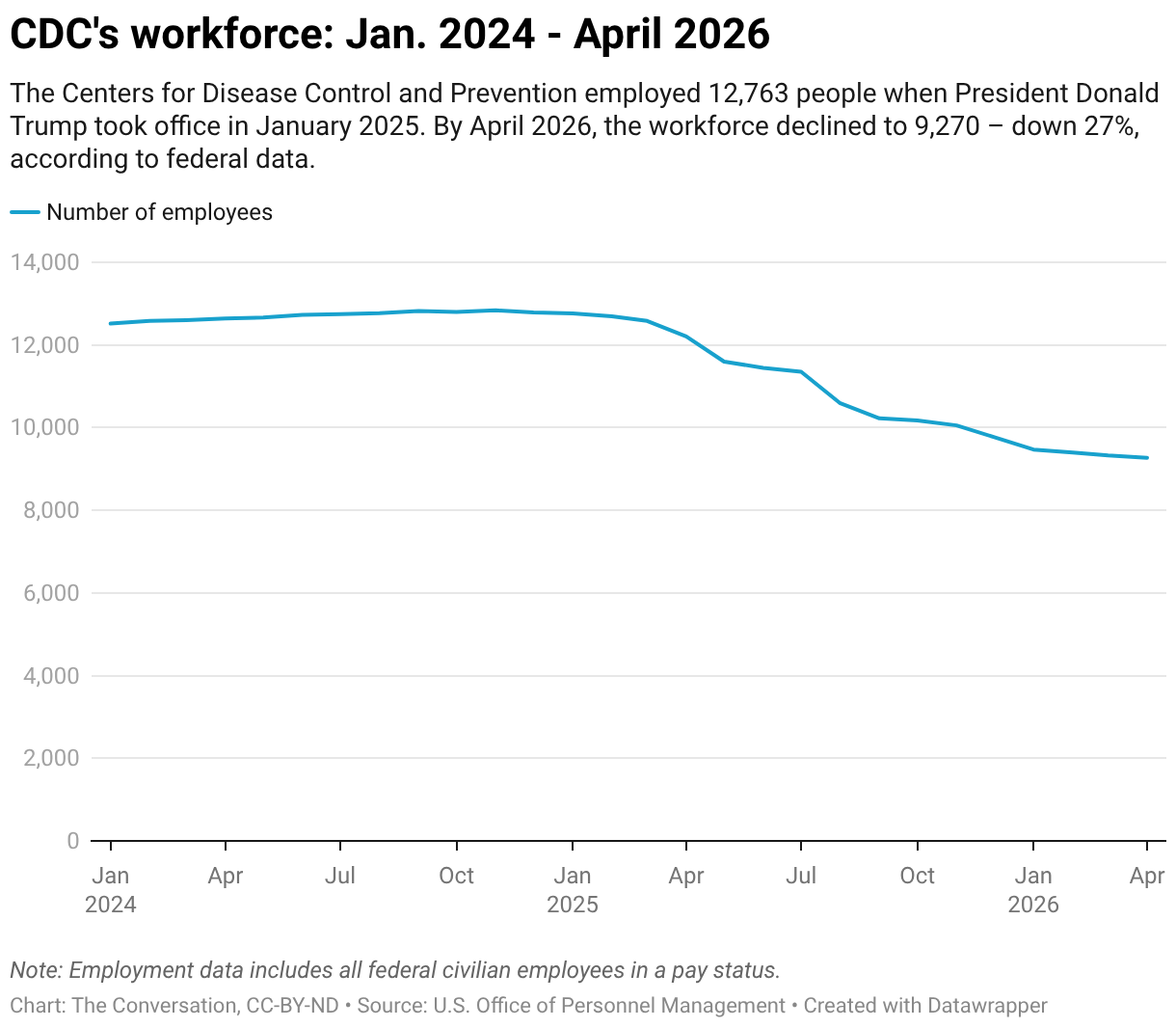
“We have the same amount of work,” wrote a CDC manager whose work unit was particularly hard-hit by staff losses, “but it is not possible to do all of it with half the staff.”
Among the current CDC workers we surveyed, 85% said they were burning out.


These cuts and challenges have made CDC employees pessimistic about the agency’s future. Of the current CDC employees we surveyed, 1 in 5 have decided to leave, further straining CDC’s resources. The vast majority who left voluntarily – 95% – told us they left mostly or entirely because of changes implemented by the current administration.
“The anti-vaccine, anti-science stance of this administration meant that I could no longer in good conscience continue to work there given the type of work that I did,” a former CDC manager explained.
Similar reasons were given by senior CDC leaders and scientists who resigned in protest since January 2025, citing budget cuts, scientific censorship and political interference with the CDC’s public health mission as the reasons they resigned.
The CDC’s nonscientific workforce was also hard-hit, with the Department of Health and Human Services eliminating CDC’s digital media teams, offices handling Equal Employment Opportunity complaints and Freedom of Information Act requests, and much of human resources and acquisitions. In our survey, 94% of CDC employees said that under this administration, it became harder to do their job.
Cuts to chronic disease and injury prevention
Although the CDC’s responses to infectious disease outbreaks like hantavirus or Ebola virus tend to dominate headlines, much of the agency’s day-to-day work focuses on chronic disease and injury prevention.
Chronic diseases are the No. 1 killer of Americans, and injuries are the No. 1 killer of American children.
Despite Kennedy’s assertions that his administration will focus on preventing chronic disease, he has quietly shuttered many of the CDC’s chronic disease and injury prevention programs, including those dedicated to improving women’s health, preventing violence and injuries, tracking infertility, reducing tobacco use and promoting healthy aging.
President Donald Trump’s fiscal year 2026 budget proposed eliminating the CDC’s chronic disease and injury prevention programs entirely. The final funding bill rejected these cuts.
We asked current and former CDC employees in chronic disease and injury prevention programs what happened to their work unit under this administration. Only three of 142, or 2%, said their work unit remains fully operational and able to meet its public health mission.
We asked everyone we surveyed if they thought Americans will die because of the administration’s changes to the agency; 95% said yes.
Cuts to CDC ripple through the country
Many of the CDC’s functions are invisible to the general public, making it easy to hide the extent to which the agency has been damaged.
In addition to responding to public health emergencies and preventing disease, the CDC plays a vital role in sustaining the nation’s public health infrastructure. About 80% of the CDC’s domestic budget goes to fund public health programs run by state, territorial, tribal and local partners, directly protecting health in local communities.
Health departments around the country are now grappling with sudden cuts to the federal funding that sustains their health data collection and health promotion activities.
I believe that current and recent CDC employees have the best view of how the administration’s cuts are affecting the agency. Their observations warn of a U.S. government losing its ability to protect the nation’s health.
This article is republished from The Conversation, a nonprofit, independent news organization bringing you facts and trustworthy analysis to help you make sense of our complex world. It was written by: Candice Johnson, Michigan State University
Read more:
- CDC layoffs strike deeply at its ability to respond to the current flu, norovirus and measles outbreaks and other public health emergencies
- Kennedy hearing deepens crisis over dismantling of CDC leadership ‑ health scholar explains why the agency’s ability to protect public health is compromised
- I’m a public health researcher, and I’m dismayed that the CDC’s missteps are causing people to lose trust in a great institution
Candice Johnson has received funding from the Centers for Disease Control and Prevention for unrelated work. She is a former CDC employee.


(0) comments
Welcome to the discussion.
Log In
Keep it Clean. Please avoid obscene, vulgar, lewd, racist or sexually-oriented language.
PLEASE TURN OFF YOUR CAPS LOCK.
Don't Threaten. Threats of harming another person will not be tolerated.
Be Truthful. Don't knowingly lie about anyone or anything.
Be Nice. No racism, sexism or any sort of -ism that is degrading to another person.
Be Proactive. Use the 'Report' link on each comment to let us know of abusive posts.
Share with Us. We'd love to hear eyewitness accounts, the history behind an article.