


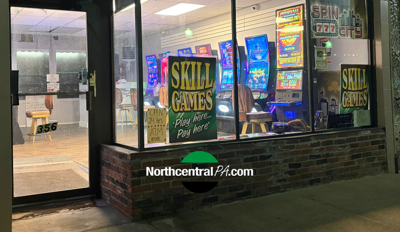
Harrisburg, Pa. — Skill game machines in bars, clubs, and shops across the state could stay safe from police seizure until February if four state lawmakers, primarily Sen. Gene Yaw, R-Lycoming, get their way.
The lawmakers filed an emergency application Tuesday, Oct. 6, asking the Pennsylvania Supreme Court to extend the 120-day "safe harbor" it set when it ruled in June that skill games are illegal slot machines under state law.
The safe harbor is set to end Wednesday, Oct. 13. The lawmakers want it pushed to Feb. 10, 2027, which would add another 120 days. They argue a crackdown now would undercut legislation to license and tax the machines.
Yaw is joined by Sen. Anthony H. Williams, D-Philadelphia, Rep. Danilo Burgos, D-Philadelphia, and Rep. Jonathan Fritz, R-Wayne. The filing describes all four as prime sponsors of a bill that would create a statewide licensing, taxation, and regulatory system for the machines.
The lawmakers aren't asking the decision be reversed, but rather that the Court gives businesses more time with the machines.
"Petitioners do not ask the Court to revisit its holding," the application states. "They ask the Court to lengthen, for a defined period, the safe harbor the Court itself created."
What the court decided
On June 15, the Supreme Court overturned two Commonwealth Court decisions and ruled that skill games are "slot machines" under the state Gaming Act. Machines running outside licensed casinos fall under the Crimes Code's gambling laws, which allow police to seize the devices and seek to keep them through forfeiture.
Because business owners had relied for years on lower-court rulings that said the games were legal, the justices put their order on hold for 120 days. During that time, the court wrote, "no law enforcement agency is to take adverse action against owners or operators of 'skill game' devices in reliance upon this opinion."
The justices also said any change in policy is up to state lawmakers, writing that "the proper remedy lies with the same legislative body that wrote those laws."
What lawmakers are proposing
The lawmakers say they're working on that fix but won't finish by Oct. 13.
A House co-sponsorship memo circulated Sept. 30 and attached to the filing lays out a plan to regulate skill games and expand video gaming terminals at truck stops. The plan calls for:
- A $500 monthly fee per machine
- A minimum player age of 21
- Central monitoring and video surveillance
- Age verification and a self-exclusion program


Under the proposal, 84% of the money raised would go to roads, bridges, and public transit, 15% to fire and EMS, and 1% to administration.
The memo says the proposal had not yet been submitted for introduction. According to the filing, it has since been drafted into a compromise House bill that is being reviewed before it's formally introduced.
An unofficial report attached to the filing lists 103 co-sponsors as of Tuesday, Oct. 6, plus Burgos as prime sponsor. The lawmakers point out that 104 is more than the 102 votes needed to pass a bill in the 203-member House. They say the count reached 106 before they filed.
Why the timing matters, they say
The lawmakers say the request is about getting the new system running quickly, not stopping enforcement for its own sake.
A machine sitting in an evidence room or tied up in a forfeiture case can't be registered, inspected, licensed, and put back into service, they argue, so it wouldn't bring in any of the fees or taxes the bill counts on. The state "would begin its new regulatory program by first recovering the very devices that program is designed to license," the filing states.
They point to the case behind the June ruling as an example. Three machines seized from a Dauphin County bar in December 2019 were still tied up in court when the Supreme Court decided the case more than six years later.
The lawmakers also estimate that 40,000 Pennsylvanians "will be adversely affected when enforcement begins," and that many would lose their jobs. The filing doesn't say how they reached that number.
A tight deadline
The four lawmakers aren't parties to the underlying cases, though Yaw filed an amicus brief in one of them. Instead, they're asking the court to use its King's Bench authority, a rarely used power that lets the state's highest court step in on urgent matters of public importance.
Under court rules, other parties have 14 days to respond. That window closes Oct. 20, a week after the safe harbor runs out. Because of that, the lawmakers are also asking the court to keep the current hold in place while it weighs their request.
The filing points to past cases in which the court timed its orders to give lawmakers room to act, including congressional redistricting fights and a 2020 extension of the mail-in ballot deadline.
If the bill becomes law before Feb. 10, the lawmakers say, it would take over from there. If not, enforcement would start on a set date.


(0) comments
Welcome to the discussion.
Log In
Keep it Clean. Please avoid obscene, vulgar, lewd, racist or sexually-oriented language.
PLEASE TURN OFF YOUR CAPS LOCK.
Don't Threaten. Threats of harming another person will not be tolerated.
Be Truthful. Don't knowingly lie about anyone or anything.
Be Nice. No racism, sexism or any sort of -ism that is degrading to another person.
Be Proactive. Use the 'Report' link on each comment to let us know of abusive posts.
Share with Us. We'd love to hear eyewitness accounts, the history behind an article.