


Today’s real estate market is a challenging one for buyers. While home prices have relaxed since their peak in the COVID-19 pandemic, the typical cost of a home in the U.S. has risen by more than 23% from early 2020 through the end of 2025. Compounding the housing affordability problem further, mortgage rates remain at elevated levels not seen since before the Great Recession. Additionally, the impacts of high rent and inflation have made it harder for many would-be buyers to save up for home purchases.
Underlying all of these conditions is the simple fact that America has been slow to add new homes to its housing supply. Estimates of the national housing shortfall range between 1.5 and 7.3 million housing units relative to the needs of the current population. One of the primary reasons is that many construction firms downsized or went out of business entirely during the Great Recession, leading to a long stretch of underbuilding.
This prolonged underinvestment has led to an aging housing stock, leaving buyers to contend with homes that often require expensive repairs, costly renovations, and higher energy bills. To better understand how and where these effects are most pronounced, researchers at Construction Coverage—a publication providing data and insight on housing costs, construction, and market dynamics—examined patterns in housing age and condition using the latest data from the U.S. Census Bureau.
Here are the key takeaways from the analysis:
- U.S. housing stock continues to age. The median age of U.S. homes has consistently risen since the turn of the century and reached 43 years in 2024.
- Historic charm means more home maintenance. Homes built before 1940 are nearly 30 times more likely to be in inadequate condition and cost nearly 10 times more in routine maintenance than new homes built after 2022.
- The Northeast is the epicenter of aging properties. Buyers in New York State face a national-high median home age of 65, a stark contrast to Sun Belt states like Nevada, Arizona, and Texas, where the median age sits at 30 years or less.
- The new construction gap. More than a quarter of homes in older metros like Buffalo and Boston were built before 1940, while booming cities like Austin and Raleigh are driven by new development and boast median home ages of 19 and 22 years, respectively.
The Age of America's Housing Stock
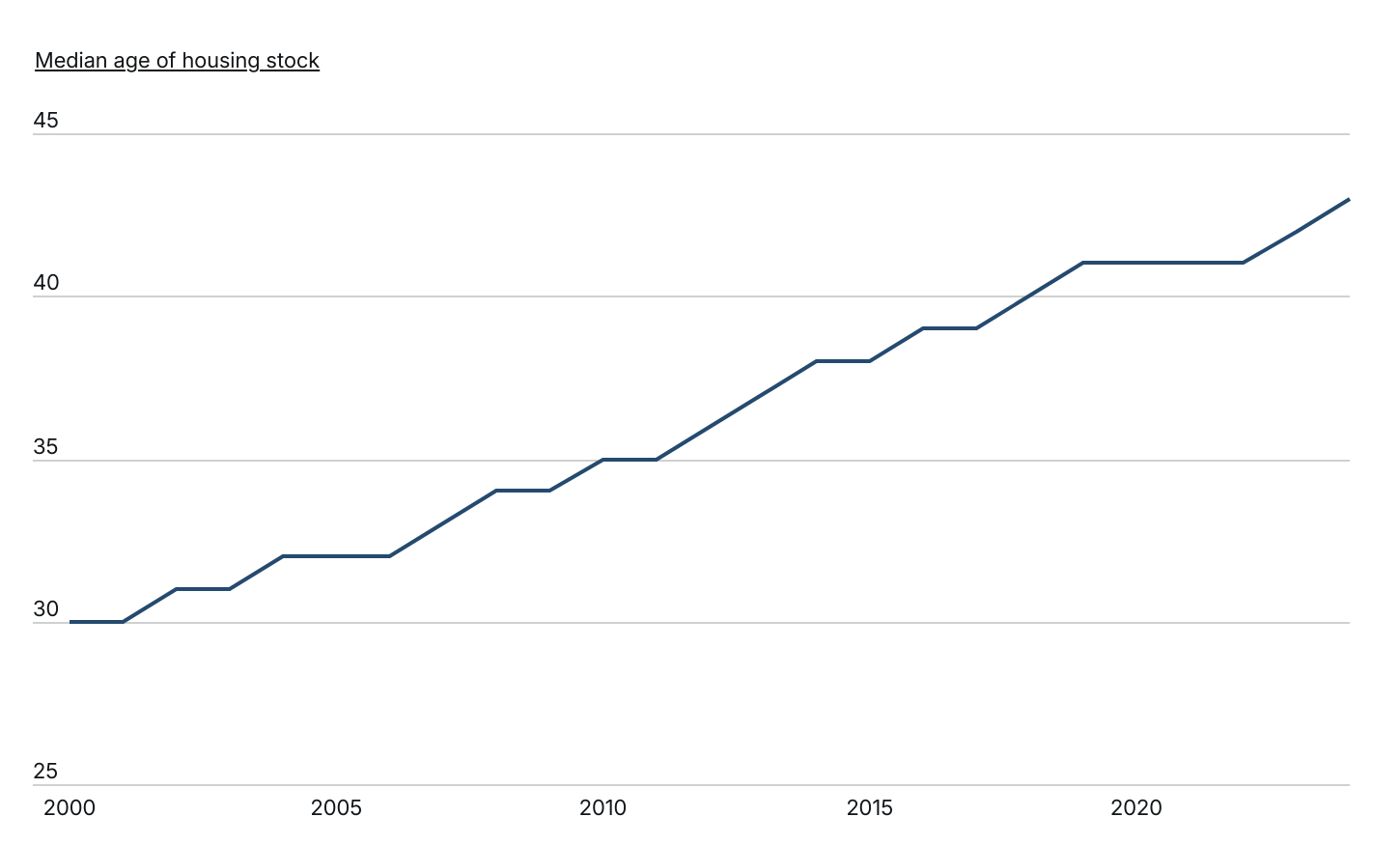
The median age of U.S. homes has increased steadily over the past 25 years
Source: Construction Coverage analysis of U.S. Census Bureau data | Image Credit: Construction Coverage
With fewer new homes coming onto the market, many buyers are increasingly competing for older homes. Over the last two decades, the median age of a home in the U.S. has increased by more than 10 years, from 30 years in 2000 to 43 in 2024.
Older homes do have some advantages for buyers. For one, they are often less expensive to purchase, making them more accessible for lower- or middle-income buyers. Old homes may also have more character, with design features and amenities that reflect the time at which they were built. And as the saying goes, “they don’t build them like they used to.” In many cases, surviving older homes demonstrate higher quality craftsmanship or the use of long-lasting materials like old-growth lumber.
Housing Age and Quality
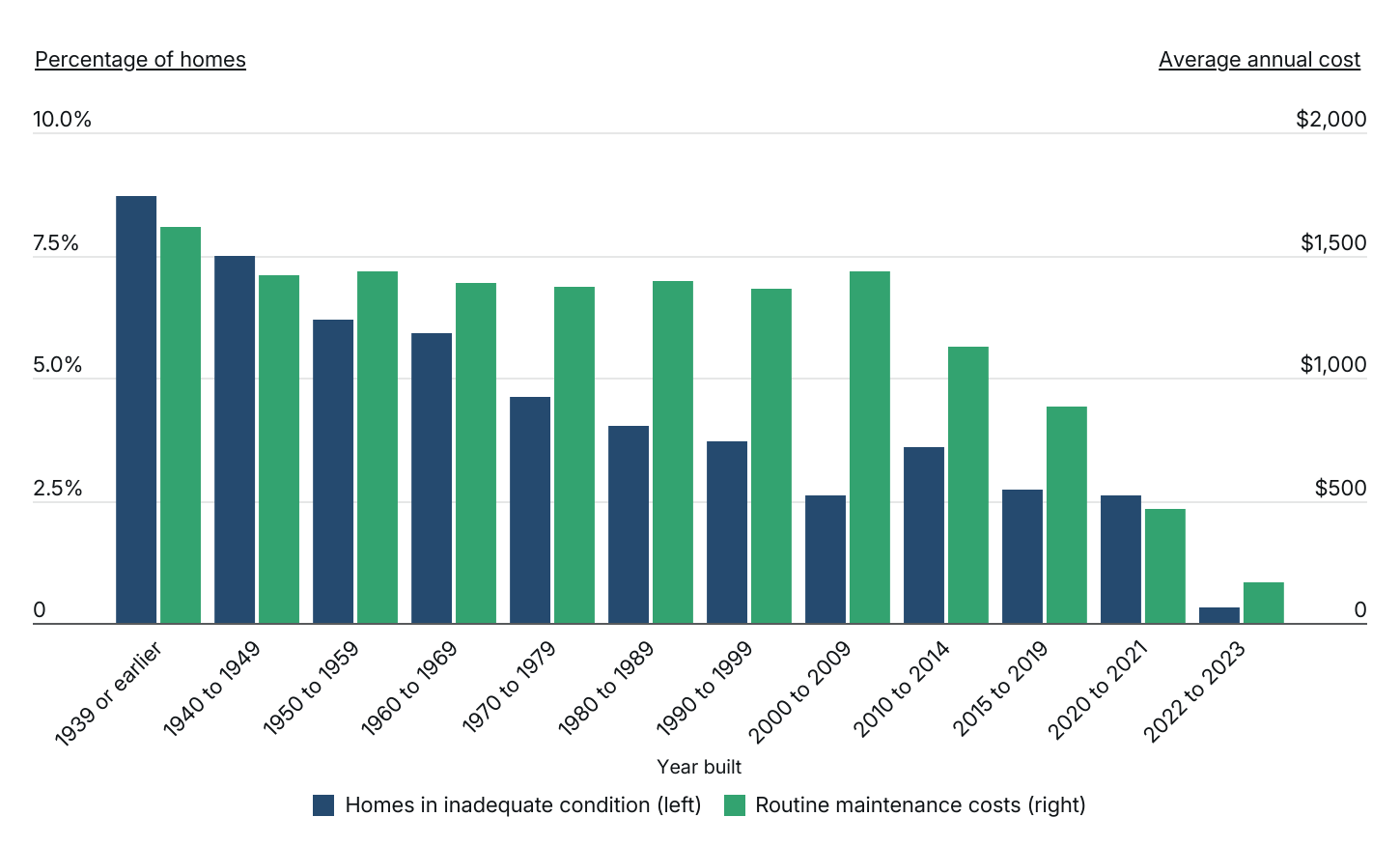
Older homes require significantly more upkeep to maintain adequate living conditions

Source: Construction Coverage analysis of U.S. Census Bureau data | Image Credit: Construction Coverage
The downside of older homes, of course, is that aging homes often come with additional costs for maintenance and repairs. According to data from the U.S. Census Bureau, both the likelihood that a home is in inadequate condition and the typical costs of routine maintenance increase with age. Of U.S. homes built before 1940, 8.7% are considered to be in inadequate condition, as opposed to just 0.3% of homes built since 2022. Meanwhile, the average annual maintenance costs for homes built before 1940 are $1,615, compared with just $164 for homes built after 2022—nearly 10 times higher.
Which States Have the Oldest Homes?
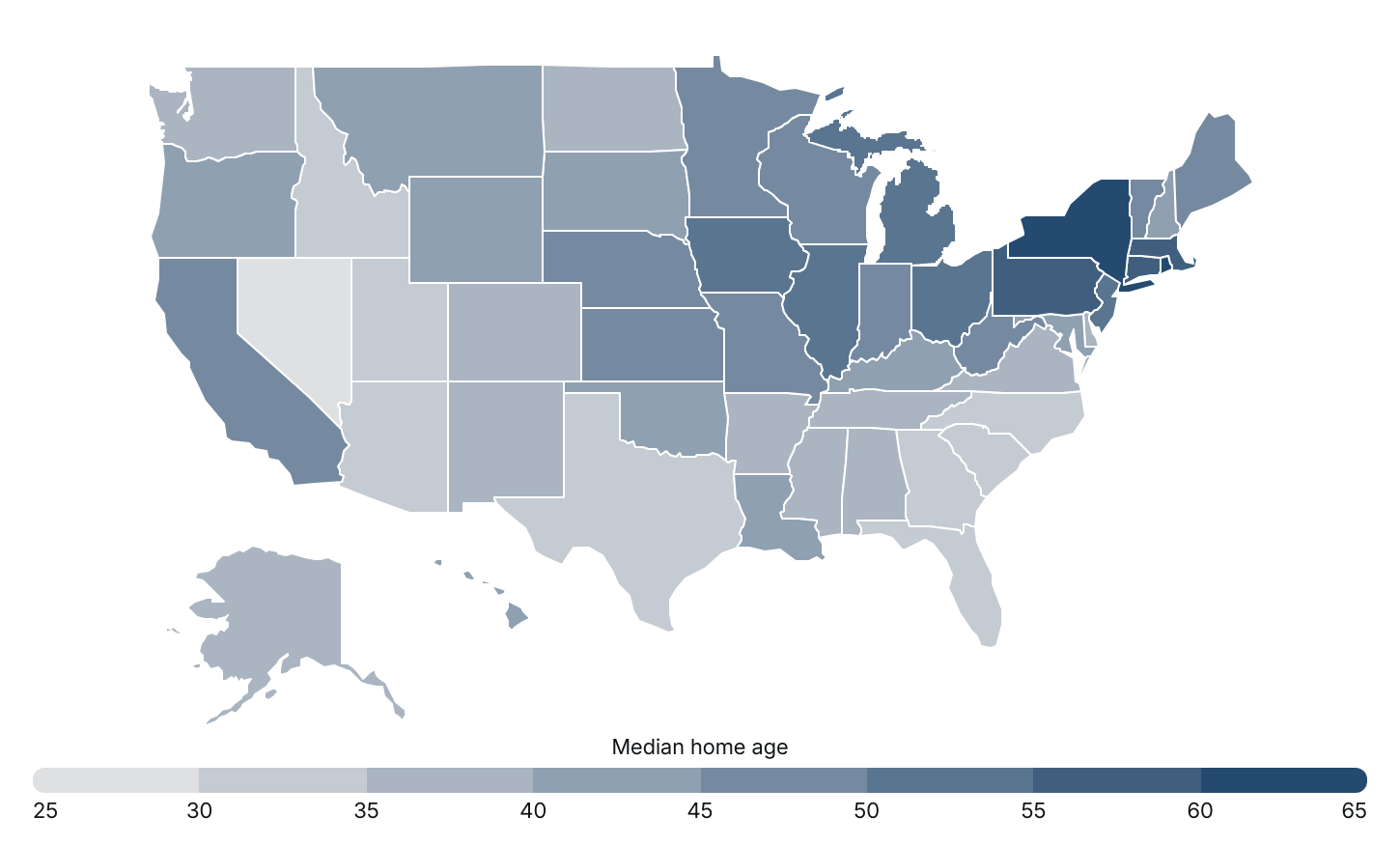
States in the Northeast and Midwest have the oldest housing stock in the nation
Source: Construction Coverage analysis of U.S. Census Bureau data | Image Credit: Construction Coverage
However, the aging of the U.S. housing stock varies across geographies. Areas that have grown quickly in recent decades, including Sun Belt states like Nevada (27 years) and Arizona (30 years), have the lowest median home ages. Many of these regions are also among the cities investing the most in new housing, helping keep their housing stock relatively young. On the other hand, states in the Northeast and Midwest tend to have the oldest supply, led by New York with a median home age of 65 years. At the state and local levels, many of the locations with the oldest homes used to be heavily populated, denser areas but have had stagnant or declining populations in recent years. With fewer people moving in and more limited space for new construction, these places have found it difficult to add new housing inventory.
Here is a summary of the data for New Hampshire:
- Median home age: 44
- Median year built: 1980
- Share of homes built before 1980: 50.6%
- Share of homes built before 1940: 18.2%
- Share of homes built since 2010: 9.5%
For reference, here are the statistics for the entire United States:
- Median home age: 43
- Median year built: 1981
- Share of homes built before 1980: 48.1%
- Share of homes built before 1940: 11.5%
- Share of homes built since 2010: 13.8%
For more information, a detailed methodology, and complete results, see American Cities With the Oldest Homes on Construction Coverage.


(0) comments
Welcome to the discussion.
Log In
Keep it Clean. Please avoid obscene, vulgar, lewd, racist or sexually-oriented language.
PLEASE TURN OFF YOUR CAPS LOCK.
Don't Threaten. Threats of harming another person will not be tolerated.
Be Truthful. Don't knowingly lie about anyone or anything.
Be Nice. No racism, sexism or any sort of -ism that is degrading to another person.
Be Proactive. Use the 'Report' link on each comment to let us know of abusive posts.
Share with Us. We'd love to hear eyewitness accounts, the history behind an article.