


Martha and Paul Dickey’s son Jason Dickey took his Merrimack Valley High School ID card with him wherever he went, and had it on him the day he died by suicide in 2017, at age 19.
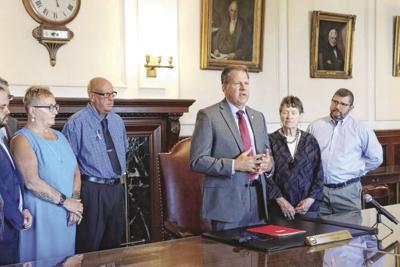
On Wednesday, Gov. Chris Sununu signed the Jason Dickey Suicide Prevention Act, requiring student ID cards to include the phone number for the National Suicide Prevention Lifeline.
The new law will impact all schools that currently issue ID cards to students, and is intended to make the number readily available in the bag or wallet of any student who is struggling with mental health, putting a resource literally in their own hands. Sununu said the state will be sending letters to school districts this week, reminding them that the bill has passed, and explaining how to make necessary edits to their fall ID cards.
“You never know when a mental health crisis is going to hit,” Sununu said. “A lot of families might think it’s not going to happen to them. It can happen to anyone, any age, any income, mental health issues do not discriminate. And as we know, especially post-COVID, the issues, especially on children, have been exacerbated. So that means we need to double down on our efforts.”
Martha Dickey had the idea for the legislation, which she pitched to Sen. Ruth Ward, a Stoddard Republican, who became the bill’s primary sponsor. In April, the House Education Committee officially named the bill after Jason. And on Wednesday, Martha and Paul Dickey were on hand to see the bill, named after their son, become a reality.
“It starts at home, with us taking care of and talking to our kids about mental health,” Martha Dickey said. “This, to me, is for the kids to now have the number on hand.”
Martha Dickey was also behind a law passed in 2019, requiring New Hampshire schools to provide suicide prevention training to staff and create policies for responding to student suicides.


Dickey, who volunteers with NAMI, is a member of many support groups and is always reading about suicide prevention legislation in other states, says her advocacy work is far from over and she’s already starting to think of new ideas. She says she feels lucky to live in New Hampshire, where she has easy access to her representatives, as it would be harder to effect change in a larger state.
“I feel like destiny put me here, because I don’t think that access would have been the same to be able to say, ‘I’ve got this great idea, who can we talk to?’ ” Dickey said.
The National Suicide Prevention Lifeline provides free and confidential support for people in distress around the clock. As of July, callers can now reach the Lifeline by dialing 988, since the Federal Communications Commission designated the three-digit number for mental health crisis and suicide prevention services nationwide in 2020. The previous toll-free phone number will continue to function as well.
If you or someone you know might be at risk for suicide, The National Suicide Prevention Lifeline can be contacted anytime by dialing 988 or 1-800-273-8255.
•••
These articles are being shared by partners in The Granite State News Collaborative. For more information visit collaborativenh.org.


(0) comments
Welcome to the discussion.
Log In
Keep it Clean. Please avoid obscene, vulgar, lewd, racist or sexually-oriented language.
PLEASE TURN OFF YOUR CAPS LOCK.
Don't Threaten. Threats of harming another person will not be tolerated.
Be Truthful. Don't knowingly lie about anyone or anything.
Be Nice. No racism, sexism or any sort of -ism that is degrading to another person.
Be Proactive. Use the 'Report' link on each comment to let us know of abusive posts.
Share with Us. We'd love to hear eyewitness accounts, the history behind an article.