


By DAYMOND STEER, CONWAY DAILY SUN
WOLFEBORO — U.S. Secretary of Agriculture Sonny Perdue came to Town Hall Friday morning to listen to concerns from the people of rural New Hampshire.
Those concerns ran the gamut from the opioid crisis to the cost of municipal infrastructure upgrades to the lack of broadband internet access in some areas.
Perdue, who has been on the job since April and served as governor of Georgia, noted that in addition to farming, his department also oversees food safety and rural development.
The format of Perdue's appearance was a roundtable discussion. About 70 people were in attendance, including 15 on the panel.
Joining him at the head of the table were Gov. Chris Sununu, and U.S. Reps. Carol Shea-Porter and Anne McLane Kuster. Other panelists included Mitch Yeaton of White Horse Addiction Center in Ossipee, Wolfeboro Town Manager David Owen and Dr. Larissa Baia of Lakes Region Community College.
"I want to hear your ideas and challenges," said Perdue. "How can the federal government, specifically, the USDA help to facilitate, improve rural prosperity, rural quality of life and not just get out of your way?"
Yeaton said he would like to expand White Horse's campus to have 120 beds for long-term recovery, but he's running into red tape when it comes to grant funding.
"We are ready to go. We can run this thing," said Yeaton. "We just need to get it started, but when you go for the grants, we are told because you are Christian, you can't get it. We are told, 'you haven't been around long enough; you can't get it.'"
Yeaton said 120 beds would be a "big deal" in New Hampshire because there aren't a lot of beds available now.
Perdue said in the past, drug abuse was often thought of as an inner-city problem, but it's in rural communities, too.
Owen discussed the needs of town water and information infrastructure. He said the town still has some of Wolfeboro's original water system from the 1890s, while other parts date back to the 1930s and '40s.
"It's going to cost, according to the asset management plan, $100 million – a million dollars a year for 100 years – to replace all the water infrastructure just in this little town of Wolfeboro, New Hampshire," said Owen, adding that rural development programs are an important source of funding for New Hampshire towns.
Owen also highlighted the importance of broadband internet connection.
He said high-speed internet allows people to work from anywhere in the world. For instance, Owen said one resident moved to Wolfeboro from Los Angeles and is operating a special effects studio out of his home.
"He just finished the latest season of 'Game of Thrones' from his studio here in Wolfeboro, New Hampshire," said Owen, adding that the resident telecommutes to work in Hollywood. "A lot of people are doing that, but you can only do it if you have broadband infrastructure."
There are some areas of town that still don't have internet access, said Owen, adding that he's been to Third World countries with more coverage.
Perdue said the USDA has programs that can help with infrastructure issues like the water system, and he agreed that internet access is critical for business and education and health-care purposes.
Shea-Porter told Perdue that New Hampshire is an aging state because people come here to retire and also because the young people are leaving.
"One of our challenges now, and it ties into broadband, counseling and jobs, is to keep the next generation in place," said Shea-Porter, adding that the cost of higher education causes many young people to go elsewhere. "Sometimes they leave and don't come back."
Sununu said that some of the various departments in Washington, such as the Federal Communications Commission, don't always treat New Hampshire as the rural state it is because of New Hampshire's proximity to Boston.
"One thing to remember and why it's so important that we all have a voice here is to remind them of what the true dynamics of New Hampshire are versus the Washington perception, and they vary from department to department," said Sununu, adding that a rural designation allows New Hampshire to pursue certain funding streams.
At another point in the meeting, Sununu said he is actively promoting New Hampshire's rural charm and that he's also seeking input from millennials to find out what they want New Hampshire to offer.
Perdue stressed that he wants to be helpful to state and local leaders.
He said when he was governor of Georgia, he felt that federal government officials were sometimes overbearing. He said that, in contrast, he wants to work collaboratively with state and local governments.
"I would probably agree the government closest to the people is the one that's trusted the most and operates most effectively," said Perdue, adding that the USDA was visiting "not from the lord-you-over perspective but from the grassroots up, from local to state and federal, how can we work together for the benefit of all these people not only in this area but across the country."
From Wolfeboro, Perdue traveled to the Russell-Colbath House, a site within the White Mountain National Forest, where he was scheduled to swear in Tony Tooke as the new U.S. Forest Service chief. The ceremony had been set to take place at the Pemigawesett Overlook on the Kancamagus, but high winds caused the ceremony to be moved to a more sheltered location.
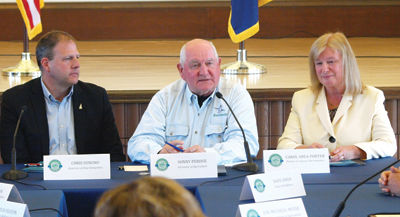
U.S. Secretary of Agriculture Sonny Perdue, center, holds court at a roundtable meeting Friday at Wolfeboro Town Hall. At left is Gov. Chris Sununu. At right is U.S. Rep. Carol Shea-Porter. (Daymond Steer/Conway Daily Sun)


(0) comments
Welcome to the discussion.
Log In
Keep it Clean. Please avoid obscene, vulgar, lewd, racist or sexually-oriented language.
PLEASE TURN OFF YOUR CAPS LOCK.
Don't Threaten. Threats of harming another person will not be tolerated.
Be Truthful. Don't knowingly lie about anyone or anything.
Be Nice. No racism, sexism or any sort of -ism that is degrading to another person.
Be Proactive. Use the 'Report' link on each comment to let us know of abusive posts.
Share with Us. We'd love to hear eyewitness accounts, the history behind an article.