


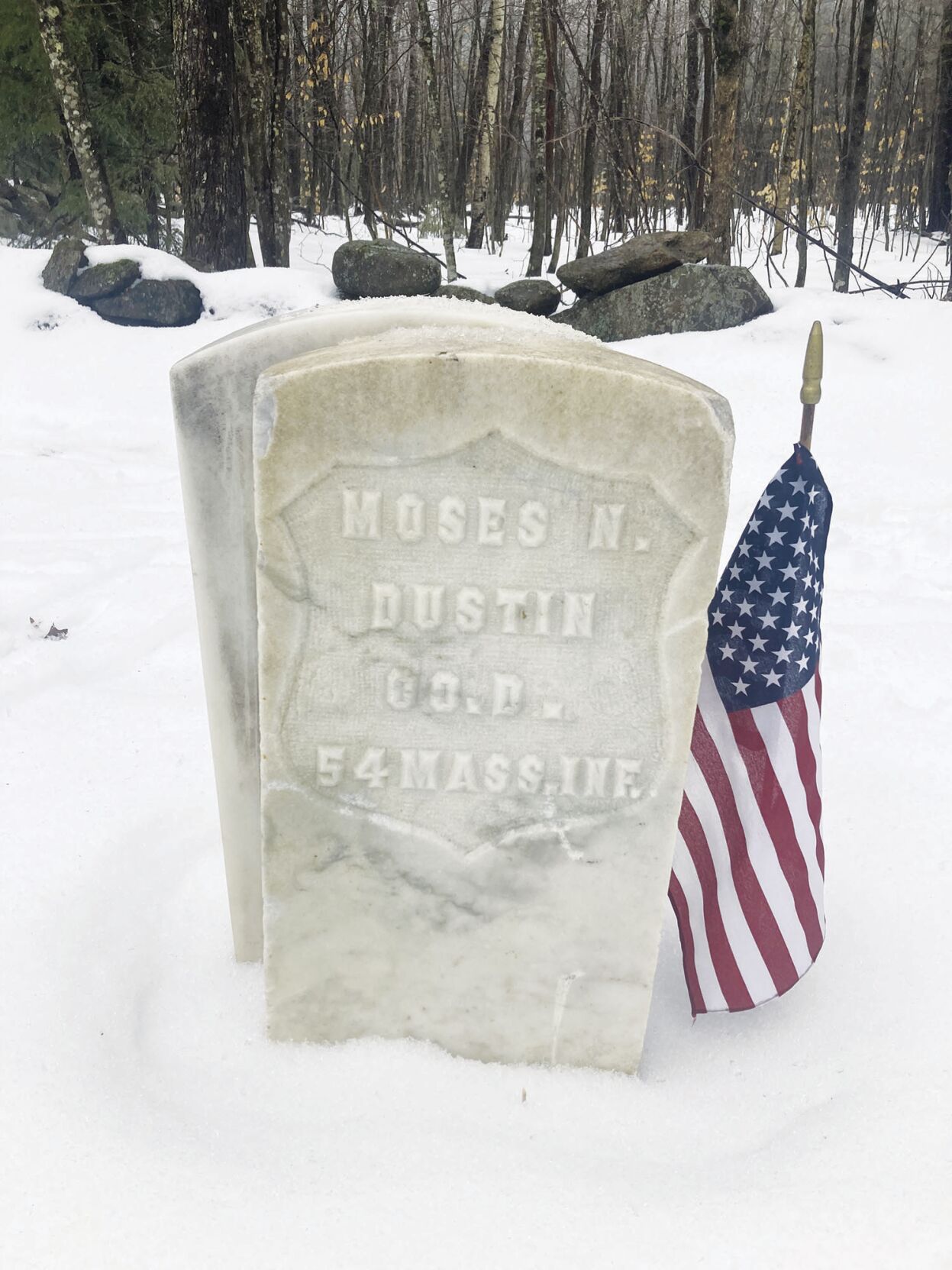
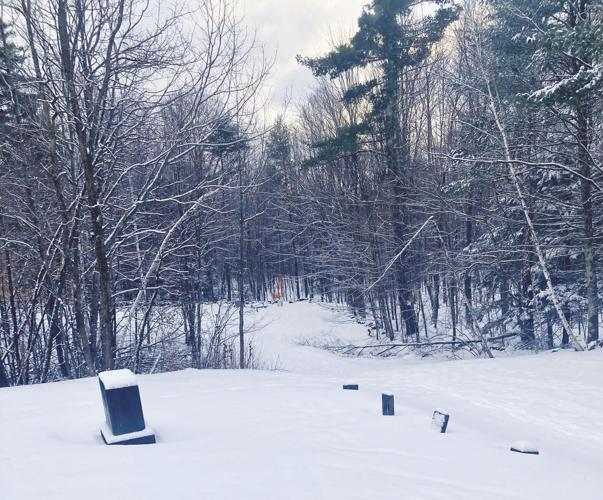
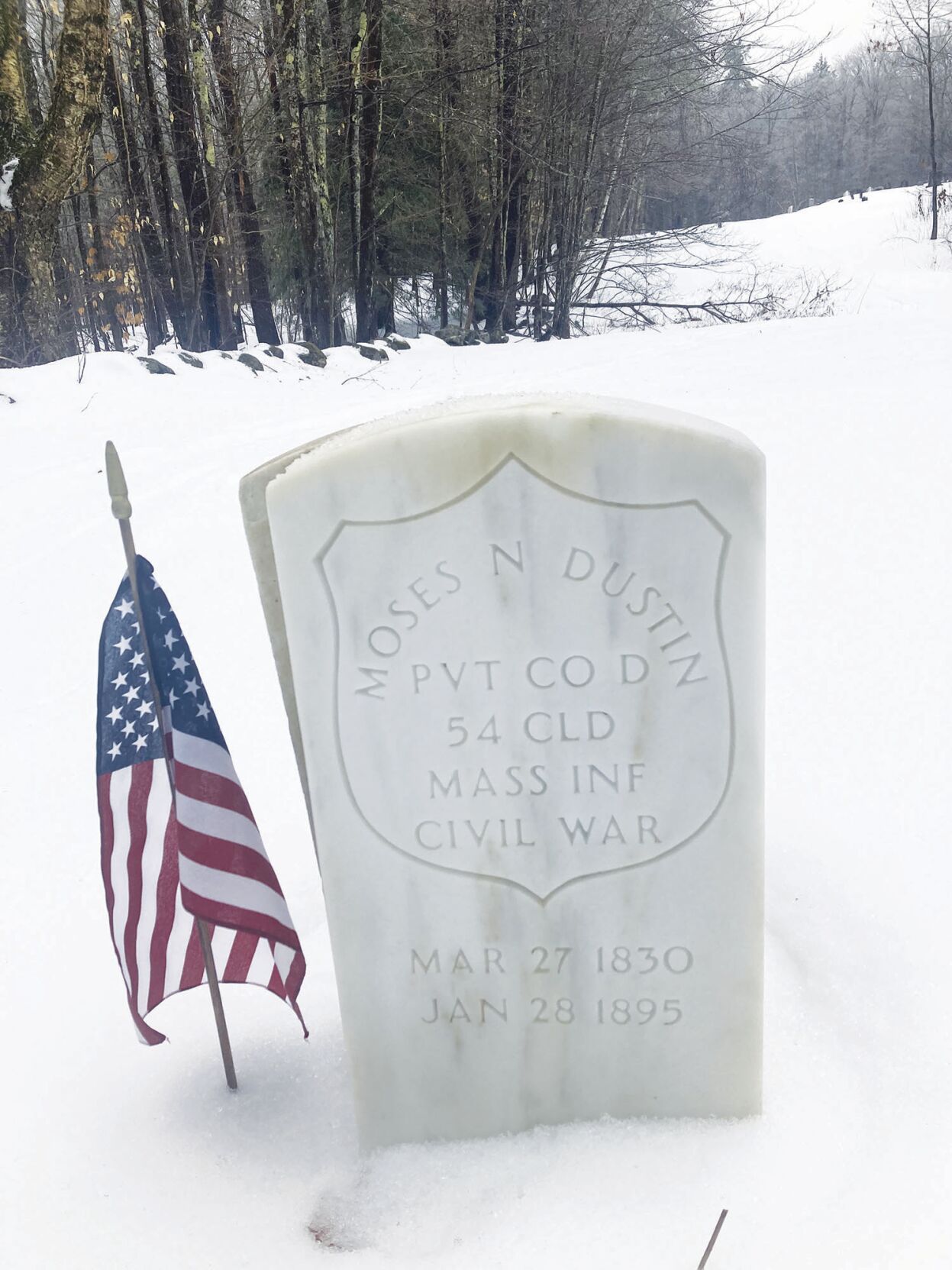


There are 38 cemeteries in Gilmanton, and of late I’ve been thinking about what may be the most solitary tomb in all of these graveyards. Civil War veteran Moses Dustin was buried in Beech Grove Cemetery in 1895, and when his grave marker went in, it was 100 feet away from the nearest other stone and more than 200 feet from most. It sat in the graveyard’s corner, on the side of a gentle hill, looking out at scores of other graves grouped closely together.
Dustin was a Black man born in 1830, in Canterbury, a small town bordering Gilmanton. In 1863, moved to fight slavery, he joined the U.S. Army as a volunteer, enlisting in a famous regiment. The 54th Massachusetts Infantry was the nation’s first all-Black military unit and so vaunted that, when it paraded through Boston in 1863, thousands gathered to watch. The Boston Evening Transcript wrote, "No single regiment has attracted larger crowds.” And in 1989, a blockbuster movie — "Glory," starring Denzel Washington — captured the 54th making a heroic but ultimately failed assault on a Confederate stronghold, Fort Wagner, in South Carolina.
A private, Dustin joined the 54th a month after that July 1863 assault, and the details of his military service are hazy. Records show he was with the Army for a year before being discharged in August 1864 "by reason of physical disability.” Was he wounded in battle? It’s unclear. But he healed up and then enlisted again, now serving in Florida with the 3rd U.S. Colored Troops. After the war ended in 1865, he returned to Canterbury and worked as a farmhand and servant before living out his last years in Gilmanton, likely in poverty.
You’d think that would be the end of Moses Dustin’s story, but no, an anonymous source — I’ll call him Mitchell Osgood — emailed me recently to reveal that in the late 1980s there came a sharp interruption in Dustin’s eternal rest. Osgood, then a Gilmanton resident, was disturbed by the remoteness of the soldier’s grave. He sensed racial exclusion at work, and he decided that Dustin needed more respect — that, in fact, he needed a new grave marker that explicitly celebrated his Civil War service. “I contacted the VA,” Osgood wrote in his email, “and after much arguing, got him a new stone.” With a friend, Osgood shoveled a hole in the cemetery lawn and put the new marker in.
Afterward, Osgood felt something was awry. “To me,” he wrote, “it looked unnatural to have two stones for the same grave, so I took the older one home.”
Osgood put the stone in his backyard, and there it remained after he moved out of town, right up until the early 2000s, when the Gilmanton Cemetery Trustees got a call from the new owner of Osgood’s home. This woman said she’d found a grave marker while she was gardening. Soon, one of those trustees brought Moses Dustin’s original headstone back to Beech Grove. It now sits back-to-back with the newer Dustin stone and within a few feet of some neighbors. Two military veterans were buried near Moses Dustin in the late 20th century.
When I visit the cemetery now, I feel heartened by the care that’s gone into preserving Dustin’s legacy. The little American flag beside his two stones helps. Still, like Osgood, I’m troubled by the placement of this Black soldier’s grave. How did the guy end up all alone in the corner? In 2003, Gilmanton historian Marion McIntyre told a reporter that Dustin chose to be there: “He said that if they didn’t want to be near him when he was alive, he didn’t want to be near them when he was dead.”
I guess it’s good that Dustin got to choose where he was buried. Still, to me it’s tragic that he felt so disliked as he contemplated death — and that the only way he could claim power in Gilmanton was by choosing to be isolated. The man was not welcomed here. And his remark raises questions about how we conceive of community. When newcomers arrive — when they look a little different than everyone else and maybe carry different cultural habits — do we just expect them to shape up and fit in?
Today, northern New England remains a challenging place for people of color. It’s the whitest region in the nation. We’re over 95% white here in Maine, New Hampshire and Vermont, and the beauty of our small towns lies partly in how much we keep the past present. Our old cemeteries, our circa 1800 white-steepled churches, our white picket fences — those are what makes our towns postcard-pretty, and so we’re very resistant to changing anything. Newcomers, new ideas? Too often they’re met with a stubborn skepticism that feels like loyalty to insiders, even as it stings the people who just got here. Conflicts well up.
Across the Connecticut River today, Vermont is facing a labor shortage even worse than the one that helped bring about the recent closure of the Gilmanton Pub. A nonprofit, the Vermont Futures Project, has proposed a solution: Vermont, it argues, needs to increase its population by 16% — to 802,000 — by 2035. It’s a given that many of the new arrivals to Vermont would be people of color, and so Vermont Futures’ scheme has met fervid resistance. In writing for the Stowe Reporter, artisan farmer Tamara Burke summed up the anti-change position when she fretted over how the newcomers “are going to fit into Vermont’s unique and carefully curated culture. There is a very real possibility they won’t,” Burke said, “that they’ll overwhelm the traditions and culture that make up what we think of as Vermont.”
Carefully curated? I love old white clapboard Colonial homes. I live in one, actually. But I also know that a culture that can’t change becomes brittle and vulnerable. It becomes, worst case scenario, just a bunch of old people, then a museum, then a memory. And isn’t the ideal of cultural flexibility — the notion that this country is big enough to assimilate large influxes of newcomers and grow — central to the American mystique? The “melting pot” and all that.
Moses Dustin’s ancestors came to America under the most brutal of circumstances, to toil for white people. Eventually we had, in Abraham Lincoln, a president who believed that the enslaved people of our nation should be freed. Moses Dustin believed in Lincoln’s cause. He enlisted. He fought, and today, I think, we should remember the solitude he suffered, even after he served his country. And we should ask ourselves: How can towns like ours change just a little to let newcomers feel included and welcome? What can we do to open our hearts?
•••
Bill Donahue has written for Outside, Harper's, The Atlantic and The Washington Post Magazine. He lives in Gilmanton, and his book, "Unbound: Unforgettable True Stories From The World of Endurance Sports," will be published by Rowman & Littlefield in June. This column is adapted from his online newsletter Up The Creek.


(0) comments
Welcome to the discussion.
Log In
Keep it Clean. Please avoid obscene, vulgar, lewd, racist or sexually-oriented language.
PLEASE TURN OFF YOUR CAPS LOCK.
Don't Threaten. Threats of harming another person will not be tolerated.
Be Truthful. Don't knowingly lie about anyone or anything.
Be Nice. No racism, sexism or any sort of -ism that is degrading to another person.
Be Proactive. Use the 'Report' link on each comment to let us know of abusive posts.
Share with Us. We'd love to hear eyewitness accounts, the history behind an article.