


MOULTONBOROUGH — Two loon deaths from ingested lead fishing tackle have been documented in New Hampshire so far this summer. The first lead-poisoned loon was discovered June 17 on Long Pond in Lempster. The loon was already deceased when it was found on the shoreline of an island on the pond. Radiographs at Meadow Pond Animal Hospital showed lead tackle in the loon's gizzard, and a necropsy found fishing line and two fishing jigs that tested positive for lead. The bird's body fluids were also tested and showed a high lead level, well above the threshold for clinical lead poisoning.
A second lead-poisoned loon was found on Cold Spring Pond in Stoddard, only miles from Long Pond in Lempster where the first lead mortality was found a few weeks before, on July 6. This male loon had been captured and released on July 1 in the course of routine banding. Blood tests conducted the following day revealed high lead levels, and Loon Preservation Committee staff and volunteers began monitoring the pond closely. The loon was found deceased on Wednesday, but it likely died over the weekend. Unfortunately, both loon chicks on the pond also disappeared—one was found dead on Wednesday as well. The chicks may have been killed by an intruding loon while the lead poisoned loon was weakened and unable to defend the territory. A necropsy performed on July 11 showed a lead jig and fishing line in the adult loon's gizzard.
July and August are when lead-poisoned loons are most often found, which correlates with peak lake use and fishing pressure in New Hampshire. The state Fish and Game Department and the Loon Preservation Committee urge anglers to stop using lead tackle to protect loons and other lake wildlife. Poisoning from lead fishing tackle is the leading cause of adult loon mortality in New Hampshire. The loss of so many adults from this preventable cause of mortality has inhibited the recovery of loons in New Hampshire, according to the Loon Preservation Committee.
"Because loons do not breed on average until 6 to 7 years of age and have low reproductive success, it is important that adult loons survive for many years to produce surviving young," said Harry Vogel, senior biologist and executive director of the committee. "The loss of an adult loon may also result in the loss of that loon's nest or chicks, further negatively impacting the population."
These loon deaths come just weeks after the implementation of a new law strengthening the ban on lead fishing tackle in the state. New Hampshire was the first state in the nation to restrict the use of small lead fishing tackle in lakes and ponds beginning in 2000. Subsequent legislation to restrict the use of this tackle in all freshwater in New Hampshire took effect in 2005, and the sale was restricted beginning in 2006. A new law implemented on June 1, 2016, increased protection for loons and other waterfowl banning the sale and freshwater use of lead jigs weighing one ounce or less, regardless of length, adding to the previous ban on lead sinkers one ounce or less.
The Loon Preservation Committee and state Fish and Game are part of a region-wide initiative called Fish Lead Free (www.fishleadfree.org), which is dedicated to providing resources for anglers across New England to help them make the switch to lead-free tackle. Safe alternatives to lead tackle, made of steel, tungsten, tin, bismuth and many other materials, are effective and readily available. Learn more tips and tactics for fishing lead-free at www.wildnh.com/fishing/get-the-lead-out.html. Collection receptacles for old lead tackle can be found at all New Hampshire Fish and Game offices and at The Loon Center in Moultonborough.
"Lead is a known factor that we have the ability to address. It is something we can choose to change," said Laura Ryder, education programs supervisor at Fish and Game. "Anglers have always been great conservationists. This new law, now in effect, gives us the opportunity to make a positive difference in the aquatic environment and our loon population."
The New Hampshire Fish and Game Department (www.wildnh.com) works in partnership with the public to conserve, manage and protect the state's fish, wildlife and marine resources and their habitats; inform and educate the public about these resources; and provide the public with opportunities to use and appreciate these resources.
The Loon Preservation Committee (www.loon.org) monitors loons throughout the state as part of its mission to restore and maintain a healthy population of loons in New Hampshire; to monitor the health and productivity of loon populations as sentinels of environmental quality; and to promote a greater understanding of loons and the natural world.
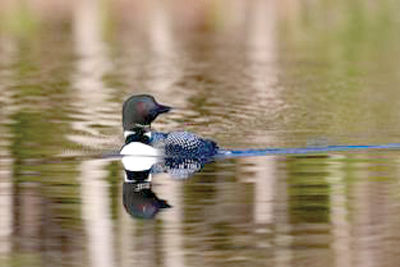
Lead fishing tackle is by far the largest documented source of adult loon mortality in New Hampshire, responsible for 48% of documented mortalities. Photo courtesy of Kittie Wilson.


(0) comments
Welcome to the discussion.
Log In
Keep it Clean. Please avoid obscene, vulgar, lewd, racist or sexually-oriented language.
PLEASE TURN OFF YOUR CAPS LOCK.
Don't Threaten. Threats of harming another person will not be tolerated.
Be Truthful. Don't knowingly lie about anyone or anything.
Be Nice. No racism, sexism or any sort of -ism that is degrading to another person.
Be Proactive. Use the 'Report' link on each comment to let us know of abusive posts.
Share with Us. We'd love to hear eyewitness accounts, the history behind an article.