


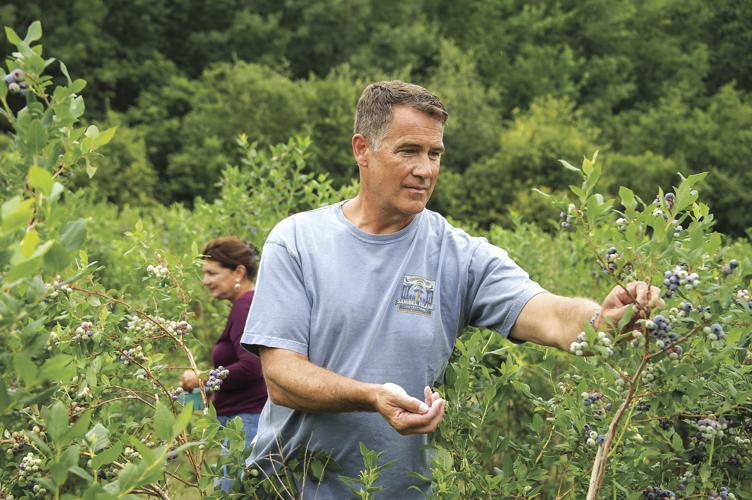
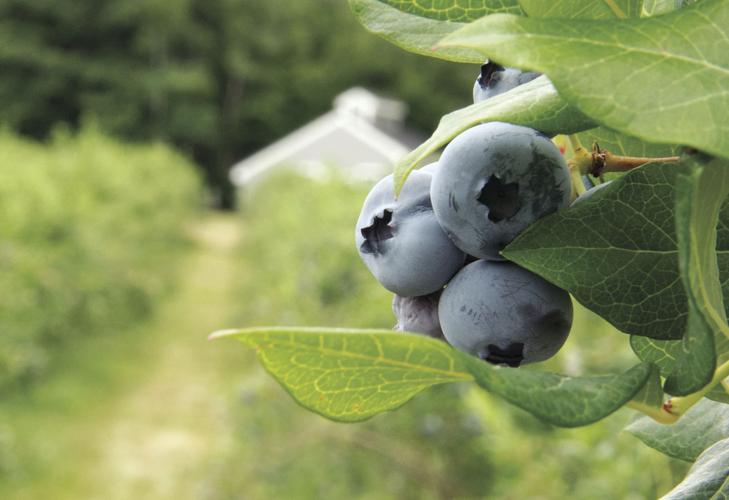
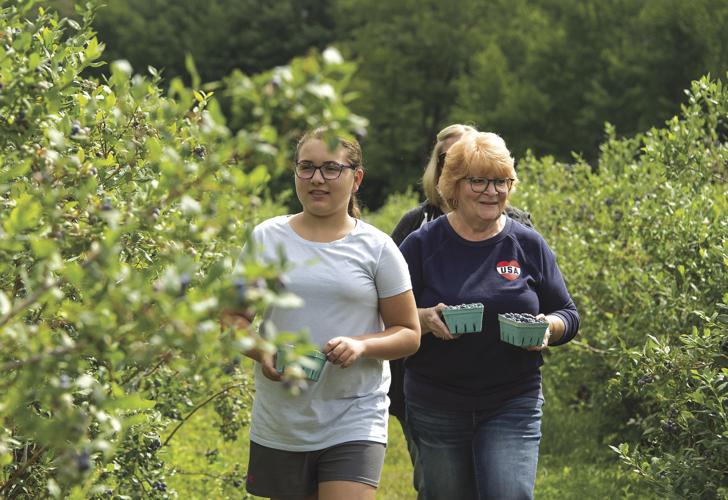
GILFORD — Blueberry season has arrived in New Hampshire and those enjoying the fresh fruit may be surprised to know that the modern high-bush blueberries has roots in the Granite State, having been developed a little over a century ago from low-bush blueberries growing in New Hampshire.
George Hamilton, small fruit specialist with the Hillsborough County Cooperative Extension Service, said the high-bush blueberry plants were developed from low-bush plants in Greenfield shortly after 1900 by Dr. Frederick Colville, a Rutgers University professor, and Elizabeth White.
He said that their work is celebrated today in two varieties of high bush blueberries – the Elizabeth and the Colville – named in their honor.
Hamilton said Colville selected desirable plants while vacationing in New Hampshire and cultivated them to develop blueberries that could be commercially grown by farmers. The work of Colville and White resulted in the plump, juicy, sweet and easy-to-pick cultivated blueberry people enjoy today.
“They developed the high-bush berries that are grown all over the Northeast and Midwest, all the way to the West Coast,’’ said Harrison.
He said Native American tribes in the Northeast used fresh and dried blueberries and much folklore developed around them.
He said the berries – and even parts of the blueberry plant – were used as medicine and a tea made from the leaves of the plant was thought to be good for the blood.
What the Native Americans knew years ago has recently been rediscovered, Harrison said. During the Civil War, soldiers drank a blueberry beverage that was supposed to improve their health. Recent studies showing the health benefits of eating blueberries, which have the highest amount of antioxidants of any fruit, confirm their benefits.
Kelly McAdam of the UNH Cooperative Extension Service says that blueberry season runs from early to mid-July to late August and that many small farms have started growing the berries in recent years.
“They’re diversifying what they offer and find that there’s good demand for blueberries. They’re relatively easy to grow provided the soil is acid enough and they do need to be pruned every year.” she said.
Blueberries are easily preserved by freezing, canning and drying, McAdam said, and they can also be juiced or made into jam or preserves.
One of the largest high-bush blueberry operations in the state is Norland Berries on North Barnstead Road in Barnstead, which has 11 acres of blueberry plants and was formerly owned by the Locke family. Now owned by the DKP LLC and managed by Jim Norris, there are nearly 10,000 plants and seven different varieties.
“These plants date from around 1960 and are good producers,” said Norris, who lamented the lack of pickers available to harvest the bountiful crop, half of which he said is left in the field.
“It all depends on the weather. Some years you get a pound off from one bush. Other years you get a three or more pounds from the same bush.”
The Norland web site advertises prices of $2.50 a pound or $3.50 a pint, with 10 pounds of frozen berries going for $30.
McAdam said this year looks good for the blueberry crop but she is concerned that the lack of rain will create drought conditions that could affect the late crop.
Low-bush blueberries are still harvested, mostly in Maine, which grows 10 percent of the nation’s blueberries.
The low-bush berries are Maine’s state fruit but demand has dropped and the largest wholesale buyer of low-bush berries in the state has stopped buying them, according to Harrison.
One of the largest users of Maine’s low-bush blueberries is Hermit Woods Winey of Meredith, which produces an award-winning wine, Petite Blue, from the berries.
Ken Hardcastle, winemaker, says that an entire pound of wild low-bush blueberries are in each and every bottle.
Last year he used 10,500 pounds of berries to produce the wine which, unlike many available blueberry wines, is a Burgundy style that embodies the characteristics a pinot noir.
“People are totally surprised when they taste it and find it’s dry with a nice finish,” said Hardcastle, who urges serving it slightly chilled.
There’s also a Petite Blue Reserve, a specially crafted vintage that is fuller in body and finishes long and dry like.
It was featured in the Food and Wine magazine’s November 2017 edition, which also named it the craft beverage of New Hampshire.
Hardcastle said that Petite Blue is also featured in a cocktail made at the Local Eatery in Laconia, where it is served as a Mimosa when mixed with proseco, an Italian sparkling wine.


(0) comments
Welcome to the discussion.
Log In
Keep it Clean. Please avoid obscene, vulgar, lewd, racist or sexually-oriented language.
PLEASE TURN OFF YOUR CAPS LOCK.
Don't Threaten. Threats of harming another person will not be tolerated.
Be Truthful. Don't knowingly lie about anyone or anything.
Be Nice. No racism, sexism or any sort of -ism that is degrading to another person.
Be Proactive. Use the 'Report' link on each comment to let us know of abusive posts.
Share with Us. We'd love to hear eyewitness accounts, the history behind an article.