


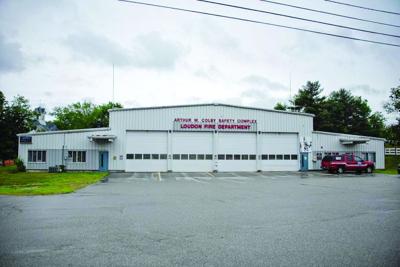
Loudon Police Chief Dana Flanders came to the most recent Select Board meeting with an idea he knew could be controversial.
He wanted to start a conversation about the police department exploring a contract with U.S. Immigration and Customs Enforcement to assist with federal operations. New Hampshire is the only state in New England to opt into these contracts with ICE since the Trump administration began heightened immigration enforcement at the start of his second term.
To explore such a partnership in this political moment, Flanders wanted to proceed slowly.
Flanders is still in the “infant stages” of researching the contract, he said, and brought it up at a meeting last month to gauge whether the select board wanted him to go any farther.
“We are lucky in the town of Loudon, I feel like, that our police department presents a professional, cooperative service to our town, and we have a good amount of support from our residents,” Flanders said in an interview. “I think that’s a risk you run sometimes when you enter into an agreement like this, is losing the support of your townspeople, and that’s certainly not something I ever want to do.”
The contract could be a revenue stream for a small town, with potential to bring in $100,000 after the first arrest, plus other stipends, Flanders said.
Funding won’t be their only consideration, however, said Select Board Chair Dwayne Gilman. He wants more information and to mull it over with the board before giving Flanders the green light to apply.
“I don’t believe in doing something just for the cash, because I think there’s more to it,” Gilman said. “It just can’t be as simple as handing out 100 grand here, 100 grand there. Just can’t be that simple … You’re dealing with families and lives and human people, so it’s got to be the right decision for the right reasons.”
Contracts with ICE, called 287(g) agreements, are becoming more common across New Hampshire and nationally. They generally authorize local police carrying out their standard operations to arrest and interrogate people for warrants on or suspected immigration violations. Local agencies can issue immigration detainers and transport them to ICE-approved detention centers.
If the town is awarded funds from the program, the Loudon Select Board would need to hold a public meeting to accept those funds.
In Flanders’ several years at the department, he said, local police have encountered people who entered the U.S. illegally several times, but it’s far from a daily occurrence.
For Flanders, the move is more a matter of being in the loop. If ICE came to Loudon, he said he hopes the contract would provide a more solid framework for federal officials to notify him of any raids or searches beforehand.
“We’ve seen this nationwide, that the federal government is going to come in and do what they want, when they want, in regards to immigration matters right now, and I think I would rather be in the know of what is happening instead of finding out after the fact and having a ton of questions asked of me” about local involvement, Flanders said.
He said his focus is to preserve local control for Loudon while getting some extra federal funding. He wouldn’t be required to send local officers to help execute raids in far-away communities, he said at the meeting.
“If the feds or ICE called and said, ‘Hey, we’re doing this in Laconia, we want you to come,’ I have every right to say’ I’m not sending any of my officers to that,’ and there’s no disciplinary action coming back,” Flanders said.
The three-year contract could be exited at any time, he added. The Grafton County Sheriff’s Office recently exercised that option, citing a strain on resources.
Gov. Kelly Ayotte has encouraged local law enforcement to work with ICE and crusaded against so-called “sanctuary” policies that seek to stop police from cooperating with ICE.
So far, two dozen local police departments, three sheriff’s departments and the New Hampshire State Police have entered these agreements.
If Loudon signs onto the memorandum of understanding, it would be the third police department in Merrimack County to do so. Pittsfield agreed to it in May. Chichester joined on July 20.
Loudon, Pittsfield and Chichester are among the more conservative towns in Merrimack County. Donald Trump won each of them handily in 2024.
Gilman said the Select Board will make a decision based on how they believe the community wants to proceed, not on their personal views. He thinks the town would likely be split on the issue.
“I think it comes down to what the town wants and what thumbprint the town wants to take on this position itself,” Gilman said.
If Loudon doesn’t move forward with it, the police department can still cooperate with requests from ICE. The town is not allowed to block the police department from doing so, according to a law signed by Ayotte last year.
Flanders stressed that he’s still researching his options, keeping an eye out for the fine print and only wants to enter the agreement if the selectmen agree.
“I am not in a position where I want to fast-play this,” he told selectmen last month. “I want to do it right and I want to do what’s best for the town.”
•••
These articles are being shared by partners in the Granite State News Collaborative. Don’t just read this. Share it with one person who doesn’t usually follow local news — that’s how we make an impact. For more information, visit collaborativenh.org.


(0) comments
Welcome to the discussion.
Log In
Keep it Clean. Please avoid obscene, vulgar, lewd, racist or sexually-oriented language.
PLEASE TURN OFF YOUR CAPS LOCK.
Don't Threaten. Threats of harming another person will not be tolerated.
Be Truthful. Don't knowingly lie about anyone or anything.
Be Nice. No racism, sexism or any sort of -ism that is degrading to another person.
Be Proactive. Use the 'Report' link on each comment to let us know of abusive posts.
Share with Us. We'd love to hear eyewitness accounts, the history behind an article.