


LACONIA — One major redevelopment project will receive a short-term tax break, while another one will not because it does not meet legal requirements.
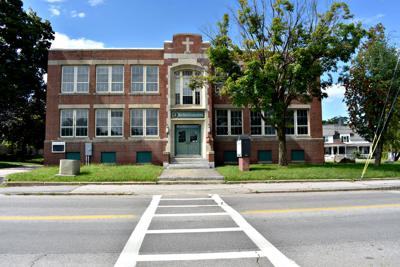
The City Council on Monday unanimously approved tax relief for the planned rehabilitation of the former Holy Trinity School on Church Street. However, a similar request related to the restoration of the Lakeport Opera House was denied — also unanimously — because the tax benefit was requested after much of the project was completed.
State law permits a municipality to freeze the property tax on a building undergoing substantial rehabilitation if the project is considered an economic benefit to the community, or if the property is an historic building. To qualify, buildings need to be located in a downtown, town center, central business district, or village center.
KNM Holdings is proposing to rehabilitate the Holy Trinity building as part of a planned construction of market rate apartments.
The city agreed in May to sell the property to the developer for $1. The purchase-and-sale agreement is still in effect. The ownership of the building has not yet been transferred to the buyer.
The front of the school — built in 1924 — will be turned into at least eight residential apartments. The back of the school, built in the 1950s, will be torn down, and eventually replaced with an addition with another four apartments. The complex will have its own parking area.
Mayor Andrew Hosmer said the city chose to sell the building for a token price partly because the upward of $1 million in improvements needed to make it usable was a deterrent to many potential buyers. Moreover, another important consideration was the fact that what until now has been tax-exempt property would begin paying property taxes.
The city acquired the building as part of the $1.13 million purchase of most of the former St. Joseph Church complex. That purchase entailed the historic Busiel House, the Holy Trinity School, and a 90-space parking lot. The city sold the Busiel House in March for $480,914 to a private owner.
St. Joseph Church was not part of the transaction, and is still owned by the Diocese of Manchester.
Hosmer called the amount the city paid for the church property, the parking area in particular, “a good investment in downtown revitalization.”
Councilor Bruce Cheney defended the sale of the building for $1, noting: “They (KNM Holdings) were the only ones interested in the building.”
Under the approval granted by the council, taxes on the building will be fixed until March 31, 2023, based on its assessed value on March 31 of next year. The building is currently assessed at $614,000. But City Manager Scott Myers pointed out the assessment could be lower come next March if the developer tears down the 1950s addition between now and then.
Myers recommended against granting the request by the Opera House, which is being developed by Scott Everett, because the law states that for an applicant to qualify for tax relief the rehabilitation has to begin after the application for tax relief is approved.
Myers told the council that the application from Paugus Union II LLC was received after work on the building’s first and second floors was complete and the occupancy permits had been granted. The state law does not allow the tax benefit to be granted retroactively, he told the council.
However, Ron DeCola, who represented Paugus Union at Monday’s meeting, said that tax relief was appropriate given chances the developer has taken by doing the project.
“This money is at-risk. Nothing was pre-leased,” he said.
He disputed Myers’ reading of the statute as limiting the tax relief to future projects alone.
The first floor of the Opera House houses two businesses, including The Laconia Daily Sun. A 250-seat theater is located on the second floor. Plans call for the third floor to be subdivided into two or three condominiums.
Myers said the developer could still qualify for the tax break for condominium development provided the application is submitted before work begins.
In rejecting the application Monday, the council said the developer is free to appeal the decision to Superior Court.


(0) comments
Welcome to the discussion.
Log In
Keep it Clean. Please avoid obscene, vulgar, lewd, racist or sexually-oriented language.
PLEASE TURN OFF YOUR CAPS LOCK.
Don't Threaten. Threats of harming another person will not be tolerated.
Be Truthful. Don't knowingly lie about anyone or anything.
Be Nice. No racism, sexism or any sort of -ism that is degrading to another person.
Be Proactive. Use the 'Report' link on each comment to let us know of abusive posts.
Share with Us. We'd love to hear eyewitness accounts, the history behind an article.