


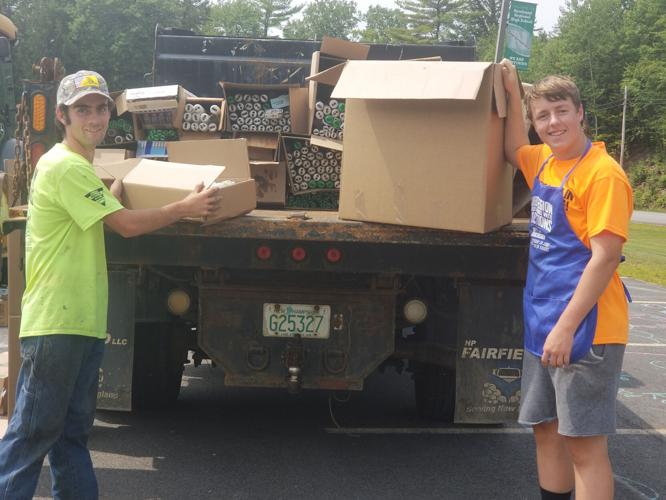
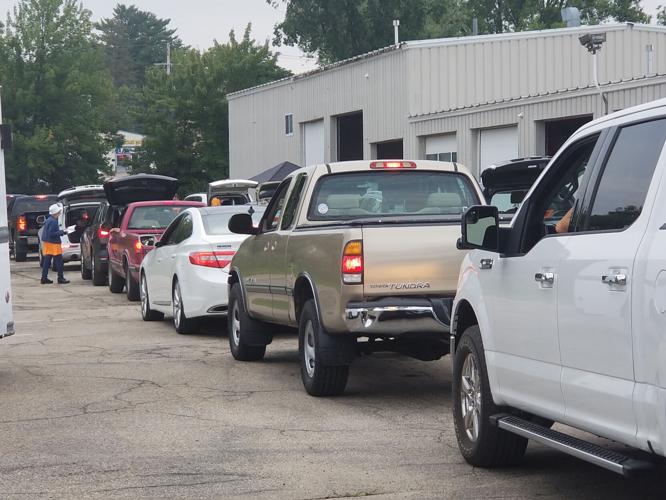
LACONIA — It’s a once-a-year chance to shed substances too toxic to put in a landfill. At Laconia’s Household Hazardous Waste Collection on Saturday, cars and trucks snaked around Bisson Ave. and lined up Strafford Street between 8:30 and noon, waiting to offload batteries, antifreeze, paint thinner, leftover motor oil and gasoline and partly used cans of house paint, and other chemicals that shouldn’t leach into drinking water or soil.
Laconia Public Works collected toxic castoffs from 317 vehicles, down from 426 at that site during 2020. But across the Lakes Region, the overall collection rose. During seven hours over two days, July 31 and August 7, over 1,700 vehicles dropped off hazardous household chemicals and batteries at sites in Belmont, Franklin, Gilford, Bristol, Ossippee, Laconia and Moultonborough, said David Jeffers, regional planner for the Lakes Region Planning Commission, which organizes the regional collection from residents of 24 communities. Last year, the total turnout was just over 1,600, Jeffers said.
On Saturday, the Laconia Public Works Department collected roughly 300 gallons of motor oil that will burned to heat the Public Works building. But the category surrendered in greatest numbers was fluorescent light bulbs, said Wes Anderson, the city's public works director.
"I would love for us to not have to do this,” said Jeffers, who added that he’s pleased the healthy turnout. “I would love for everyone to use up everything they have, or find ways to donate it. Small trace amounts of toxic substances can have great impact.”
No one seemed to be bothered by waiting in line. Most drivers considered it a small sacrifice to protect drinking water and the local environment.
“I have last minute items that I don’t want to put in the garbage,” said Steve Loughlin of Audrey Lane, who brought bug killers, weed killers, an old fire extinguisher and more. “We don’t want to pollute the water system. It makes sense.”
It was the big day to dump unwanted chemicals stored in residents’ garages, tool sheds, basements, barns, and under the kitchen and bathroom sink. The annual take is around 20,000 gallons of toxic liquids that might otherwise end up in the water supply, Jeffers said.
“We got a huge turnout,” said Tyler Smith, an equipment operator for Laconia Public Works, who served as Laconia’s site director. “We didn’t know what to expect.” Last year was a record turnout, with 426 people dropping off at the Department of Public Works garage on Bisson Ave.
“Our communities find it’s a service people want,” Jeffers said. “If people don’t have an opportunity to turn stuff in, (town roads crews) find it at the end of a dirt road.”
This year, through a joint effort of LRPC and the Look Preservation Committee in Moultonborough, residents of towns participating in the hazardous waste collection could also get rid of lead fishing sinkers, which are banned because loons eat them.
Usual items accepted include oil-based paint, pesticides and fertilizers, pool chemicals, drain cleaners, oven cleaners, paints, gasoline contaminated by water and fuel and lubricants for power equipment and vehicles including cars, boats, trucks, tractors and snowmobiles. Items that don’t qualify for the regional hazardous waste collection include tires, electronics, ammunition, fireworks, asbestos, propane tanks and radioactive materials.
To increase the participation rate, LRPC is using traditional and social media to reach more of the 90,000 houses in the greater Lakes Region before their chemicals are disposed of by flushing down toilets, spilling down drains, or pouring outside or in bodies of water.
“It’s good for the planet. It’s no bother to wait,” said Howard Doherty of Howard Street, as his car inched closer to the garage, where employees were collecting universal waste such as batteries, fluorescent light bulbs and motor oil. Items eligible for drop off included art supplies, cleaning fluid, roofing tar, unbroken flourescent bulbs, car wax polish, antifreeze, diesel fuel, carburetor cleaners, herbicides, pesticides, pool cleaners, tar-based driveway sealers, oil-based paint, paint removers, stains, varnishes and spray paint.
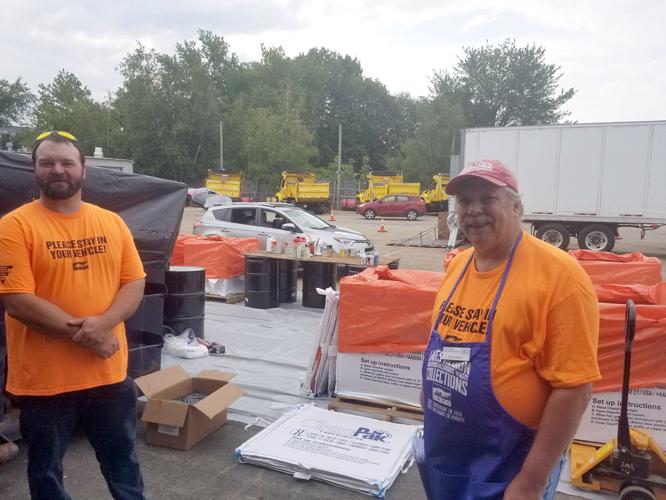
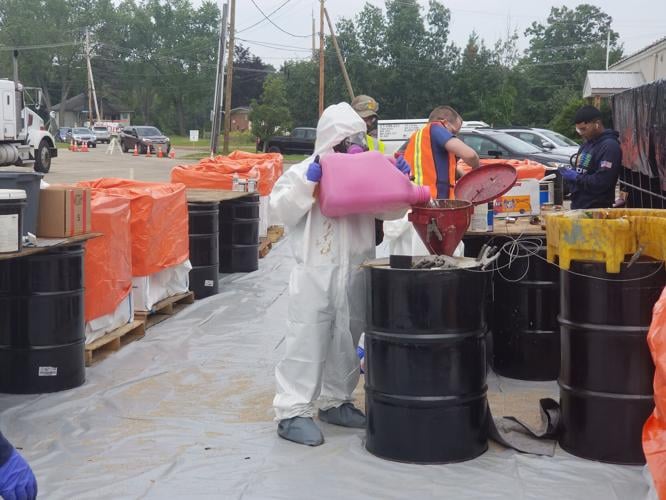
Around the corner from the open garage bay, things got more serious and odoriferous. Waste technicians from Tradebe, an international waste removal company with a headquarters in Newington, emptied containers of volatile organic chemicals into drums, including unused fuel and oil contaminated with water, and sorted chemicals according to substance type. One worker wore goggles and a hazmat suit while pouring off gasoline, solvents and other liquids that are dangerous to inhale or ingest.
In the past 20 years, Kris Fournier, Tradebe’s vice president of technical services, said he’s seen greater numbers of people people participating, but the quantities collected have decreased. One notable exception has been fertilizers, weed killers and pesticides – chemicals for gardens and lawns, which seem to be common across geographic locations, and have increased.
Here, where boating is popular, Fournier expects to haul off a lot of gasoline mixed with water. “The ideal would be if they just bought enough so we wouldn’t have unused gas sit around. We collect tens of thousands of gallons every year,” he said.
Ellen Gambee of Gilford brought unused chemicals for the garden, “Things I thought I would use, but couldn’t lose, and vow never to buy again,” she said.
Liz Sibson-Tuan, who lives in California but summers in Gilford, came for the first time, with a pickup filled with bags of bottles of oil, paint thinner and various lubricants, which were supposed to be in open bins or boxes to allow for easy handling and inspection. “I just cleaned out my dad’s garage,” she said. “I showed up and said, ‘I don’t have this planned correctly.’ They said, ‘Don't worry, we’ll take care of it.’ What’s great is, these towns support each other.”
“I was cleaning out my garage. Most of the stuff was from the previous owner, and I didn’t know what to do with it,” said Gail Sibley who lives on Valley Street. She brought anti-freeze, rat poison and oil for a lawnmower, among other things. “I think some people would tend to throw it in the regular garbage if they didn’t have this.”
Bristol’s collection at Newfound Regional High School witnessed a steady stream, but no numbers were available on Saturday. “We started at 7:30 with people lined up, waiting to get in,” site coordinator Steven Favorite said.
Jeffers, who has been running the regional collections for 20 years, said misunderstandings abound about what constitutes hazardous waste, and what can safely be tossed in the trash. Leftover latex house paint, which is often brought in car trunks filled with partly or mostly empty containers, is not yet considered hazardous waste in New Hampshire, although surrounding states collect and recycle it as hazardous waste.
“Latex paint has been a bee in our bonnet for decade,” said Jeffers. In New Hampshire, “it’s not hazardous waste. It’s water-based and not oil-based. You dry it out and it can go in the trash.” That is, until the legislature passes laws that require it to be added to the hazardous waste stream. If transported to a treatment plant, it can be recycled and reused as paint.
Jeffers said that to his knowledge, no hazardous waste is stored or processed in New Hampshire. Most is trucked to an EPA-approved kiln in New York.
For more information on what to do with hazardous household materials, alternative drop-off locations and a list of specific substances and how to get rid of them safely, go to lakesrpc.org. Look under “services” and “household hazardous waste collection.” The Lakes Region Household Hazardous Product Facility in Wolfeboro is open the third Saturday of the month from May through October, 8:30 to noon. Free or a fee depends on whether you live in a participating community, but anyone can bring hazardous materials and pay. For more information, call 603-569-5826.





(0) comments
Welcome to the discussion.
Log In
Keep it Clean. Please avoid obscene, vulgar, lewd, racist or sexually-oriented language.
PLEASE TURN OFF YOUR CAPS LOCK.
Don't Threaten. Threats of harming another person will not be tolerated.
Be Truthful. Don't knowingly lie about anyone or anything.
Be Nice. No racism, sexism or any sort of -ism that is degrading to another person.
Be Proactive. Use the 'Report' link on each comment to let us know of abusive posts.
Share with Us. We'd love to hear eyewitness accounts, the history behind an article.