


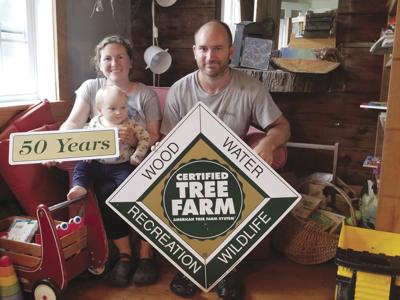
SANBORNTON — For Brittany Abbott, the family’s 100-acre woods is a garden of resilient beauty, an oasis where she can walk, camp, snowshoe and listen to the call of a solitary owl.
For her husband Aaron Abbott, who is a carpenter, the forest is nature’s wood shop and timber supplier, a renewable crop of pine, hemlock and maple where animals abound, where it’s possible to spy skunks, raccoons, porcupines, deer, bear, moose, fishers and coyotes.
“It feels good to have a place wildlife can go to and not worry about crossing the road or being harassed,” said Aaron, the third generation of Abbotts to manage the family’s wood lot. “People undervalue undeveloped land. We spend most of the time just walking through the trees.”
It’s also Belknap County’s oldest certified tree farm, a member of NH Tree Farm, the state’s chapter of the American Tree Farm System founded in 1941 to encourage arboriculture, sustainable forests, water quality and wildlife habit. It’s a mission that’s gained urgency as open space and working farms disappear, and development reduces the amount of forestland.
“I’m not a forester,” said Abbott. “Trees grow by themselves. But if you tend to them like a garden, you can thin them out and they’ll grow better.”
That’s sage advice for property owners with land to spare, who may own 10 or more acres that can be maintained or enhanced for future generations with a forest management plan, a free visit and consultation by a county forester, and TLC that amounts to periodically eliminating invasive or unwanted plants.
According to NH Tree Farm, there are currently 69 certified tree farms in Belknap County which together contain 16,400 acres. In New Hampshire, over 1,500 New Hampshire tree farmers, comprising professionals and hobbyists, currently manage about 436,000 acres. That doesn’t include unenrolled landowners who independently or professionally manage their woods for timber, wildlife, or outdoor pursuits. In Belknap County alone, 104,344 acres under current use are categorized as forest, according to the New Hampshire Department of Revenue Administration.
But in one of the New Hampshire’s oldest counties, and in the nation’s second oldest state, most tree farmers are now age 60 and older. And forest advocates wonder: Who will step up to preserve privately-owned forest for future generations?
“A lot (of forest) held by baby boomers is going to change hands in the near future,” said Jasen Stock of Sanbornton, executive director of the NH Timberland Owners Association, one of the underwriters of the NH Tree Farm program. “What happens to that land when the kids are living all over the country, and there’s a real estate boom?” The temptation is, “’Hey, there’s a chance to cash in. We can put in a 10-lot subdivision.’ When you look at the amount of land in documented stewardship, it’s quite significant across the state .”
New Hampshire is the second most forested state behind Maine, consisting of more than 82% woods. Based on USDA Forest Service data from 2019, New Hampshire has 4.69 million acres of forest, down from 4.77 million in 2014, and roughly 73% of that land is privately owned.
New Hampshire’s forest and open space benefit from the fact that almost 34% of the state is under some type of conservation protection, one of the highest percentages of any state east of the Mississippi, according to the 2020 New Hampshire Forest Action Plan. But New Hampshire’s population is predicted to grow 64% in the next 40 years, and with that comes development pressure. By 2060 New Hampshire forestland acreage is expected to drop by 8%, according to the Forest Action report.
That puts pressure on private landowners to protect and manage their current holdings in a sustainable fashion.
“Private landowners own almost 3/4 of the state’s forest resource, which is quite significant,” said Belknap County forester Rebecca DiGirolomo, who is also the forester for Strafford County.
The portion of forest land in the NH Tree Farm program “is a big number,” said Stock, and the overall value of managed woods to New Hampshire’s environment and economy, including tourism, is monumental, according to economists and forest experts. Forests also protect the environment. Trees and their root systems act as natural erosion controllers and filtration systems for reservoirs, and they capture and store carbon.
Then there’s the timber industry. “If you’re in it for the long haul, if you’re a sawmill, you want to be sure there are long-term landowners growing wood,” Stock said.
Since 2019, there have been no new enrollments in NH Tree Farm in Belknap County, down from a peak in the 1980s and 1990s, although many independent landowners maintain woodlots. DiGirolomo said she continues to see interest in tree farms in Belknap County. Data from the US Forest Service in 2017 shows that Belknap, Strafford, and Rockingham Counties are less than 70% forested, while all other counties range from 70–86% woods.
The onus is on property owners to be responsible with what they have, foresters say. The point of a management plan, said DiGirolomo, is to understand and inventory the resources on your property and develop a strategy for reaching your goal over the next 10 to 15 years, whether that’s enhancing wildlife habitat, creating opportunities for recreation or making money from cyclical timber harvests.
“Many people are not aware of what they need to do,” said DiGirolomo. “It gives you a schedule of what to expect and the type of work you might be looking at. It’s a long term picture with lots of details.”
Management plans from a consulting forester cost several hundred dollars to roughly $2,500, depending on the amount of acreage involved. Much of the price, including for ongoing forest maintenance, is reimbursed through federal programs, primarily the Natural Resource Conservation Service.
Certified NH Tree Farms are automatically eligible for reduced taxes under the state’s Current Use program, which indirectly compensates them for their maintenance expenses and offsets their ongoing costs.
To be a certified tree farmer, a landowner must have at least 10 acres and a written plan, follow recommendations from a professional forester, and demonstrate a commitment to forest stewardship. The plan can travel through generations.
Advice and education from county foresters is free. “We do it whether there’s five acres or 1,000 acres. We don’t tell them what to do. We tell them how to do what they want to do,” said Merrimack County’s forester Tim Fleury.
The goal for tree farms is to be green certified, meaning their management techniques do not damage the soil or water, and will sustain the parcel’s natural assets.
"My dad wasn’t a forester,” said Aaron Abbott. “He was self-taught and spent a lot of time in the woods,” which included removing sick or damaged trees and low-quality growth that crowded healthy and more valuable specimens. “Now we’re left with a couple of nice wood lots,” as a opposed to the forest in its natural state, which has more invasive insects and dead or diseased trees, and is more susceptible to damage from natural disasters.
“We like to go out and get a Charlie Brown Christmas tree when it snows and drag it home. I think anyone who has open space should have a tree farm,” said Abbott. “You don’t have to be proficient with a chain saw.”


(0) comments
Welcome to the discussion.
Log In
Keep it Clean. Please avoid obscene, vulgar, lewd, racist or sexually-oriented language.
PLEASE TURN OFF YOUR CAPS LOCK.
Don't Threaten. Threats of harming another person will not be tolerated.
Be Truthful. Don't knowingly lie about anyone or anything.
Be Nice. No racism, sexism or any sort of -ism that is degrading to another person.
Be Proactive. Use the 'Report' link on each comment to let us know of abusive posts.
Share with Us. We'd love to hear eyewitness accounts, the history behind an article.