


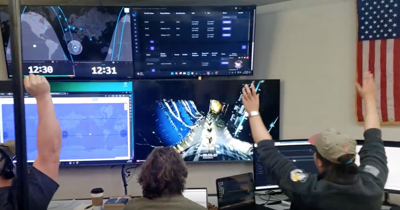
GILFORD — When Rogue Space Systems formed four years ago, the startup had an audacious concept and a need for as much capital as it could collect to bring their concept to market. The company today is now still partly in startup mode and courting venture capital investors, but has also turned a corner to making significant revenue from its business plan.
Jon Beam, one of three founders of Rogue and its chief executive officer since December, said Rogue started turning that corner last summer, and the company is “taking on the identity of a larger operational company,” yet still using government grants to further its research and development.
Rogue, which was started in Laconia and now is headquartered in Gilford, aspires to develop and operate the premier logistical support network in low-Earth orbit, largely through orbiting robots — “orbots,” they call them, which will be able to inspect and even service the growing and increasingly valuable field of satellites in orbit. Those ambitions took a significant stride last year, when the company sent some of its own equipment into orbit aboard a rocket, and demonstrated that its robot was functional in the zero-gravity, vacuum and high-radiation environs of space.
The small but growing company just took another giant step, winning a contract with the Space Force that — although details are kept confidential — could prove to be a major accelerant for Rogue’s growth, both in terms of prestige with U.S. military contacts as well as operating capital.
And, as Rogue evolves, so too has its leadership structure. Jeromy Grimmett, founder and its first CEO, has transitioned into the role of chief visionary officer, while Beam, previously chief operating officer, is now CEO.
“We have two business verticals,” Beam said. Rogue is working on research and development of its own systems, largely funded by grants, and it leverages its access to rockets — they are next scheduled to participate in a launch in February of next year — to offer space in their payload for other companies that want to test out their own developments.
“As we are operating those, we are developing our technologies for our big mission,” Beam said.
Rogue’s grand vision includes the construction of permanent orbit-based infrastructure, which will support a burgeoning space-based industry.
The global shipping industry was transformed by the development of shipping containers, Beam noted, standard-sized boxes that can be stacked on ships, loaded onto railcars or onto a flatbed trucks. He sees a similar innovation on the horizon for space-based industries.
“The whole idea behind it is we can attach and detach external payloads — ‘orblocks,’ what I call smart shipping containers,” Beam said. “That’s what we want to provide for space, to become the leading logistical supplier for space.”
“That infrastructure in space, for an in-space economy does not exist,” said Grimmett. “So we are literally building the nuts, the bolts, the shovels, pickaxes, building the railroads, clearing woods, starting little towns along the way.”
In Grimmett’s office is an array of Lego creations, largely space-faring vehicles from science-fiction stories conceived by dreamers a generation or two ago.
Those designs are no longer fiction, just science, Grimmett said.
“All these Legos that are on my table, that is the imagination of what people thought or believed that it would look like, right? But every single thing on that table of Legos is possible. Every single one of them is possible with the technology we have but there has to be a motivation to actually execute that,” Grimmett said.
An X-wing might excite cinema-goers, but what’s more likely to find motivation to be created is something a bit less dramatic, but perhaps more significant in the development of human technology. Grimmett said there are promising signs that things such as pharmaceuticals, fiber optics and microchips could all be made more efficiently and more effectively in a zero-gravity facility.
It might sound fantastical, but then again, so does every technological breakthrough, right up until the moment it arrives. As Grimmett has noted in previous interviews, low-Earth orbit is closer to Laconia than are many parts of the United States.
Once those manufacturing facilities start to come online, he said, so too will the need arise for technicians, skilled laborers and other support staff to reside in those facilities. It’s the next great economic frontier, and Rogue wants to help create it.
“We’re in this because we believe in the future. We believe in space, and we believe in what it can be,” Grimmett said. “That’s not fantasy. That’s not some pie-in-the-sky dream. This is reality, man, this is happening.”


(0) comments
Welcome to the discussion.
Log In
Keep it Clean. Please avoid obscene, vulgar, lewd, racist or sexually-oriented language.
PLEASE TURN OFF YOUR CAPS LOCK.
Don't Threaten. Threats of harming another person will not be tolerated.
Be Truthful. Don't knowingly lie about anyone or anything.
Be Nice. No racism, sexism or any sort of -ism that is degrading to another person.
Be Proactive. Use the 'Report' link on each comment to let us know of abusive posts.
Share with Us. We'd love to hear eyewitness accounts, the history behind an article.