


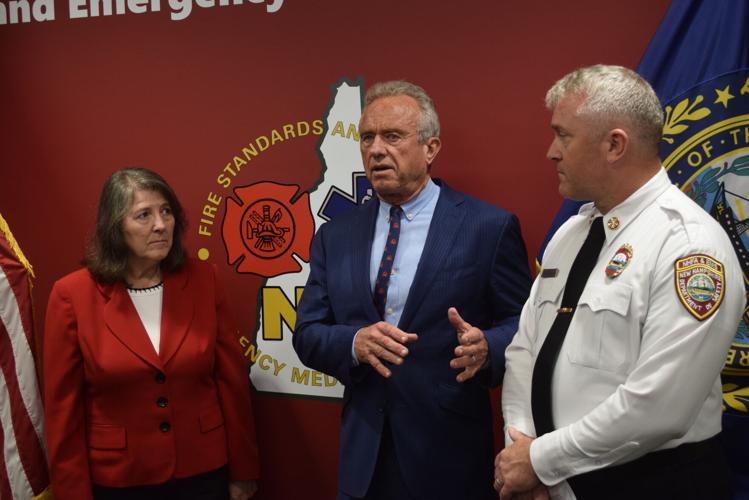
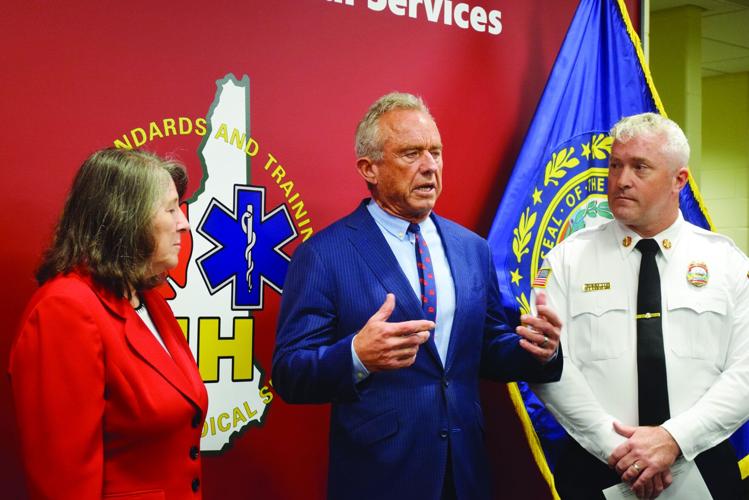
CONCORD — Health and Human Services Secretary Robert F. Kennedy Jr. visited the Granite State last week, to talk about the allocation of $11 million in federal funds to expand mobile healthcare in rural New Hampshire.
A GO-NORTH grant, part of the Rural Health Transformation Program, will not only expand mobile integrated health, a program in which the City of Laconia is involved, but will help launch new programs in the state’s most rural communities. The goal is to bring care closer to home, and provide patients with lower costs, quicker access, and more options.
“This will provide mobile technology, telehealth, and worker retention and training to allow a lot of procedures,” Kennedy said at the New Hampshire Fire Academy & EMS on Friday. “Primary care procedures, respiratory procedures, chronic health treatment, pulmonary issues, and also childbirth, to be done at home, so that those patients don’t have to go to the hospital.”
Kennedy — a 2024 presidential candidate, son of the late Sen. Robert F. Kennedy, and nephew of the late President John F. Kennedy — said 42% of the Granite State population lives in rural areas. He said they are dependent on emergency medical services, and rural areas are “strapped” for staffing.
“We have an increasingly aging rural population that is making more calls,” he said. “Staffing is down.”
Kennedy said funds will benefit “the whole system,” and will help take the stress off emergency departments, freeing them up for patients requiring acute care.
The investment is part of the $50 billion Rural Health Transformation Program. Funding will strengthen rural EMS through new equipment, technology, workforce training and support for shared services.
Kennedy praised New Hampshire for the state’s involvement in the Rural Health Transformation Program, noting it had an “exemplary application,” which is why it received $204 million from that program in 2025. He said this is “proportionately high” compared to most other states, with good reason.
“In its execution of the program, it’s also been exemplary,” Kennedy said. “And this project, which came from New Hampshire — it’s a community based project — is one of the projects that we think should be a model nationwide.”
The Health Care Consumer Protection Advisory Commission held a public forum at Winnisquam Regional High School in June, where patients shared experiences of long wait times, scheduling conflicts and overcrowded emergency departments at area hospitals. One patient spoke about waiting for 23 hours, with an average of eight to 12 hours at Concord Hospital-Concord. Laconia waits were shorter, at about six hours.
Kennedy addressed how mobile health programs could alleviate some of these issues.
“The purpose of this program, one of the purposes of it, is to equip the EMS teams with telehealth capacity, so that they’re connected to the hospital here in Concord,” Kennedy said. “The doctors in that hospital can advise them about how to do certain procedures at home, so that patient will never have to go to the emergency room, never have to go to the hospital.”
Kennedy said this is beneficial across the board, and not only frees up the emergency department, but also beds in hospitals, and even the mobile units.
Kennedy was joined by GO-NORTH Director Donnalee Lozeau and Mark Wholey, director of the NH Division of Fire Standard Training and EMS. Wholey said this program and the $11 million investment are “significant.”
“One of the biggest parts is our increase in mobile integrated health,” Wholey said. “Right now, we have eight programs that are out there. With the money that’s coming in, those programs are going to expand their current capabilities. We’re going to bring five more mobile integrated health programs on board. The amount of impact that that’s going to have is significant.”
Wholey said the Division of Fire Standard Training and EMS works closely with EMS partners to track who is going to the hospital, and why. The care patients are receiving, as well as the frequency they visit the hospital, is recorded.
“We’re tracking that stuff on a regular basis,” Wholey said. “The mobile integrated health teams are going to work directly with us and with GO-NORTH to understand where the gaps exist.”
Wholey said they hope people who often wind up at an emergency department can receive that care outside a hospital.
“That’s our goal,” Wholey said. “It’s going to take some time to work through, and we’re excited about the five-year program that’s ahead of us.”
The Laconia Fire Department currently has a mobile integrated health program. Earlier this month, city council set a public hearing to approve applying for a half-million-dollar grant to support it. The grant is from GO-NORTH Foundations for Healthy Communities, with a focus on expanding and improving the program.
City Manager Kirk Beattie praised the program, on Oct. 15, which he said is commonly referred to as the community paramedic program.
Laconia’s program is called Winnipesaukee Mobile Health, which is a collaborative healthcare program in partnership with Concord Hospital and the Partnership for Public Health. According to the city website, it is designed to provide “proactive, patient-centered care that extends beyond traditional emergency response.”
The public hearing to approve the application for the $500,000 grant is at 7 p.m., on Monday, Oct. 26, at Laconia City Hall.


(0) comments
Welcome to the discussion.
Log In
Keep it Clean. Please avoid obscene, vulgar, lewd, racist or sexually-oriented language.
PLEASE TURN OFF YOUR CAPS LOCK.
Don't Threaten. Threats of harming another person will not be tolerated.
Be Truthful. Don't knowingly lie about anyone or anything.
Be Nice. No racism, sexism or any sort of -ism that is degrading to another person.
Be Proactive. Use the 'Report' link on each comment to let us know of abusive posts.
Share with Us. We'd love to hear eyewitness accounts, the history behind an article.