


LACONIA — When Brandon Borghi toured the new condominiums above the Colonial Theatre, he found an ideal spot to live and walk to work at FitFocus, the fitness center he owns. The condos were a masterful transformation of space in need of purpose and a facelift - and they offered a ground-floor investment in a reborn city center.
“I wanted to show people I was heavily invested in the community by living downtown,” said Borghi, 27, who relocated to Laconia from Boston in 2017. He recently bought one of the condos for himself and his brother, and another for their father. “If you’re going to have a true city, you’ve got to be able to walk to stuff,” he said. “I wanted to be in the thick of everything.”
It's a sentiment widely shared as Laconia springs to life with attractions for younger people, and some attractive places to live. Will there be enough?
With antique trim and restored wood floors, and views of Main Street from picture windows, the nine condos above the Colonial provide easy access to quality of life: a budding arts and music scene, a local coffee roaster, eateries that serve healthy food including sushi, a pub with vintage vinyl and craft beer, and places to work out. A juice bar opened last month.
Priced at $260,000 for a one bedroom and $280,000 for a two-bedroom unit, the condos also presented a rare opportunity for middle-income buyers - and for investors with cash.
All but two of the units above the Colonial went under contract in the first two months, said ReMax Bayside real estate agent, Warren Clement. Now all but one are under agreement. “Most of the people who looked at them bought one,” Clement said. The condos were not posted on MLS, the online real estate listing service. Interest spread by word of mouth.
Developer Rusty McLear, who built the condos, is credited with shapeshifting Meredith from a factory town into to a thriving regional and tourist destination. “It’s a good product lower priced than it should be,” McLear, who built the units above the Colonial without making a profit, he said. “It will mean the city gets something pretty nice. What I hope we’ll see is people who are 35 and just starting out, who will look at downtown Laconia as a place to plant their flag, or a place to start their career. If any downtown is going to be truly successful, the downtown living facilities need to be successful. You have to have people who add to the community by living downtown.”
Their appeal was nearly instantaneous, crossing age and income levels.
“We were the first ones in,” said Mayor Andrew Hosmer, who, with his wife, Donna, contracted to purchase a pair of two-bedroom units and a one-bedroom unit above after viewing the plans in June, for themselves and their adult children, before any were built. “I really believe the city is on an upswing and it’s an exciting time. It’s where we want to be.”
“Everybody feels the energy of Laconia,” said Donna Hosmer. “I can’t wait to go to a show at the Colonial in my slippers, then just walk back upstairs.”
“Fridays if you go to Defiant Records, it’s a bustling place with a large demographic of many ages,” said Borghi. “Most of the business happening downtown occurs in coffee shops and gyms.” Fitness trainers have rented apartments downtown, he said.
The allure is based on a desire to be in an active, walk-able downtown.
Last year, Emily Gaudet, 24, who works at Lovering Volvo in Meredith, bought a two-bedroom condo for $263,000 at Landing Lane off Beacon Street West in the former Allen-Rogers building. "I wanted a place where I could walk, not drive to restaurants. I feel like downtown has a lot of hidden gems, like the antique store and the Jekyll & Hyde art gallery. What surprises me is how quickly downtown is turning,” she said.
“Downtown Laconia feels energetic,” said Mandie Hagan, who moved downtown this year. “It feels powerful and there’s a great sense of community. You can feel the buzz. It feels purposeful and energetic. It has old architecture turned new and modern and bright.”
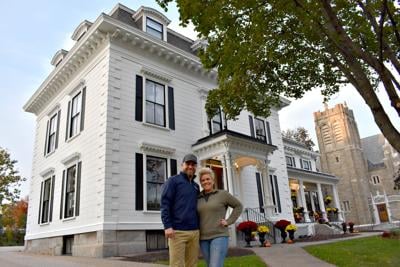
Hagan and her husband Ian, owners of Rowell’s Services, sold their home in Gilford. In April they purchased the Busiel House on Church Street, an 1865 Victorian with 10 bedrooms and a wide center staircase, and was for a stretch of time the church rectory next to Holy Trinity Catholic School. The family has posted footage of their remodeling efforts – which include restoring the original tin ceilings – and the community has tuned into watch a longtime landmark revitalized. So far their Facebook page, Downtown Hagans, has attracted roughly 2,000 followers, said Hagan, including one woman who dropped off a chair she thought was just right in the stately home - a place where the Hagans eventually hope to hold local fundraising events.
Hagan, who grew up in Franklin, used to spend Saturday afternoons with her siblings watching movies at the Colonial Theatre. In warm weather, she and her husband now sit outside at Defiant Records and Craft Beer, under the lights of the marquee, and wave to people they know. She said living around the corner from the heart of downtown has jump-started a lifestyle that’s engaging. “It’s been great to go out for a walk. We walk to the gym. We go to Local Eatery for a drink. We jump on the WOW trail,” she said. “Everything is just so spectacular.”
No one can dispute the value and draw of a revitalized city core, now a magnet for people who would like to live in a small, happening neighborhood surrounded by lakes and beautiful outdoors. The question is: Will there be enough reasonably priced housing to satisfy growing demand, especially from middle income buyers?
In order to survive, downtowns need to become active neighborhoods with a steady flow of pedestrians, day trippers, arts and culture seekers, diners, shoppers and business people, according to McLear and Stephen Duprey, who transformed Concord into a business, culture and day trippers' hub - with increased options for living. Desirable housing at prices that are affordable is part of the sensitive mix, Duprey said.
Will there be enough to keep downtown's engine going?
At the end of September there were only 13 condominiums for sale throughout the city, only two for less than $300,000, said Frank Roche of Roche Realty Group. Seven cost more than $400,000. The lowest price was $235,000. The high fell just shy of $900,000.
“Around $200,000 is considered affordable for young couples and singles moving into the area,” said Roche. “That’s where the demand is. Unfortunately, there just isn’t many.”
That’s a stumbling block in an area that increasingly needs staff for restaurants, hotels, hospitals, banks and industry – a problem acutely recognized by business and city leaders, not just in Laconia.
“Now there’s an interest from younger people,” said Borghi. “I think there’s a lot of interest from younger people.”
“I definitely think there’s a need for affordable housing in the area,” said Mandie Hagan. “The city needs to determine what customers and clientele they’re trying to attract downtown,” and match the housing to that demographic.
Much of the housing currently available in Laconia is expensive, or in need of work.
Last year, Emily Moulton found her one-bedroom apartment on Pleasant Street, which costs just under $800 a month for slightly under 500 square feet, when she mentioned her plight to a customer at Sunflower Natural Foods, where she used to work. The 26-year-old had been commuting from Bristol and living with her parents. "Looking before was fruitless. All the good properties aren't listed," said Moulton, who just started bartending at Defiant Records and Craft Beer and making smoothies at Good Natured Juice and Smoothie Bar - walkable jobs from a rare find: an affordable apartment downtown. "It was in my price range, and not a sketchy place to live," she said.
For people in her age and income bracket, the housing landscape is a desert, she said. "I have a couple of friends looking for places here. It's so slim. Most is in Manchester. Then when you find a good listing, most are gone." She believes most of her generation is stymied by lack of options.
In Laconia, will there be enough entry-level and affordably-priced homes now and in the future to support growth? Will downtown become gentrified? Will new housing be snapped up by investors who resell or rent it at a comfortable profit? Or will the new inventory supply the missing link for people who want to live and work here?
Does the "missing middle" in housing stock depend on who develops the former State School property?
“One of the things the city is struggling with is there’s no shortage of high-end stuff,” said Laconia city planner Dean Trefethen. Many of the people who work here earn too much to qualify for subsidized housing but too little to realistically rent somewhere else. “However you want to define mid-price range for a rental, there’s very little available in the city," he said.
There’s no overnight instant fix. It will require a pro-active approach that moves beyond preserving the status quo, according to housing advocates.
In the past three years, Laconia has made changes to local zoning and building regulations to allow more affordable housing to be built. The city combined different zones on Court Street, Main Street and Union Avenue with different codes into a single Urban Commercial zone with common, less restrictive rules. The zone now allows 20 housing units per acre instead of six, which drops the per-unit cost of building and remodeling, and the end price for consumers. In accordance with state law, the city can offer tax incentives on building projects that are considered economically beneficial to community, including workforce housing. So far, Laconia hasn't received the interest from developers it had hoped for, said Trefethen.
In contrast, allowing detached and non-detached accessory dwellings to built for anyone (including renters and non-family members) has netted an encouraging response. Roughly 20 ADUs (also known as mother-in-law apartments) were built in Laconia in the last four years. On November 9, there will be a hearing on removing the requirement for Zoning Board of Adjustment approval for accessory dwellings, and reducing the size required. Under the proposal, the process would streamlined and handled within the planning department. “We’re trying to make it as user friendly as possible,” Trefethen said.
To increase housing creation throughout the city, a planning board subcommittee is currently working on revising the rules and regulations that apply to different zones. “We’re haven’t gotten there yet, but we’re working on it,” said Trefethen.
In any housing market, there is little control over selling price other than the tug between supply and demand, unless the government is subsidizing homes. Property owners are typically in the driver seat, able to charge what the market will bear.
“There are people who earn a good living who do want a nice place and don’t want to pay that high rent, but don’t have much choice,” said Trefethen. “So far, as a city, we’re not building enough apartments, condos or single-family homes in the middle price range. It’s either very high end or low-end and subsidized.”
Rocketing costs of land, raw materials and infrastructure mean builders can profit more by creating high-end housing. Converting industrial space or redoing existing housing is a less costly option.
In September, Raja and Samir Khanna of Londonderry bought Lakeshore Estates, a four-building apartment complex on Blueberry Lane, with plans to remodel 18 vacant units and more as tenants move.
“If they move, we renovate. If they stay, they stay,” said onsite manager Jessenia Mercure, who says the remodeled apartments will be available between the end of November and January, at prices from $1,000 for a studio to $1,695 for a three-bedroom apartment.
Within 36 hours of advertising an unrenovated one-bedroom apartment for $1150 including heat and hot water, Mercure received six applications, and that unit was off the market.
The speed and number of inquiries speaks to the pent-up demand for rental housing, even at prices that may exceed 30% of one’s income, which is considered the threshold for housing that’s truly affordable. In reality most people pay much more, according to housing experts in New Hampshire.
Even options for wealthy people disappear quickly. All but one of 16 luxury condominiums in the first two buildings at Lakeside at Paugus, on the former site of Barton’s Motel, were presold in three months, before any were built. Prices for a 2,240- to 3,300-square-foot condominium with a community beach and docks on Paugus Bay start at $899,000, a far cry from the overnight rate at Barton’s.
Finding the most auspicious mix of housing is a thorny problem, housing authorities and economists agree. It can stunt economic growth and the state’s regional advantage if it’s not balanced and sufficient for all income brackets - especially if it doesn’t provide realistic options for essential workers to live and stay.
In the Lakes Region, prices are driven by the demand to live in vacationland, and recently by the pandemic, which reduced the number of homes for sale. Well-heeled retirees, vacationers and out-of-staters have been able to pay cash and outbid area residents, pushing prices higher, especially now that more people can work remotely and live where they choose.
At the end of September, the number of homes for sale in Laconia was leaner than it has been in decades, said Roche. There’s a tighter supply at every level, he said, including starter homes. When wealthier buyers snap up bargains because they can move fast and pay cash, they often beat middle-income buyers who require financing, and are more limited by what they can afford.
At a recent forum on residential land use regulations in New Hampshire, Sarah Marchant, head of community development in Nashua, said that in order to create housing for middle income people, towns and cities either need to subsidize the “missing middle," or allow greater density in every place that makes sense - including in places where current residents may object. One effective strategy is requiring developers to include mid-priced housing when they’re allowed to go up a floor or build closer to lot lines. For there to be adequate housing, people need to worry less about density, Marchant said, and more about appearance and whether a building is a plus for the neighborhood and the units are well-designed and built.
In downtown Laconia, the price of new housing remains unclear for projects underway, and for buildings that have recently sold. No one really knows how many housing units are needed here, now or in the future. This makes solving the problem harder.
In December the 2020 census data will give a clue to the current mix of renters and owners. The number of homes that are needed will come into focus when the Lakes Region Planning Commission, with federal funding, completes an updated housing needs assessment.
“We want our teachers and firefighters to live here. We want to figure out how to do that in today’s world,” said Susan Slack, principal planner at LRPC.
Meanwhile, new options are on the horizon in Laconia.
Builder Kevin Morrisette is planning to construct 12 to 14 apartments in the former Holy Trinity Catholic School building on Church Street, according to city officials. Trefethen said it’s unknown when those will be ready for occupancy, or how much they’ll cost. No building permits haven’t been applied for yet.
In recent years, Morrisette remodeled 111 Church Street, the former home of Lakes Region Mental Health Center, into condos priced between $199,000 $229,000, which did not sell, according to local real estate agents. He then converted them to one- and two-bedroom apartments which rented for $1,400 to $1,800 a month. In September the building was sold for $2.42 million dollars, according to city records.
Lakeport developer Scott Everett recently remodeled the Lakeport Opera House, which is now a regional performance venue and an anchor for neighborhood growth. Everett is planning to build a mix of 12 condominiums and apartments above first floor stores on Elm Street near Union Ave. He said it’s too early to know how much the housing units will cost, but they should be available by fall. He has also purchased a large apartment building across a side street from his development site, and he plans to tear it down.
“I want to make it nice so people are safe there. The white building was a drug haven right downtown,” said Everett, a Laconia native who now lives in Dallas. “I would like to make it affordable. The apartments are intended for people who want to live local and work local, and the condos will help subsidize that.”
“If you’re going to try to redo any area, you need walk-in traffic and people to live there,” said Everett. “l think Lakeport can and should be one of the great towns around the lake. The goal is to uplift the area one situation at a time.”


(1) comment
[thumbup][sneaky]
Thank you Roberta, for exposing the shading dealings using taxpayer's money in the renovation of the Colonial while also using it to build luxury condos for Hosmer's friends and family.
Welcome to the discussion.
Log In
Keep it Clean. Please avoid obscene, vulgar, lewd, racist or sexually-oriented language.
PLEASE TURN OFF YOUR CAPS LOCK.
Don't Threaten. Threats of harming another person will not be tolerated.
Be Truthful. Don't knowingly lie about anyone or anything.
Be Nice. No racism, sexism or any sort of -ism that is degrading to another person.
Be Proactive. Use the 'Report' link on each comment to let us know of abusive posts.
Share with Us. We'd love to hear eyewitness accounts, the history behind an article.