


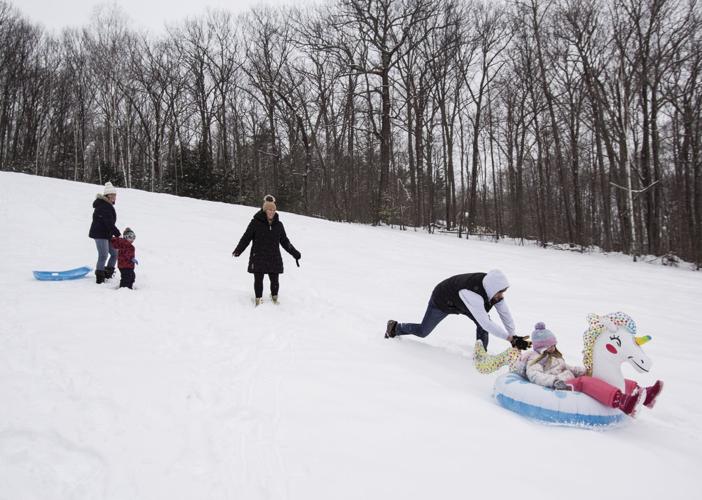
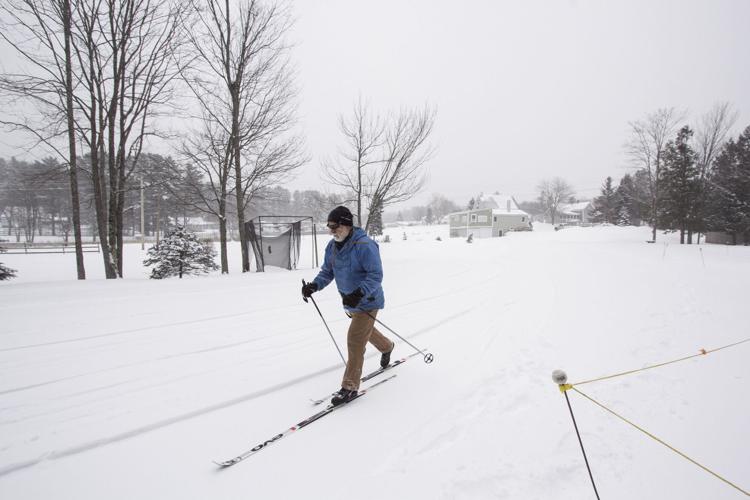
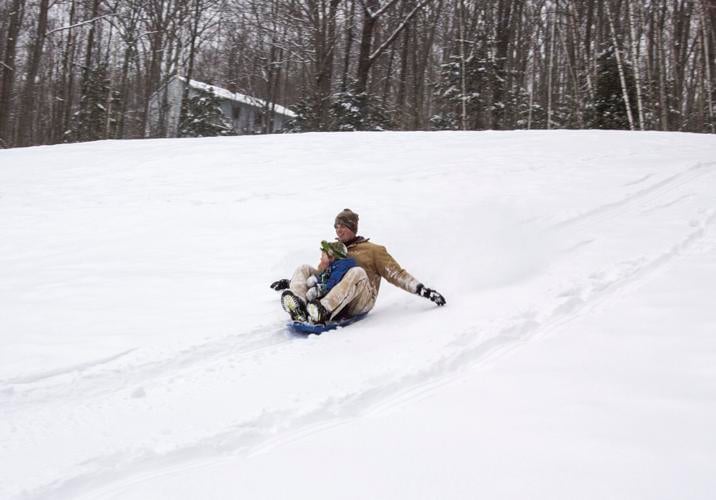
Students in the Lakes Region woke up Thursday morning to see a thick blanket of fresh snow, with more falling, and regular school canceled for the day. But how they were able to spend that day varied depending on what town they lived in.
Even prior to the pandemic, some districts were beginning to employ “blizzard bags,” collections of prepared materials that students had at home already, so they could do enough learning at home on a snow day so the district wouldn’t have to make up that day at the end of the year. Then, when COVID forced the closure of in-person education, districts, teachers and students had to learn overnight how to master the skill now known as “remote learning.”
With the ability to virtually attend school now widespread, some districts have sought to employ remote learning whenever possible, if in-person education is unsafe due to weather. However, others have decided against such a strategy, instead allowing students and teachers the chance to spend snowy days as they did before, as an unexpected day off from the regular routine.
Inter-Lakes says ‘no school’
Mary Moriarty, superintendent of the Inter-Lakes School District, said that outside of the pandemic, her district has opted not to do remote learning, choosing instead to schedule another day of in-person instruction once the roads are clear.
“Our stance has been that the value of in-person time is so valuable that we want to work with kids face-to-face,” Moriarty said. “We want to seize every opportunity we can to make it an in-person day.”
Gilford says ‘remote school,’ unless ...
The Gilford School Board decided last fall to give students and staff one old-fashioned snow day each year, and to go remote, if reasonably possible, for any subsequent weather-related closures. Superintendent Kirk Beitler said that discussion was informed by community feedback.
“We surveyed parents in the past and teachers, people still like to have that traditional snow day. We try to start our winter off with one of those if we can,” Beitler said.
Gilford has provided Chromebooks for all staff and students, and “We do get a bang for our buck when we do a remote learning day,” Beitler said.
Connecting remotely isn’t something that’s unique to the K-12 crowd, Beitler added. The ability to learn and work from home is something Gilford students will likely need to do later in life.
“Since the pandemic happened, there’s a lot of people working remotely now, and those jobs will just expand. Even in college, kids are often taking one of their classes remotely,” Beitler said. “I do think it’s a skill that students will use, whether it’s going to college or going into the workforce.”
From an educator’s perspective, Beitler said he understands the argument that a remote day is not as valuable as an in-person day. But, he said, it’s a more complicated equation.
“You have to weigh between a remote learning day in the middle of February, and an in-person day on June 20-whatever,” he said. If the school year runs too far into summer weather, students’ minds might not be present in the classroom, even if their bodies are.
Even in a district that is more pro-remote than others, Gilford still has its reservations. If it seems like the type of weather that could result in power outages — wet snow, ice, strong winds — Beitler would call for an old-fashioned snow day. If the storm comes on the Friday before a vacation week, it isn’t realistic to expect high participation rates on a remote day. And he said there’s a limit to how many remote learning days his staff and students would tolerate.
“When we get to three or four remote learning days, that probably feels like enough for us,” Beitler said.
Laconia says no school initially, but ...
“Basically, the first [snow day] is no school for staff and students,” said Steve Tucker, superintendent of Laconia schools. After that, there’s a progressive plan.
The first snow day for Laconia came on Dec. 16, giving students and staff a day off. The next one was Jan. 20, which was already scheduled to be a no-school day for students so staff could pursue professional development; that work was transitioned to a remote training module so teachers could complete their development at home.
The third snow day, on Jan. 23, was off, again, for students, while teachers were asked to connect with their team members and work on planning and other work. The same plan expectations were in effect for the fourth snow day, which occurred on Thursday. Part of teacher expectations were to prepare for remote instruction.
Only if there’s a fifth, or subsequent, snow day, will students be expected to engage in remote learning, Tucker said.
The plan reflects the many concerns that the district balances when making the decision, he said. At play are the instructional expectations that the state Department of Education has for the district, the contractual agreements between the district and the teachers and consideration of the effect the snow day plan will have on families throughout the city.
The pandemic experience proved a couple of things, Tucker said.
“I think that school districts around the country pivoted to remote and made it work,” Tucker said, but, “I think the reality is that remote is challenging.”
During the pandemic, the high school found that around 10% of its students lacked reliable access to the internet while at home, he noted. And, especially for younger students, it’s likely that adult support at home would be necessary for remote learning to be effective. Many parents still have to work on snow days, so they would already be scrambling to secure care for their children; finding care providers that could also help lead them through remote learning would make that burden yet greater.
“Parents have to shift and accommodate their schedules when we pivot to remote. We have parents that work and try to manage a household and manage a job, we have staff who live in different districts. It’s hard if we have inclement weather days,” Tucker said. “I think for all those reasons and more, it’s really hard on staff and families.”
Yet, those same burdens can reappear in late June, if a snowy winter leads to a week of additional school added onto the calendar, which is why Laconia will employ remote learning on the fifth and subsequent snow day.
Snow day assignments
There can be a kind of peace provided by a winter wallop, a humble sacrificing of daily plans to the altar of Mother Nature.
Beitler said that’s something that isn’t lost on school superintendents. He recalled one storm, a few years ago, that sprang to mind.
“They predicted we were going to get 3 or 5 inches, and we got 40 inches. That was a crazy day,” he said.
He had canceled school, but many staff, especially administrators, still tried to come into work that day. “It was absurd how much snow was in Gilford. We got out of here as quick as we came in,” he said.
“When you say the phrase ‘snow day,’ I think there’s an expectation that goes along with that, and I get that,” Tucker said. “I hope that our staff and students, on a traditional snow day, that people have a chance to sleep in, that people get outside and enjoy New England weather, and I hope that people spend time with family, because those times are precious.”
Moriarty said canceling school can make space for something else.
“We do live in a beautiful area. Sometimes the chance for kids to get outside, play in the snow, that’s a healthy thing, too,” she said. “Play outside, and read when you get in.”


(0) comments
Welcome to the discussion.
Log In
Keep it Clean. Please avoid obscene, vulgar, lewd, racist or sexually-oriented language.
PLEASE TURN OFF YOUR CAPS LOCK.
Don't Threaten. Threats of harming another person will not be tolerated.
Be Truthful. Don't knowingly lie about anyone or anything.
Be Nice. No racism, sexism or any sort of -ism that is degrading to another person.
Be Proactive. Use the 'Report' link on each comment to let us know of abusive posts.
Share with Us. We'd love to hear eyewitness accounts, the history behind an article.