


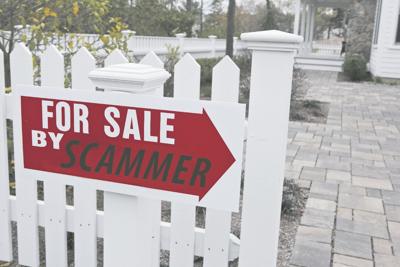
LACONIA — A fraudulent scheme is making waves through the Lakes Region real estate market in recent weeks with local agents receiving shady inquiries from scammers intent on stealing thousands of dollars from unsuspecting buyers.
Real estate agent Tracy Jenkins of The Legacy Group, Keller Williams Coastal and Lakes & Mountains Realty, has received several fishy propositions since Feb. 5. The interactions all follow a similar pattern: an agent receives an email from a person purporting to be the owner of a vacant property.
“Talk to your neighbors,” she said. “Ask them to look out for the property and have eyes on the land. Keep a look-out for 'for sale' signs in the yard.”
The sellers are always in a hurry to offload “their” property, preferring transactions to be completed in cash and be wrapped up as soon as possible. Those are magic words for a real estate agent or prospective buyer.
But after some digging, Jenkins noticed serious red flags on multiple occasions. In one example, she explained, the fraudulent seller attempted to convince her he was a deceased homeowner, insisting the record of his death was inaccurate and provided a clearly-doctored driver’s license.
When Jenkins contacted the property owner listed on a government information services network, the owner explained her husband had been deceased 19 years.
“The real owner never would have seen a sign on the property,” Jenkins said. “They aren’t in the area and they can’t easily check on their property in person.”
Most of these cases have a few things in common: The true owner of the property nearly always resides out of the area, rendering them unable to check on the property in person or notice a “for sale” sign in the yard; fraudulent sellers impersonate the out-of-state owner, ask an agent to conduct a market analysis and then insist on listing the property for sale at a steep cut-rate; and the fraudsters refuse to speak with an agent on the phone or to meet them in person, only communicating via email and text messaging, and the messages are clearly cut-and-paste with odd grammar and phrasing.
One way out-of-state owners can protect themselves is by putting a lien on their property, Jenkins explained. For a title to be transferred, the property deed must be clean. And an agent will never send an email containing instructions to wire transfer money.
Michael Gates of Illinois owns a vacant lot on Endicott Street near Plantation Beach. He closed on that property in 2019, but recently received a voicemail from a Lakes Region real estate agent who was about to close another deal on his property for $90,000.
But Gates’ property isn’t for sale.
“I’m in Illinois,” he said. “I don’t know if there’s a ‘for sale’ sign in my yard in New Hampshire.”
That agent told Gates the sign had been in his yard for over a week. The fraudster had forged his driver’s license and email address.
“They’re preying on people who own property but don’t owe [the bank] anything,” Gates said.
That deal nearly closed. Soon thereafter, Gates received a call from Jenkins, who was skeptical regarding another deal for the property.
“I don’t understand how it could be so easy,” Gates said. “This is insane that this is happening — I’m going to put a lien on my own property.”
There are three other buyers who have sought fraudulent offers in the same area, all of them properties with beach rights, he noted.
“We’ve got to change some laws and this stuff shouldn’t be public knowledge,” he said. “It is what it is, we live in a different world. Those computers are really good and they’re really bad.”
Gates said property owners, especially those who live out of state, need to take steps to protect themselves from fraud.
“You have to call,” he said. “Make sure you have title insurance and put a lien on your property.”
The Laconia police department is looking into two cases of real estate fraud in the area, Chief Matt Canfield said Friday.
“This one is unique,” he said. “It’s difficult to investigate.”
Thieves mask their real phone number and make it look as though the call is local, he said. Often, the real number is traced overseas, which makes investigating and ultimately prosecuting such cases difficult.
The two cases have numerous similarities and suggest a similar modus operandi, he said. His intuition is they’re likely connected, but police don’t know enough to say for sure.
“If someone gets a call like this,” he said. “If it looks too good to be true, it probably is. It’s very important that agents work to verify a caller’s identity. In this day and age, people really have to be on guard.”
It’s likely the fraudsters are searching on a database such as the Vision Government Solutions page, which lists property information including the names of the owners and the address as a matter of public record, real estate agent Brie Stephens of Lake Life Realty said Wednesday.
“We’re seeing that as well,” she said. “It’s been rampant just in the last two weeks. It’s costing us money as well because we pay for certain lead sources and certain ads. They’re using the tax GIS database systems and pulling tax information for the listings and the homeowners have no clue that this is going to happen to them.”
There are several warning signs property owners and agents should be aware of.
“The biggest red flag is the unavailable aspect over the phone,” she said. “We haven’t had the opportunity for it to go much further than their initial contact.”
Stephens noted agents should make certain to thoroughly interrogate the legitimacy of potential sellers, take the extra step of getting them on the phone to have an in-depth conversation and to pay attention to the grammar in phishing emails.
“It’s tough and it’s getting tougher as people are getting access to these documents,” she explained.
Area agents have seen a massive uptick in this sort of scam in recent weeks, Crystal Bullerwell of Keller Williams said Wednesday.
“It’s new as of the past year or so,” she said. “Keller Williams is seeing a lot of it.”
She noted the scam has been running rampant in Maine for much longer, likely due in part to lower prices there.
“Make sure that you have title insurance on your property,” Bullerwell said, explaining title insurance can help to protect a homeowner against such cases of fraud. “Continuously make sure that you check with city [property] listings.”
Scammers are also using fully-electronic means of contacting agents. Instead of calling an agent, the scammers tend to use third-party lead sites.
“Both of my leads are coming directly from Realtor.com,” she noted. “I’ve never gotten contacted directly by somebody from that website before.”


(0) comments
Welcome to the discussion.
Log In
Keep it Clean. Please avoid obscene, vulgar, lewd, racist or sexually-oriented language.
PLEASE TURN OFF YOUR CAPS LOCK.
Don't Threaten. Threats of harming another person will not be tolerated.
Be Truthful. Don't knowingly lie about anyone or anything.
Be Nice. No racism, sexism or any sort of -ism that is degrading to another person.
Be Proactive. Use the 'Report' link on each comment to let us know of abusive posts.
Share with Us. We'd love to hear eyewitness accounts, the history behind an article.