


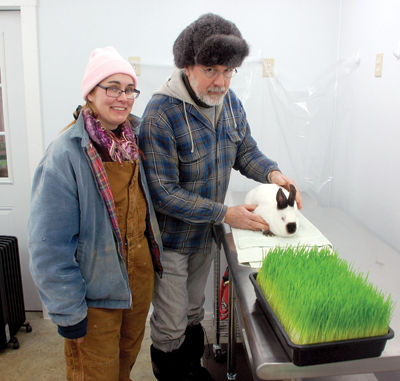
Steve and Kay Doyon with "Koko," a fine example of the Californian breed, one of more than 40 breeding does in their rabbitry at Song Away Farm in Loudon. (Laconia Daily Sun photo/Michael Kitch)
By MICHAEL KITCH, LACONIA DAILY SUN
LOUDON — "Education is our marketing campaign," said Steve Doyon, an engineer with the Dam Bureau at the New Hampshire Department of Environmental Services, who with his wife Kay, a nurse, has been raising rabbits for restaurant tables and family kitchens at Song Away Farm for the past five years.
Kay said that despite culinary and nutritional qualities of rabbit, it has been slow to gain popularity in New England. She explained that rabbit, while very high in easily digestible protein, is low in both fat and cholesterol and rich in minerals and low in calories compared to other meats. In southern states, she said, rabbit is commonly served in hospitals, especially to patients with digestive disorders.
In 2014, New Hampshire enacted a statute allowing certified farms to sell as many as 1,000 rabbits to restaurants without undergoing inspection by either the New Hampshire Department of Agriculture, Markets and Food or the United States Department of Agriculture. Today Steve said that by catering to a number of restaurants, "We are selling what we produce."
The Doyons began farming in 2002, when the news was rife with reports of tainted foodstuffs. They began with chickens, then added turkeys and pigs.
"The tom turkeys bark like a dog," Kay said, "and if we could hear them, our neighbors could hear them. And the pigs were a lot of work."
"We were dabbling," said Steve, "and about five years ago we focused on rabbits."
Most of their stock are Californians, snowy white with black ears, noses and feet, which share space with some New Zealands and Americans, both white rabbits. The rabbitry, a dedicated space in the barn always filled with music and kept above 40 degrees, is lined with spacious cages, some with boxes filled with straw where breeding does give birth and rear their kits, others holding a lone breeding buck or doe and still others alive with growing rabbits.
"We buy only from certain breeders and may quarantine new rabbits. We're very selective," she said, stressing that their goal is to improve the breed as well as produce meat by working with "show quality" stock. The ideal rabbit, Steve explained, has the shape of a toaster — square with rounded corners — with weight in the haunches and along the back. "Every rabbit has a name," she said, their health and breeding schedule closely monitored and recorded.
Steve said that does are bred between 6 and 10 or even 14 weeks between litters, depending on their condition.
"We don't work them too hard," he said, adding that breeding does are retired after about three years, again depending on their condition and size of their litters. He calculated that they breed four times a year and average litters of seven kits, the 45 breeding does produce more than 1,250 rabbits.
The rabbits are fed a varied diet, high in protein and fiber, of organic alfalfa pellets, oats, barley, hay and sunflower, along with homegrown organic wheat fodder in winter and fresh garden greens in spring and summer. They are raised without antibiotics or hormones and packaged without preservatives or additives.
The Doyons raise "fryers," rabbits that reach four-and-a-half to six pounds in weight within 9 to 11 weeks, which represents between two-and-a-half and three-and-a-half pounds of meat. fetching about $7 per pound. Fryers, Kay explained, are the most tender and versatile rabbits, suited to the widest variety of recipe. Steve said that, with their breeding regimen, each doe produces between 60 and 70 pounds of meat in a year, a fraction of the output of large commercial operations where does are bred every four or five weeks. He added that rabbits, common prey in their natural environment, are sensitive animals prone to stress and do not fare well under factory farming conditions.
Rabbit from Song Away Farm is served at a number of restaurants, including Tek-Nique in Bedford, the Granite Restaurant at the Centennial Inn in Concord and Moxy and the Black Trumpet , both in Portsmouth.
Evan Mallet, the chef and owner of the Black Trumpet, guessed that a half-dozen restaurants in Portsmouth serve rabbit from time to time. He recalled that dining on rabbit in 1998 "got me back in the kitchen after years as a food writer." But, when China became the sole source of rabbits, the quality was so poor that he struck it from the menu.
"The Doyons," he said, "were the key to the success of getting rabbit back on our menu. Their rabbits are the most favorful and consistent," he said. "Just sensational."
Currently he is serving rabbit paella, featuring meatballs, snails, peppers, leeks and mushrooms.
"The meatballs are to die for," Doyon remarked.
Kay said that rabbit, like chicken, to which it is often likened, takes on the flavors of the seasonings and spices it is prepared with and can be substituted for chicken in a variety of recipes.


(0) comments
Welcome to the discussion.
Log In
Keep it Clean. Please avoid obscene, vulgar, lewd, racist or sexually-oriented language.
PLEASE TURN OFF YOUR CAPS LOCK.
Don't Threaten. Threats of harming another person will not be tolerated.
Be Truthful. Don't knowingly lie about anyone or anything.
Be Nice. No racism, sexism or any sort of -ism that is degrading to another person.
Be Proactive. Use the 'Report' link on each comment to let us know of abusive posts.
Share with Us. We'd love to hear eyewitness accounts, the history behind an article.