


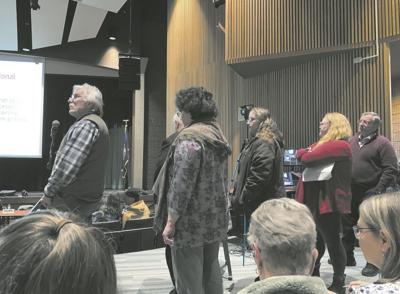
BRISTOL — Voters at the Newfound Area School District’s Feb. 3 deliberative session increased the proposed operating budget by $616,041 in order to restore seven teaching positions and money for field trips that was stripped from the budget in order to keep spending within the district’s tax cap.
The increase brings the amount appearing on the March ballot to $27.97 million, or $206,369 more than the default budget figure.
Voters also amended two petitioned articles targeting the teaching concept known as social-emotional learning to instead form a study committee to review what SEL is and the fears that have arisen about its use.
Bristol resident Rick Alpers, a member of the district’s budget committee, offered the amendment to increase spending to cover the cost of the elementary school teacher, two middle school teachers, two high school teachers, a support staff member at the high school, and a district-wide teacher whose positions were unfunded because the district’s tax cap limits the increase in the property tax assessment to the seven member towns to 2% a year.
The amendment added $544,091 for the teaching positions and $71,950 for the field trips that also had not been funded.
The tax cap allowed $474,420 in additional spending compared to the current-year budget, but contractual obligations and a 16.4% increase in health insurance, along with other spending priorities, would have resulted in an operating budget $1.846 million higher than the allowed appropriation.
Interim Superintendent Steve Nilhas told the crowd the administration is looking into cheaper options for health insurance, but the teachers’ contract requires equitable benefits unless they reopen negotiations on health benefits.
“I sound like a broken record at this point, after five deliberative sessions in a row,” Alpers said. “I think we’ve come very far as a district, I think, academically, with our facilities, improvements all around ... [T]he academic growth of our students is incredible. The reasons it’s better is because we fund the staff positions we need to educate our children. So I ask you to join me here today in approving this amendment, and then getting the vote out in March to get it passed.”
Rep. John Sellers of Bristol asked why the default budget would not preserve the current teaching positions. The default budget is calculated to continue current spending levels for school operations, with adjustments to exclude one-time expenditures and add money to cover contractual obligations.
Sellers noted the central office had removed $9,000 of one-time expenditures when calculating the default budget figure of $27.77 million.
“If the voters vote this default budget in, it’s the budget that you guys are running this year, right now,” Sellers said, “... with all the contractual increases that are necessary: the teacher raises, the retirement funds, and also insurances. So nothing has been cut but $9,000.
“What’s going on here, by adding this half a million dollars in, or more, is a sleight of hand,” he said. “The voters in March will have a choice of $27.766 or $27.972 [million] and change. So no matter what, the voters in March, if they vote one budget or the other, everything will be funded.”
Nilhas pointed out the current spending that is the basis for calculating the default budget does not include positions that remained unfilled because no one applied, and he said that was one example of the things the district runs into each year.
“It has to do with a lot of factors: post-pandemic factors, hiring factors, and then the fact that, into this year, costs have gone up significantly in a lot of areas that, frankly, the default budget doesn’t account for.”
Addressing the school district’s history of having more than a million dollars leftover at the end of the year, Nilhas said, “I can guarantee that there won’t be a million dollars left over [this year].”
Erin Edwards of Hebron, a teacher at the middle school, complained that “we’re creating a school system where we have a lot of teachers who are feeling insecure about their jobs. There are cuts every year, people feel like they have to fight for them, and they can go elsewhere and get paid more and not have to sweat it out each year, whether or not they’re going to be able to keep their jobs.”
The amendment easily passed on a voice vote.
Throughout the four-hour meeting, the majority of the discussion revolved around the role of social- emotional learning and the costs associated with it.
The core concepts of social-emotional learning — teaching the life skills necessary to be successful, such as building confidence, friendship, teamwork, decision-making, and character-building — have been part of public education since the beginning, but its expansion into the areas of psychological support, such as managing emotions, has attracted criticism and anger. Broadening the approach to education has pitted residents against administrators, teachers, and the parents whose children have benefitted from the interventions.
Many in the audience during the deliberative session opposed the entire concept of social-emotional learning, giving examples of being left in the dark about what services were being provided to their children. Lead complainant Marie Carson of Alexandria quoted from a department of education meeting transcript in which several speakers advocated ways to get around privacy rights.
She quoted one speaker as saying, “Services provided in schools that are not reimbursed through insurance are not technically subject to HIPAA [the Health Insurance Portability and Accountability Act of 1996], so your child’s medical records are not protected under HIPAA. To what degree do folks need or want to inform the parents about the data being shared in our platform? The bottom line is you are not required to because you fall under your FERPA [Family Educational Rights and Privacy Act] protections.”
FERPA provides that parents have a right to the records, but states, “Schools are not required to provide copies of records unless, for reasons such as great distance, it is impossible for parents or eligible students to review the records. Schools may charge a fee for copies.”
Of special concern to the families is the FERPA statement, “FERPA allows schools to disclose those records, without consent,” to school officials with legitimate educational interest; other schools to which a student is transferring; specified officials for audit or evaluation purposes; appropriate parties in connection with financial aid; organizations conducting studies for or on behalf of the school; accrediting organizations; to comply with a judicial order or subpoena; to officials in cases of health and safety emergencies; and to state and local authorities within a juvenile justice system.
“So if your child has a medical record here at Newfound,” Carson said, “it is being shared with outsiders. If you’re OK with that, fine. But I’m not.”
The majority of the speakers supported SEL and gave impassioned testimony about their personal experiences with the success in overcoming trauma and suicidal tendencies, building social skills, and the ways that social-emotional learning boosts academic performance.
There were two petitioned articles that must appear on the ballot. One would have ceased the use of social-emotional learning, and the other would have required parental permission each time its concepts were used.
Opponents pointed out how unworkable the passage of those articles would be, essentially blocking any effort at teaching. Instead, the body amended both articles to form a study committee to examine SEL and make a recommendation next year.
Petitioners challenged Moderator Ned Gordon’s ruling, backed by the school district attorney, that the amendments were germane to original articles. Put to a vote, the majority sustained Gordon’s decision on the legality of replacing the language in the petitioned articles.
Gordon managed to keep the emotional meeting civil but three times had to remind the citizens to be courteous. Two occurred when several people jeered and drowned out Sellers and Carson as they spoke. The third was a reprimand to school board member Tom Edwards of Hebron, who stood and called out, “All the people are ignoring the parents.”
“No, please sit down,” Gordon chastised him.


(0) comments
Welcome to the discussion.
Log In
Keep it Clean. Please avoid obscene, vulgar, lewd, racist or sexually-oriented language.
PLEASE TURN OFF YOUR CAPS LOCK.
Don't Threaten. Threats of harming another person will not be tolerated.
Be Truthful. Don't knowingly lie about anyone or anything.
Be Nice. No racism, sexism or any sort of -ism that is degrading to another person.
Be Proactive. Use the 'Report' link on each comment to let us know of abusive posts.
Share with Us. We'd love to hear eyewitness accounts, the history behind an article.