


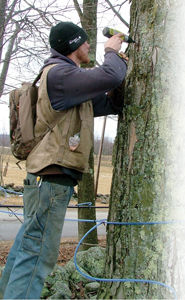
Jeff Moore of Windswept Maples in Loudon taps trees along Loudon Ridge Road.
By Roger Amsden
FOR THE LACONIA DAILY SUN
The New Hampshire maple syrup season is off to a quick start, thanks to an unusually warm winter.
Jeff Moore of Windswept Maples on Loudon Ridge Road in Loudon says that he and his brother and father, Larry, held their first boil of the season Tuesday, which produced 160 gallons and that they have been collecting sap since last Wednesday.
Yesterday marked their second boil of the season, a marked contrast with last year, when a cold winter kept the operation from getting into full swing until late March.
He said that sap starts flowing when temperatures stay below freezing overnight and rise above freezing during the day with ideal conditions having temperatures ranging from mid-20s at night to the to mid-40s during the day.
"It's quite a bit earlier than last year but there's no such thing as a typical year for making maple syrup," Moore said. "It's all weather dependent."
He says the farm has 8,500 taps and last year made 3,300 gallons of syrup. It has a vacuum system that sucks the sap from the trees as well a reverse osmosis system at its sap house which removes more than half of the water from he sap before it is boiled.
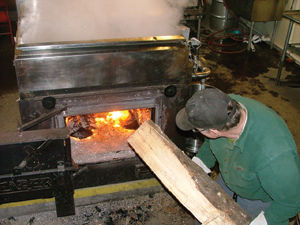
He said that new high efficiency arch for the boiler along with the reverse osmosis system greatly reduces the amount of wood used to boil the syrup down.
"Before the reverse osmosis system was installed, we used 35 cords of wood to produce 3,000 gallons of syrup," said Moore. "Last year, we only used 14 cords of wood to make 3,300 gallons."
Windswept Maples is one of the few remaining major maple syrup producers to continue to use a wood-fired boiler. Most other large producers have switched to oil-fired or natural gas systems.
Moore said that work on tapping the trees started on Jan. 10 this year and that 6,000 had been tapped at the start of the week.
"We've got one orchard left to tap. It's really the most important work we do all year and you have to take your time and do it right. If bacteria grows at the tap site you lose your production much faster," said Moore.
Jim Fadden of North Woodstock, president of the New Hampshire Maple Producers Association, said family records going back to the 1940s show that this year is very unusual with such an early start.
"Typically, maple season doesn't start until around Town Meeting time in mid-March. But over the last 10 to 15 years we've had more early starts than I can remember. This year, farms on the Seacoast and in the Wilton area were boiling in late January. There's even a farm in Lancaster which is starting to boil this week. I haven't started yet, and it looks like the cold weather will be coming back soon and shutting things down."
He said he has about 10,000 trees tapped on Lost River Road and produces about 3,000 gallons a year.
He said last year was a good year for New Hampshire maple producers, who made 120,000 gallons of syrup, compared 112,000 gallons in 2014 and 124,000 gallons in 2013. The year 2012 was a bust, however, with only 76,000 gallons produced.
Larry Moore of Windswept Maples in Loudon loads wood into the boiler at the farm’s sugar house yesterday. It was the second boil this week for Windswept Maples and one of the earliest starts to making syrup in the farm’s history. (Roger Amsden photo for the Laconia Daily Sun)
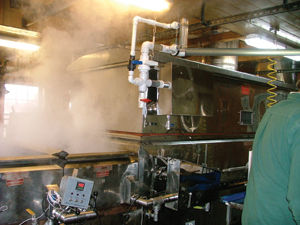
Steam rises from the evaporator at Windswept Maples in Loudon as they boil the maple sap for the second time this year. (Roger Amsden photo for the Laconia Daily Sun)


(0) comments
Welcome to the discussion.
Log In
Keep it Clean. Please avoid obscene, vulgar, lewd, racist or sexually-oriented language.
PLEASE TURN OFF YOUR CAPS LOCK.
Don't Threaten. Threats of harming another person will not be tolerated.
Be Truthful. Don't knowingly lie about anyone or anything.
Be Nice. No racism, sexism or any sort of -ism that is degrading to another person.
Be Proactive. Use the 'Report' link on each comment to let us know of abusive posts.
Share with Us. We'd love to hear eyewitness accounts, the history behind an article.