


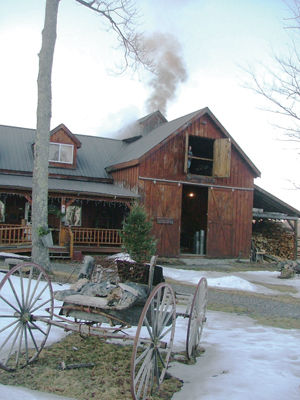
Steam rises from the evaporator and smoke billows from the fire heating sap at Heritage Farm in Sanbornton. (Roger Amsden/Laconia Daily Sun)
By ROGER AMSDEN, The Laconia Daily Sun
SANBORNTON — Maple season is in full swing at Heritage Farm on Parker Hill Road here, where Matt Swain has 1,800 trees tapped and is looking at making 400 gallons of maple syrup this year.
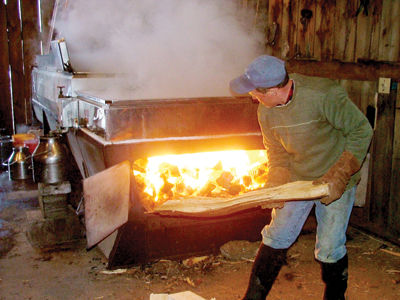
Swain, who held his first boil of the season this week, said he likes to use pine slabs for their quick, intense heat which gets the collected sap, held in an 800-gallon steel tank which feeds into the large pans, boiling rapidly.
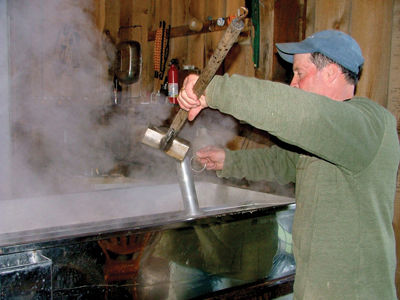
Once it is hot enough and sending off clouds of billowing steam, the hot sap is drawn off and finished in a smaller, gas-fired evaporator that brings it to the syrup state. It is then strained and bottled, each gallon produced from about 40 gallons of sap.
Swain said that generally he has some 2,500 trees tapped, 500 of which have old-fashioned buckets, with sap from the rest of the trees collected through a system of plastic tubes.
"Most years we do 450 to 500 gallons," said Swain. There about 7,000 maple trees on the property.
He's the third generation of his family to make maple syrup and grew up at the Swain Farm, about a mile away.
"My grandfather, Frank, started making syrup in a converted icehouse near Hunkins Pond," he said. "After it burned, a new one was built up above the farm and my father David and I made syrup there until 2004, when we moved it here."
David Swain, the last dairy farmer in Sanbornton, died at the age of 80 on Christmas Day last year.
The Heritage Farm sugarhouse is located in a timber frame barn with an attached pancake house and was built from lumber harvested on the farm property and sawed into boards with a portable saw mill.
The pancake house will open this weekend from 8 a.m. until noon for pancake breakfasts. Visitors can also view maple syrup operations.
Swain said the sap he’s collected so far this year is not as sweet as usual and has about a 1.5 percent sugar content, instead of being closer to the 2 percent range he usually sees.
Normally, he uses about 30 cords of wood during maple season, which he said seems to be trending toward earlier starts in the last decade and also ends earlier than it used to.
Larry Moore of Windswept Maples on Loudon Ridge Road in Loudon also said he has seen the season start earlier than it used to decades ago.
“We had our first boil this year in January, when we had warm weather right after a long cold spell. As of this week, we’re at about half of our normal production with 1,600 gallons,” says Moore.
He said that the sugarhouse, which was built in 1999, had its first ever boil on March 1 that year.
Moore says the farm has 8,500 taps and last year made 3,300 gallons of syrup. It has a vacuum system that sucks the sap from the trees as well a reverse osmosis system at its sap house which removes more than half of the water from the sap before it is boiled.
He said that new high efficiency arch for the boiler along with the reverse osmosis system greatly reduces the amount of wood used to boil the syrup down.
“We used to use a cord of wood to produce 25 gallons of syrup. Now we’re getting 250 gallons from a cord,” said Moore.
He said Windswept Maples is one of the few remaining major maple syrup producers to continue to use a wood-fired boiler. Most other large producers have switched to oil-fired or natural gas systems.
Moore said that sap starts flowing when temperatures stay below freezing overnight and rise above freezing during the day with ideal conditions having temperatures ranging from mid-20s at night to the to mid-40s during the day.
The North American Maple Producers Council says New Hampshire usually produces between 70,000 and 90,000 gallons of syrup a year. 1986 was a record year for the state with 102,000 gallons.
But that pales in comparison to Vermont, which produces around 500,000 gallons a year, some 60 percent of New England's annual production of 850,000 gallons. Maine produces about 230,000 gallons a year.
• • •
NH Maple Syrup Weekend - March 24-25
Sugar makers open their doors to the public to demonstrate the centuries-old craft of maple sugaring.
Hosted by the New Hampshire Maple Producers Association, the 23rd Annual New Hampshire Maple Weekend will be held March 24–25.
Across the state, sugar makers open their doors to the public to demonstrate the centuries-old craft of maple sugaring.
Visitors can enjoy free samples of fresh syrup, maple candies and confections, coffee and doughnuts. Some locations offer pancake breakfasts, petting farms or horse-drawn rides.
Participants in and around the Lakes Region include:
Hutchinson’s Family Sugar House, Hackleboro Road, Canterbury
Just Maple, School Street, Tilton
Lamb’s Maple Syrup, Shaker Road, Canterbury
Mud Season Maples, Rte. 129, Loudon
Pearl and Sons, Loudon Ridge Road, Loudon
Red Roof Maples, Pleasant Street Extension, Loudon
Shepherd’s Hut Market, Morrill Street, Gilford
Smith Farm Stand, Morrill Street, Gilford
Still Seeking Farm, Loon Pond Road, Gilmanton
Sunnyside Maples, Route 106, Loudon
Todd’s Sugar Works, Rogers Road, Belmont
Windswept Maples, Loudon Ridge, Loudon
See nhmapleproducers.com/maple-month.
Matt Swain tests the maple syrup, which is in the final stage of production in a gas-fired evaporator. (Roger Amsden/Laconia Daily Sun)
Matt Swain loads the evaporator at Heritage Farm with pine slabs. He said the maple season started early this year at the Sanbornton farm and is now in full swing. (Roger Amsden/Laconia Daily Sun)


(0) comments
Welcome to the discussion.
Log In
Keep it Clean. Please avoid obscene, vulgar, lewd, racist or sexually-oriented language.
PLEASE TURN OFF YOUR CAPS LOCK.
Don't Threaten. Threats of harming another person will not be tolerated.
Be Truthful. Don't knowingly lie about anyone or anything.
Be Nice. No racism, sexism or any sort of -ism that is degrading to another person.
Be Proactive. Use the 'Report' link on each comment to let us know of abusive posts.
Share with Us. We'd love to hear eyewitness accounts, the history behind an article.