


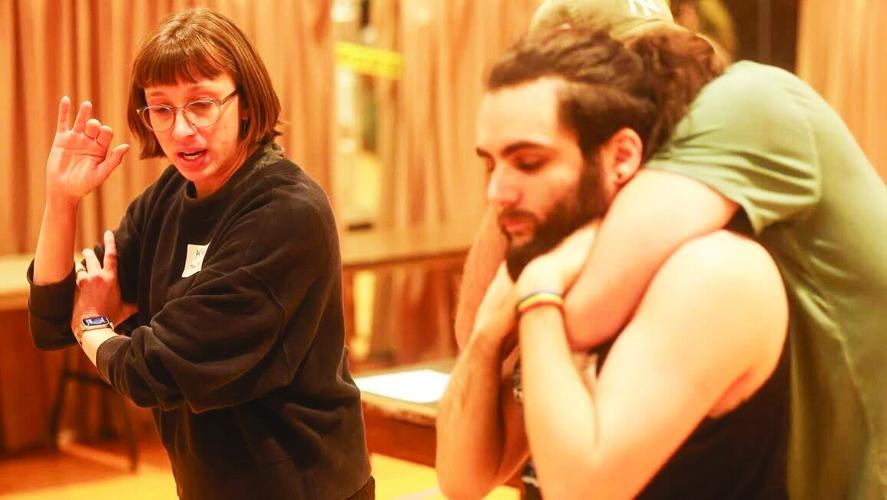
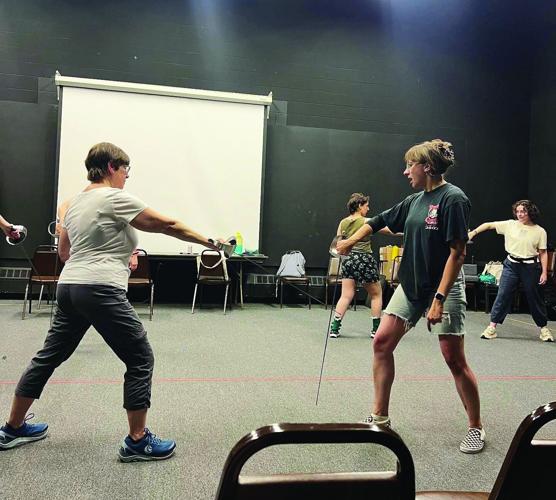

Fight and intimacy director — Kyrie Ellison’s title — often catches people’s attention as they read through a playbill.
“I facilitate spaces in which directors and actors can have vulnerable and meaningful experiences with audiences,” is often how Ellison often eases into the conversation.
Essentially, the work is coaching actors involved in fight scenes or romantic stage interludes to help them understand — very specifically — what’s being asked of them, establish and articulate their boundaries, and choreograph movements that feel safe, authentic and resonant for all involved.
Just what it sounds like, in other words. Fight and intimacy director.
“This work is deeply important,” said Ellison, who uses they and them pronouns. “It’s still fairly new, especially in New England and New Hampshire.”
Up close and personal
At the start of every performance they undertake with companies such as the Winnipesaukee Playhouse in Meredith or theatre KAPOW in Concord, Ellison first reads the script and tracks, on a spreadsheet, any moments of possible contact between actors.
Ellison then collaborates with the director to gather ideas, and begins the process of getting to know each actor individually.
“I ask if there is anything in the script content they have questions about, are excited about, need more info about,” they said. “These questions help me better understand moments where actors might need more information before consenting to a storytelling moment.
"Just because it says so in the script doesn’t mean we have to do it.”
Listening, elaborating, collaborating, discussing and getting creative and are all part of tapping into what's possible, and working past what doesn't feel right.
In one production in New Hampton, for instance, two high school students held the lead roles, and the script said they had to kiss in several scenes. “They were uncomfortable, so we took kissing off the table, and came up with a gesture that was intimate and personal, and used it any place where a kiss was scripted,” Ellison said.
The actors, rather than kissing, placed their fingertips together and tapped them while going up and down on their toes.
“It was so sweet and genuine and disarming, and fit both of their characters perfectly, and was somehow more intimate than watching two people kiss,” Ellison said. “I facilitate the autonomy of the individual. I’m empowering actors to make decisions that feel right and true to themselves, not to the idealized character of a page.”
Conversation is key in mapping out fight scenes, as well.
In “Witch,” performed at the Winnipesaukee Playhouse last summer, the director called for one particular fight scene to be bloody, visceral.
“The two [same-sex] characters in the show were rivals for status, and one was in love with the other, but due to gender and time, it wasn’t possible for them to be together,” Ellison explained. “That fight started with one character attempting to kiss the other.”
“Fight me instead” was the scripted response, uttered playfully.
With a huge dining room table in the scene, loaded with trays, food, goblets, pitchers and knives, everything within reach became a weapon, and the fight ended in death.
There were no particular boundaries for Ellison to help navigate in this situation, but neither actor had ever done a fight with knives or found objects, and neither had engaged in intimacy with someone of the same gender on stage.
“We worked hard to go slowly and be very specific about where hands, faces and objects would go,” Ellison said. “There was nervousness about contact with the throat. That was an area we stayed away from, which was fine.”
Every interaction, discussion and piece of choreography depends on each person, their history of touch or performance, or their life history. “I’ve worked with people who express that they are open to everything, and then we get into the work and some trauma they didn’t realize they had comes up, and we have to deal with it,” Ellison said. “Our brains know when we are pretending — when we’re acting — but our bodies don’t. When we’re vulnerable, our bodies react without our brains.”
Onstage from a young age
Ellison grew up in Loudon, and graduated in 2009 from Merrimack Valley High School in Pennacook. From the time Ellison was 10 and involved in community theater with the Acting Loft, they knew they belonged onstage.
“It was just a natural place for me. I took a lot of dance classes and gymnastics and sports, and musical theater was a place I could embody different characters and express and have fun and play pretend,” Ellison said. “It was easy, and it just felt right. It was something I never wanted to stop doing. Acting, dancing, singing.”
After earning a bachelor’s degree in musical theater at Russell Sage College in Troy, New York, Ellison moved to New York City, and had success in developmental theater, performing new works.
“I did well for myself, but around the time of 2016, I started to see a lot of my very talented friends get very burnt out and very tired. And a lot of them said it was because of the way directors spoke to them and made them feel dehumanized,” they said. “I had my own share of experiencing that kind of behavior in rehearsal rooms. I wondered if there was a better way.”
Ellison quit performance theater and began to research rehearsal practices. Then, on social media in 2018, they first heard the term “intimacy direction,” which first came into play in 2011, along with the #MeToo movement and #NotInOurHouse, which erupted over allegations of sexual harassment and abuse over the course of 20 years at Profiles Theatre in Chicago.
“All of these conversations about consent and autonomy and how we interact with actors when giving them direction began to be a part of something I was hearing quite regularly,” they said.
In 2019, Ellison enrolled at Sarah Lawrence College and two years later, earned a master of fine arts degree in theater, with a concentration in directing for intimacy and stage combat. Ellison and their husband moved back to New Hampshire, to their roots.
Educating the region
“I had a really hard time getting people in this area to engage with what intimacy direction is,” Ellison explained.
They emailed theaters and schools, offering workshops or conversations about consent-forward rehearsal spaces. “It was really hard to get people to respond.”
Then, the work clicked for theatre KAPOW, and Ellison engaged with Matt and Carey Cahoon for the 2022 season. That work led to a connection with the Winnipesaukee Playhouse, and Ellison also works at New Hampton School as associate director of theater.
They are much busier now. Fully engaged, and eager to share the learning and process with other companies.
Find them online at ellisonarts.com.
“There are a handful of us doing this work, and I think if a theater is interested in working with me or a colleague, cost is an easy barrier to think about,” Ellison said. “Many of us are willing to have these conversations in order to keep people safe and whole.”



(0) comments
Welcome to the discussion.
Log In
Keep it Clean. Please avoid obscene, vulgar, lewd, racist or sexually-oriented language.
PLEASE TURN OFF YOUR CAPS LOCK.
Don't Threaten. Threats of harming another person will not be tolerated.
Be Truthful. Don't knowingly lie about anyone or anything.
Be Nice. No racism, sexism or any sort of -ism that is degrading to another person.
Be Proactive. Use the 'Report' link on each comment to let us know of abusive posts.
Share with Us. We'd love to hear eyewitness accounts, the history behind an article.