


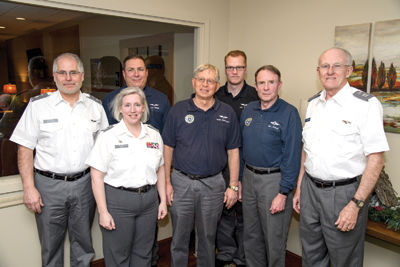
Several members of the Civil Air Patrol were recently recognized for their actions in locating and rescuing Randy Willett of Manchester from the White Mountains. From left are Lt. Col. Bruce Determann of Laconia, Capt. Darlene Cray, Lt. Donald Medine of Gilmanton, Lt. Col. Hank Dahlquist of Moultonborough, Lt. Eric Tierno of Gilford, Col. William Moran of Gilford and Capt. Bruce Neff of Laconia. (Alan MacRae/for The Laconia Daily Sun)
Civil Air Patrol members help rescue critically hypothermic hiker
By ADAM DRAPCHO, LACONIA DAILY SUN
LACONIA — Marooned aside a rockslide on the eastern side of Mount Lincoln, Randy Willett was in trouble. He had called 911, but had no idea where he was or how much longer he could survive. The one shred of hope he had, in between bouts of unconsciousness, was the sound of a small plane passing again and again over the crevice he had tucked himself into for shelter.
That was on May 4 of last year. This year, on Feb. 5, the local people who participated in locating Willett were honored in a meeting at Laconia Airport.
The honorees are members of the local squadron of the Civil Air Patrol, the civilian wing of the Air Force, who joined the multi-agency search that ultimately plucked Willett from the side of the mountain hours before he would have died from hypothermia.
Lt. Col. Bruce Determann of Laconia, Lt. Donald Medine of Gilmanton, Lt. Col. Hank Dahlquist of Moultonborough, Lt. Eric Tierno of Gilford, Col. William Moran of Gilford, Capt. Bruce Neff of Laconia and Maj. Scott Davis of Gilford were all presented with the Air Force Civil Air Patrol’s Rescue and Find award on Monday night.
Half of the Pemi Loop
Willett, a 53-year-old resident of Manchester, is a veteran hiker who set out for a solo multi-day hike on April 28. He hiked half of the Pemi Loop, making it to the top of Mount Bond, Guyot, Zealand, South and North Twin, and Garfield. The loop continued for five more mountains, completing a circle that would have taken him back to the trailhead. But Willett had already hiked those other peaks in his quest to reach the summit of all 48 of New Hampshire’s 4,000-footers, so he elected to take a trail that cut off half of the peaks and headed directly back to his starting point.
It had been warm when he started his hike — he recalled wearing shorts as he started on the trail. But he knew how quickly circumstances can change in the White Mountains, so he came prepared with a pack filled with 80 pounds worth of supplies. He had backup clothing, food and cooking equipment, a backpack and sleeping bag. What he didn’t have, though, was a pair of snowshoes.
“Post-holing”
The Loop trail took Willett mostly above treeline, and it was easy to stay on track. But the shortcut trail he took back descended, and soon he encountered snow — deep snow. Soon, he was “post-holing” — stepping on top of snow, only to have his foot punch through and have the snow swallow his leg up to his hip. In some cases, he fell into snow over his head and had to crawl his way back to the surface.
The deep snow made travel slow and exhausting. It also obscured signs or cairns used to mark the trail.
“I completely lost the trail. Even my GPS lost the trail,” Willett said.
As a backup, he had his cell phone for navigation. A phone’s battery won’t last several days, so he brought a device that could charge the phone through a small solar panel or with a hand crank. But there wasn’t enough sun for the panel, and the hand crank broke.
So, on Tuesday of that week, with little battery left and a weak signal, Willett made his first 911 call. He called because he hoped that the dispatcher would be able to tell from his signal where he was. Because of the rough terrain and weak reception, the call dropped before he could get a location.
Ninety seconds later, he called again, but that second call lasted only a few seconds.
The 911 system provided rescuers with an estimate of Willett’s location. However, there was good reason to doubt its accuracy. Each call had a different estimated position, and the two were a mile-and-a-half apart.
Meanwhile, Willett decided that, if he didn’t know where he was, his best bet was just to travel west, which would eventually bring him to Route 93. Two days later, on May 4, that route took him up the side of a mountain where there was a large rockslide that made further going tough. But, because of the exposure, he decided to check his phone, which was showing a good signal. He called 911 again, and this time he told the dispatcher that he was starting to question his decision-making, that hypothermia was clouding his mind.
“I always heard: If you don’t know where you are, stop. That’s a double-edged sword,” Willett said. He figured, at that point, his best option was to stay put on the side of the mountain so rescuers could find him. It wasn’t a nice place to spend time, though, exposed to strong and cold winds. As he sat and waited, his body temperature was slowly dropping. To try and stay warm, Willett did the only thing he could think to do: scream.
“That got my endorphins going to stay warm.”
Eyes in the sky
Earlier that day, Bruce Determann, a Laconia resident and the director of operations for the New Hampshire Wing of the Civil Air Patrol, was watching the morning news on TV and saw a report about a search for a mission hiker. He called fellow CAP member Bill Moran, who had just seen the same report. They contacted the New Hampshire Department of Fish and Game, which was heading the search, and offered to help.
“We’ve got a few tools we could bring to the search that none of the other agencies have, primarily a cell phone forensics team,” said Determann.
The CAP’s cellular forensics team, which includes a handful of experts spread around the country, gathers not just the data from the 911 call, but also data from other cell towers in the vicinity, then layers that information with topographical contours and analyzes those data sets with custom software. “They have been extremely accurate.”
Within an hour of contacting Fish and Game, the NH CAP had three planes in the air, which took off from airports in Concord, Laconia and Lebanon, and searched areas as directed by Fish and Game officials.
“The task was to cover areas, to see if we could visually locate him. At the same time, the forensics team was doing its research,” Determann said.
Within two hours of the first call to the CAP forensics team, they had generated a search area on the eastern slope of Mount Lincoln, with a 299-meter radius from a specific point.
Bruce Neff, of Moultonborough, was in the CAP plane that was launched out of Laconia. Hank Dahlquist was flying the plane, Eric Tierno was co-pilot, and Neff was in the back seat, acting as navigator and photographer.
Fish and Game first directed them to search Franconia Ridge, then the Pemigewasset Wilderness, but when they got the updated estimate from the forensics team, Neff said the flight crew was sure that Willett was within that 299-meter radius.
A small red light
“We were convinced that he was either there or nearly there. We flew by at least 20 times, but we couldn’t get visual contact with the person.”
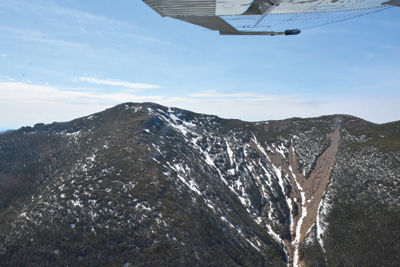
Neff’s photos from that day show a steep mountain slope covered in trees, streaked with rockslides and with fingers of heavy snow.
Neff and crew spent four hours searching the area, without success. Then Willett was able to summon the strength — and cell battery power — to dial 911 one more time. This time, the dispatch center was able to locate the source of the call to within the same radius that the forensics team prescribed. The CAP plane was ordered to leave the area so a National Guard crew in a Black Hawk helicopter could come in for a view.
By that time, the sun was sinking toward the horizon, and though the Black Hawk could fly much lower than the planes, the crew didn’t immediately spot Willett.
He wasn’t easy to see, Willett admitted. His clothing blended in with the color of the surrounding rock, and all of the tricks he knew to make himself visible didn’t work. It was too windy to start a fire, too cloudy to use a signal mirror, and whenever he tried to stretch out a bright piece of material, the wind blew it away.
It was a last-ditch effort, Willett said, that saved him. He saw the helicopter turn away, as if to leave, and he switched the light on his headlamp from white to red. The medic, looking out the open door of the chopper, saw it.
The terrain was so rough that the decision was made to use the helicopter to rescue the hiker instead of sending in a ground crew. That was a fortunate decision, because Willett would likely have been dead by the time rescuers could hike to his location. When he was hoisted back up to the helicopter, his pulse was recorded at 40 beats per minute and his core body temperature was 80 degrees.
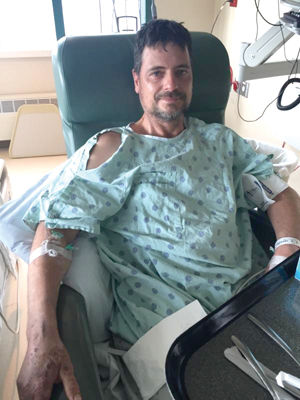
Usual protocol would be for the helicopter to land in a parking lot to transfer the patient to an ambulance. In this case, the pilot flew Willett directly to Dartmouth-Hitchcock Medical Center in Lebanon. He passed out as soon as he was brought into the helicopter and didn’t wake until nurses were cutting off his clothing at the hospital.
“I was always outside as a kid,” Willett said. He was at home in the woods growing up, and found solace in the mountains in his adulthood. His interest in hiking all 48 4,000-footers in New Hampshire had become a “bucket-list” item, and he had spent more than six months planning his hike of the Pemi Loop.
With all of his experience, he said it was “surreal” the first few hours after he realized he was lost. Then it became more real, and after being in the woods for nearly a week, he could feel himself mentally slipping down a slope that would end him.
“Midway through the last day, I wasn’t quite sure they would find me. I was ready to pack up my stuff and roll back into the woods.”
He knows now that would have been the last decision he would have made. “I guess I was worse off than I thought I was.”
What kept him from leaving the mountainside and making his way back into tree cover? The constant, albeit distant, companionship of the Civil Air Patrol plane, circling 1,000 feet overhead.
“I knew the plane — white plane with red stripes. I could see it all the time. I knew they were up there,” he said, and it gave him hope. “I just didn’t give up. I was so close to curling up in a ball and going to sleep. It pushed me to stay, because it was so close.”
Willett, an IT expert and entrepreneur, has a 16-year-old daughter and a 19-year-old son who is serving in the U.S. Army and is stationed at Fort Drum in New York.
It took all summer for Willett to recover. It was a couple of months before he could walk for even a short distance, and he still doesn’t have feeling in his fingertips and toes.
He returned to hiking in October — though he is taking the winter off — and has taken to hiking with a beagle that he hopes to train in search and rescue.
The experience has made Willett feel humbled and grateful. He’s humbled to know that, despite all of his experience and preparation, all it takes is a whim from Mother Nature to leave him fighting for his life.
“You read certain things about people being lost in the woods, and you don’t think it’s going to happen to you,” he said. “I thought I was invincible, for the most part.”
It did happen to him, though, and he’s thankful for the extraordinary talents of people who immediately respond, many of whom are volunteers, leaving the safety of their own homes to search the wilderness for someone they’ve never met.
“It gave me complete gratitude for people going out looking for me. These organizations are so phenomenally organized. I always knew they were there; I didn’t know what they did.”
A reason to hope
“As we learned in survival training in the Air Force, the will to live is what gets you through,” explained Moran.
Willett had already been in the wilderness for several days, and likely hypothermic for 48 hours, by the time he heard the Civil Air Patrol plane. “Even though the CAP aircraft didn’t see the guy, he knew we were overhead. What that does to the person who is in trouble, when you’re in distress on the ground and you hear air assets circling overhead, that gives you a certain amount of hope that you’re going to be helped. Hope can add to a will to live.”
The Civil Air Patrol meets monthly and trains for just such an emergency.
“We felt really good about it, after we left the area and learned that he had been rescued,” Neff said. “It’s just the service that we provide. We’re all volunteers. We’ve got a lot of resources, a lot of talented people that have been flying for a long time. We add a lot of value, being able to be the eye in the sky.”
The pilot’s view of Mount Lincoln, where Civil Air Patrol members were unable to see Willett, though his spirits were buoyed by the sight of the plane. He was later rescued by a National Guard helicopter crew. (Courtesy photo)
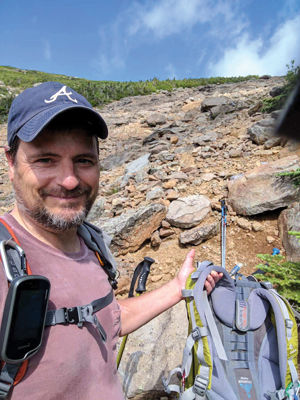
It took Randy Willett all summer to recover from his near-death experience after being lost in the White Mountains for several days. Once he was able to return to the mountains, Willett found the spot on Mount Lincoln where he was rescued via helicopter. His backpack was still there, though someone had taken his GoPro camera and cooking device. (Courtesy photos)


(0) comments
Welcome to the discussion.
Log In
Keep it Clean. Please avoid obscene, vulgar, lewd, racist or sexually-oriented language.
PLEASE TURN OFF YOUR CAPS LOCK.
Don't Threaten. Threats of harming another person will not be tolerated.
Be Truthful. Don't knowingly lie about anyone or anything.
Be Nice. No racism, sexism or any sort of -ism that is degrading to another person.
Be Proactive. Use the 'Report' link on each comment to let us know of abusive posts.
Share with Us. We'd love to hear eyewitness accounts, the history behind an article.