


LACONIA — Tourists who cross the Canadian border into Quebec are greeted with "Bienvenue," the French word for "welcome," and the phrase on local license plates, “Je me souviens,” which means “I remember.”
That’s been the motto of the province since 1868, when the premier of Canada added “Je me souviens” to a coat of arms sent to the nation by Britain’s Queen Victoria.
Today, these words have special significance for people of French descent who live in and around the city — once a magnet for French-Canadian immigrants who came to work in textile mills.
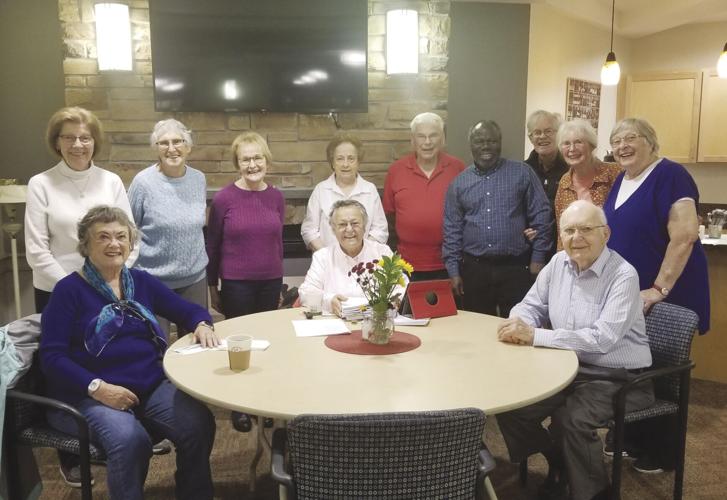
Now, for the dozen or so people who belong to the French club at Taylor Community, and another 10 who come to a French language club at the Gilford library, they sum up an abiding mission: keeping family culture and history alive and passing a beloved language to others.
“I was a French major and French teacher and I know how important it is to keep your heritage,” said Rose-Marie Robichaud, whose family came from Nova Scotia, when the maritime region was known as Acadia. “Keeping the language is a way of helping me keep that heritage. At my age, it keeps my mind going,” said Robichaud, who 10 years ago co-founded Taylor’s club, which is open to any age, including people who don’t live at Taylor. “We have such a good time and we laugh a lot. It keeps the language alive in all of us.”
A conduit from past to present that works today
Almost every American has multiple identities. As immigrant, native or naturalized citizen, they also have ethnic, cultural and religious ties they came with or inherited from older family members. In a melting pot society where diversity and varied perspectives are strengths, these roots also provide an anchor, social connections and a sense of place in time and the world. Speaking a family language in addition can be a way to do that.
“My heritage is important to me,” said Laconia-born Mariette Facques, who spoke French in the city’s Catholic schools, then studied French language and literature as a scholarship student at Rivier College in Nashua. Now retired, Facques attends Taylor’s French club, and leads a similar group at the Gilford Public Library. “I’m very proud of my family. When I pass away, my heritage is not going to be lost.”
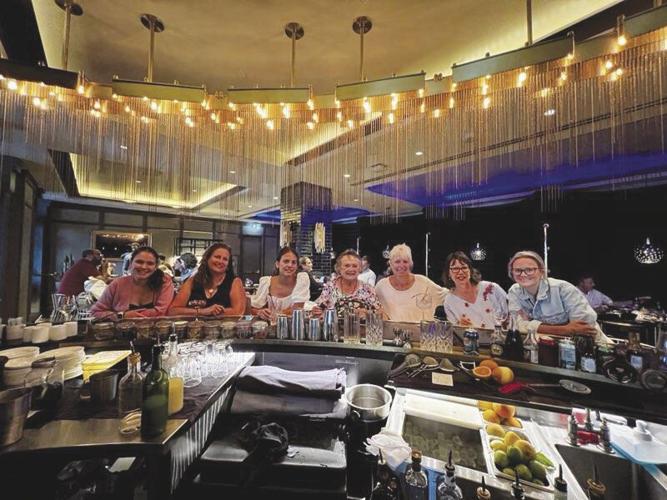
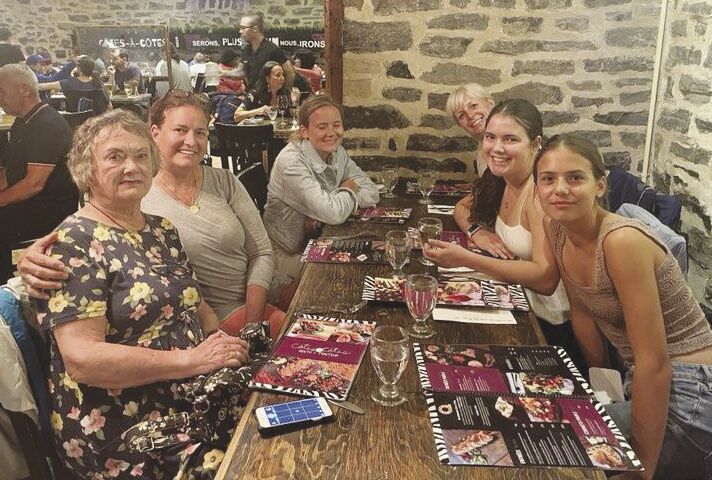
To bring French heritage to life for younger family members, Facques took her daughter, two daughters-in-law and three granddaughters this summer to visit their ancestor Gabriel Gosselin’s home — the oldest house today in Quebec. Built in 1683, it’s now home to the Cotes a Cotes restaurant. After scouring history and genealogical records, Facques learned that nine generations of the Gosselin family lived in that house, including one of her forbearers, Clement Gosselin, who spied on the British for Gen. George Washington during the Revolutionary War.
While in Quebec, the Facques family visited four other houses Gabriel Gosselin owned on nearby Isle d’Orleans — a place loaded with Gosselin descendants, including distant relatives.
Ten years ago, Facques took the same trip with the men and boys in her family. It made everyone feel their connection to French-speaking Canada, as well as their ancestral place in American history.
“This was on my bucket list and it was great,” she said.
Cultural identity and family roots, including native languages, are important to Americans who arrive in the U.S. to start lives in a country that’s essentially a tapestry of ethnic and racial groups sewn together in one sprawling location by shared experiences, hopes, goals and hard work. In Laconia and Manchester, the history of French Canadians migrating south to work in factories during the Industrial Revolution is a mixture of hardship, triumph, and channeling strength. Between new and recent arrivals and longtime residents, there’s a ready-made link: others who speak the same first or second language and can share meals, photos, and tidbits from the past, and laugh together.
“It means a lot to me to promote the language with two different groups,” said Facques, who now uses French to converse by phone and email with her husband’s family members who live in northern France. “It’s a good thing intellectually to be able to speak two languages. Being bilingual makes it possible to communicate with so many more people.”
French clubs attract people from different places, backgrounds
Perhaps few know that better than Assou Sagara who, in 2012, emigrated from the West African nation of Mali, where French is the official language. He’s been in the United State for five years, speaks English, and discovered Taylor’s French club while working at McDonald’s delivering coffee and donuts to the club, whose president invited him to join.
Today, Sagara, who is trained as a French teacher, works in housekeeping at Concord Hospital—Laconia. He’s been a member of the Taylor club for three years, and it feels like a home away from home. Meetings are in English and French, with novice and expert speakers, including people born in Austria and England who learned French in school, but not at home. For Sagara, it fills an important role: Conversations in English with the group, and side-by-side translations in English and French of what they take turns reading, help him expand his knowledge of English.
“This group has everything I need to know,” said Sagara, who recently became a U.S. citizen. “People here are so nice. Before I came here, I hear that Black people are not loved” in America. “That is not true.”
Joan Denne, who lives at Taylor, served in the Peace Corps in Dominica, and joined the French club to learn and practice the language that filled her ears while she was living and working in that Caribbean island nation.
Joe Picard’s parents emigrated from different parts of French-speaking Quebec, and came with noticeably different accents. But the last time Picard, who is 97, spoke the language before joining the Taylor club was with his father 30 years ago. For him, the French group offers a pleasant social outlet, plus nostalgic immersion.
“Coming from Quebec, my parents couldn’t speak English. I learned to speak French before I spoke English,” he said. But the community where he lived had no French church or schools, and he never took any French courses.
“I had trouble getting back into the groove,” said Picard, who lives at Taylor. “It’s almost like the old saying, ‘Use it or lose it.’” He joined to refresh his ability to speak and read and found a welcoming circle of friends from different places and pasts. “You really have a variety of people.”
“I used to speak French. Then I lost it,” said Rena Fitts, a Laconia native who went to French-speaking Sacred Heart School from second through eighth grade, whose parents were Francophones. Once they died, she no longer had an opportunity to use it, so it feels like starting all over again. “They translate and make it interesting.”
“A lot of people who are part of it have had their French improve,” said Robichaud, adding that members enjoy the socialization and learn a little about a lot of subjects when they take turns reading Boston Herald articles translated into French, provided by member Rock Drouin. They read French literature, including "Le Petit Prince (The Little Prince)," a classic on political philosophy. The group has singalongs with sheets of lyrics printed in French from La Bonne Chanson, a collection of traditional songs that some club members learned in French-speaking schools. Slide presentations by video call reach members at home, including one Taylor resident who lives in southern France for six months each year.
Friedl Scimo, a native of Austria, married an American and learned to speak English when she moved here. She learned French in Vienna while attending a Lycee Francais school.
“This is my European connection,” said Scimo, a Taylor resident. “My French is just good enough” to understand and be understood. But the main value of the club is friendship.
“I’m not a morning person,” she said, “but if I don’t get up and come here, things are not right with the world.”
The club that meets Thursday afternoons at 4 p.m. at Gilford Public Library is a mixture of travelers who want to boost their spoken French, and others who heard French in school or used by family members. Many are trying to get in touch with their roots.
At the library, Karen Boucher-Rousseau recently shared information she unearthed through Ancestry.com about her French-Canadian family member, Nicholas Perrault, circa 1660.
“I’m doing this for my children,” said Boucher-Rousseau, a retired nurse and school counselor who lives in Laconia. “It’s like detective work. When you read about this, your family becomes alive for you.”
The French Club at Taylor Community meets Fridays, 10-11 a.m., and is open to members throughout the Lakes Region.





(0) comments
Welcome to the discussion.
Log In
Keep it Clean. Please avoid obscene, vulgar, lewd, racist or sexually-oriented language.
PLEASE TURN OFF YOUR CAPS LOCK.
Don't Threaten. Threats of harming another person will not be tolerated.
Be Truthful. Don't knowingly lie about anyone or anything.
Be Nice. No racism, sexism or any sort of -ism that is degrading to another person.
Be Proactive. Use the 'Report' link on each comment to let us know of abusive posts.
Share with Us. We'd love to hear eyewitness accounts, the history behind an article.