




LACONIA — With 6,928 current COVID-19 cases in the state and 284 people hospitalized, local health officials say they are closely watching their resources but continue to have enough capacity to handle more people with the virus should that become necessary.
Last spring, hospitals reduced non-emergency and elective services to make space for an expected surge of COVID-19 patients. State officials are hoping that won’t be necessary again even as case numbers increase.
The vaccine is beginning to arrive, but it will be many months before most people can get an injection.
When elective surgeries are cancelled, patients are denied important services for debilitating conditions and hospitals suffer major financial problems that affect their stability.
No service cuts
LRGHealthcare is not planning to scale back procedures, but hospitals in the southern part of the state are considering just that because they have significant numbers of surgical patients who require long lengths of stay, said LRGH President and CEO Kevin Donovan.
“At LRGHealthcare, most of our elective surgical services do not require long stays, or any overnight stay at all, so curtailing that work would have little impact on our bed availability,” he said.
“At this point we also have adequate access for COVID-19 and non-COVID-19 inpatients and plenty of safety measures in place to cohort COVID-19 patients away from other patients.”
He said Lakes Region General Hospital recently hit a high of 16 COVID-19 positive cases.
“The numbers have been increasing over time and we expect them to continue to do so,” Donovan said.
High-water mark
Dr. Christopher Fore, chief quality officer at Concord Hospital, said that facility recently had 31 patients with the disease, the most since the pandemic began nine months ago.
Many of the hospital's patients come from the Lakes Region, including some from the New Hampshire Veterans Home, which has had a severe outbreak leading to 35 deaths.
Even though the overall number of people being hospitalized for the virus has increased, doctors now have a better understanding of how to treat these patients.
“In the early days we were seeing about 50 percent of people admitted were requiring a ventilator,” he said. “That number is down quite a bit and is below 25 percent at this point,” said Fore, an emergency room doctor.
Improved treatments
Remdesivir, an anti-viral drug, is now available and has been found to be helpful. There is also better guidance for use of steroids, and an improved understanding of when a COVID-19 patient needs to be placed on a ventilator.
Monoclonal antibody drugs are starting to become available for use in a limited number of cases.
“A lot has happened through sheer experience,” Fore said. “We’ve kind of nailed those things down that produce better outcomes.
“In a nutshell, we're all a lot better at this than we used to be. Most people are doing better and responding to therapy.”
There is also more personal protection equipment available. Institutions are working together to share resources.
“Work we’ve done for the last nine months to prepare and get good at this is paying off,” Fore said. “We are collaborating well across the state. Most recently the two hospitals in Manchester were at or over capacity, and along the I-93 corridor we work together in an interagency capacity to meet demands.”
Anxious patients
Even with the advances, a COVID-19 case severe enough to require hospitalization is a serious matter.
“In general we’re able to put people’s minds at rest, and most people can be reassured, but the sensation of shortness of breath can be anxiety provoking,” Fore said. “We let them know we do a good job, they are in the right place and even in a worst-case scenario, we can help them.”
The decision on whether to admit is often predicated on whether the patient needs continuous intravenous fluids for dehydration and whether they need supplemental oxygen. Length of stay will be dictated by clinical improvement, but many patients can go home and improve as an outpatient.
Patients with the disease are placed in negative pressure treatment rooms to prevent spread of the virus.
Help on the way
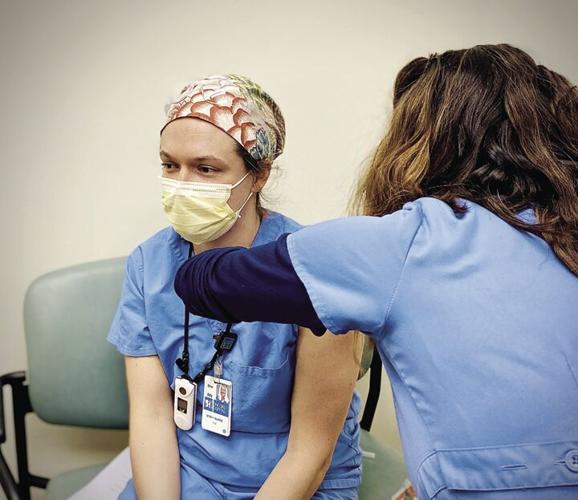
Meanwhile, the vaccine is slowly starting to arrive and health care workers are in the first group to get the shots.
About 90 employees at Concord Hospital have tested positive for the virus since the start of the pandemic. They are believed to have been infected while out and about in the community.
Fore received his vaccination on Wednesday, and was happy to have the inoculation.
He understands that some people may have concerns about a vaccine that was produced in record time and approved under emergency circumstances.
“My caveat to that is this is clearly an exceptional circumstance. We have a vaccine that is safe and effective and has been tested on two cohorts of greater than 30,000.
“People are dying every minute, so when you weigh the risk and benefit, it leads you to conclude that we should be vaccinating as many people as we can."
Staying vigilant
Gov. Chris Sununu said Thursday the state has distributed 3,135 doses of the Pfizer vaccine to hospitals.
Fore is one of 901 front-line health workers who have received the vaccination.
In the months it will take for millions of doses of vaccine to be produced, delivered and administered, it is essential that people continue to observe social distancing and use of face masks, Fore said.
“Ask yourself, ‘Is there an inherent risk in what I’m about to do and is it really worth it?’”
He tells people that if they catch the virus, they might not have a bad outcome, but could spread it to someone, who spreads it to someone else, and eventually it reaches a vulnerable person who does suffer a serious or fatal case. That person is somebody’s loved one — a parent, a grandparent, a relative, a friend.


(1) comment
I am hearing the most of the Laconia School Administration have tested positive for COVID -19, Woodland Heights Grammar School is going totally remote; and yet I don't seem to see it anywhere in the Sun.
I think it's pretty clear as the local hospital systems are getting stressed, and the schools are having breakouts of COVID -19 and we are going into the worst time of the season, holidays and winter seclusion in our homes, the only safe and common sense way to proceed with Schooling in Laconia is by going to total remote until Spring of 2021; it's time to think about saving lives, all lives, teachers, students and families.
Welcome to the discussion.
Log In
Keep it Clean. Please avoid obscene, vulgar, lewd, racist or sexually-oriented language.
PLEASE TURN OFF YOUR CAPS LOCK.
Don't Threaten. Threats of harming another person will not be tolerated.
Be Truthful. Don't knowingly lie about anyone or anything.
Be Nice. No racism, sexism or any sort of -ism that is degrading to another person.
Be Proactive. Use the 'Report' link on each comment to let us know of abusive posts.
Share with Us. We'd love to hear eyewitness accounts, the history behind an article.