


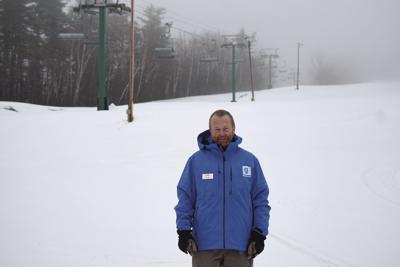
GILFORD — In a meeting that marked a change in approach, the new chair and vice chair of the Gunstock Area Commission pressed management on a number of issues including a proposed new restaurant and the area’s master plan, and considered a request that the recreation facility make public its entire budget.
Commissioner Peter Ness was elected chair, and Commissioner Dr. David Strang was elected vice chair, early in a meeting which lasted close to four hours and was attended by about 60 people. Ness succeeds Commissioner Gary Kiedaisch who had been serving as acting chair following the resignation of Brian Gallagher who stepped down from the five-member panel in January, citing the increasing stress and level of strife surrounding the commission.
Gunstock Chief Financial Officer Cathy White told commissions that Gunstock is wrapping up a very profitable ski season.
She said revenues for February were $4.9 million, 17% higher than had been projected. Since its fiscal year began last May Gunstock has taken in $14.4 million, more than 20% ahead of projections.
Gunstock President Tom Day said management’s decision to limit the number of season passes as well as the sale of day tickets has helped build a loyal customer base among skiers who know that the slopes and facilities will not be overcrowded.
Management decisions have also played a part, he said.
“We are cutting out the dead wood, and cutting out what isn’t working,” Day told the commissioners. Another factor is that labor costs have been 20% below than what the area budgeted for, he noted.
Ness told the managers they needed to be more even-handed in providing information about the area’s finances and operations.
“There has been selective sharing of information with commissioners,” he told Day and White.
Managers implored that the commission unfreeze $2.4 million budgeted for capital improvements. The money was approved in the area’s current budget and management had already ordered equipment and paid deposits with the understanding that those funds were available for use.
Early this month the commission told Gunstock to stop tapping into the capital budget until it received more information about the individual projects or purchases.
For about a half-hour the commissioners and managers went back and forth over plans to convert the Stockade Lodge into a restaurant.
Day said the building at the base of the mountain, which provides a panoramic view of the slopes, would be a very popular attraction for skiers looking to enjoy a restaurant-style meal, and so would add another profit center to the area’s operation.
Strang, however, said using the Stockade strictly as a dining venue would mean that it would no longer be available for skiers who have in the past been able to use it as a place to suit up and then easily ski the short distance to the nearby Ramrod and Panorama lifts. Otherwise they will be forced to make the longer, more arduous uphill trek from the historic base lodge, he noted.
Strang, who was appointed to the commission last month, told managers that increasing profits should not be their only consideration.
“We cannot be slave to the dollars. We need to listen to our constituents,” he said, adding that many people have told him they want the Stockade available for use by all skiers.
Kiedaisch cautioned Ness and Strang against interfering with the work of the area’s management and department heads, especially now when the Gunstock is doing well.
“We’re not elected to run the business, but to make sure they can put together a good operating plan,” Kiedaisch said. “There needs to be a level of trust that management knows what it’s doing.”
The time for commissioners to intervene is when management is not doing well or not meeting its operating goals, he said.
Strang, however, said the commissioners’ call for more information was not undue interference, but due diligence.
“We have a right to ask questions,” he said.
Ness said he was looking for answers “to better understand the core resort business.”
In particular, Strang and Ness told Day they wanted the managers to prepare an overview of the main points in Gunstock’s master plan which was unveiled as a concept last December.
“Can we get a document that describes the 5 pods (in the master plan) in more detail … like an executive summary?” Strang asked.
Day agreed and said that, based on Gunstock’s current financial position he felt that some parts of the master plan might be able to be accomplished in the not-too-distant future.
As the chair, Ness announced that he was establishing two commission committees. One would look at how Gunstock obtains its legal services.
The second committee would focus on snow sports operations — the ski school.
That proposal provoked catcalls from some in the audience and criticism from Kiedaisch.
Before being appointed a commissioner in 2019 Ness was a ski instructor at Gunstock. When the commission last year asked the delegation to remove Ness from the body, It said one reason was because he disrupted ski lessons and publicly questioned the ability of other instructors, allegations that Ness has staunchly denied. The delegation declined to remove Ness from the commission.
After announcing the creation of the committee, Ness said to Day, “For 18 months I’ve been asking questions (about the ski school) and now I want answers.”
The issue of the access to Gunstock’s budget came up when Skip Murphy, a Gilford resident and a conservative blogger, gave the commission a Right to Know request asking that Gunstock provide him with a copy of its full line-item budget.
Day had declined to provide the information recently when he received a separate request directly from Murphy.
Murphy insisted that since Gunstock is a governmental entity all of its financial records are public documents under the state’s Right-to-Know Law.
Day, however, said that the law says a governmental body is not required to turn over information which would place it at a competitive disadvantage, and that he sees portions of the budget as containing information which would have commercial value to Gunstock’s competitors, and so should be protected.
Commissioners voted unanimously to have Ness look for two or more attorneys familiar with the the Right to Know Law which the commission could consider hiring to advise it on how to deal with Murphy’s request.
Gunstock regularly releases certain financial information, such as its balance sheet, profit-and-loss statements, and cash-flow reports. However, it does not release a detailed report of its estimation of its revenue and expenses for each of its various departments of its operation. Murphy said it used to but that the last time it released the budget was in 2017.





(0) comments
Welcome to the discussion.
Log In
Keep it Clean. Please avoid obscene, vulgar, lewd, racist or sexually-oriented language.
PLEASE TURN OFF YOUR CAPS LOCK.
Don't Threaten. Threats of harming another person will not be tolerated.
Be Truthful. Don't knowingly lie about anyone or anything.
Be Nice. No racism, sexism or any sort of -ism that is degrading to another person.
Be Proactive. Use the 'Report' link on each comment to let us know of abusive posts.
Share with Us. We'd love to hear eyewitness accounts, the history behind an article.