


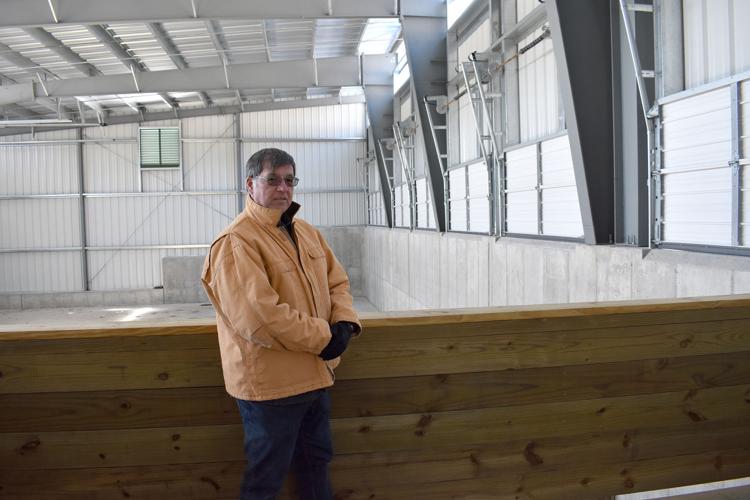
GILFORD — Selectman Richard Grenier knows why certain people, such as the members of the Gilford Taxpayers Coalition, oppose Article 7, which asks voters to approve an additional $400,000 to complete the upgrade to the town’s recycling center.
“I understand they’re upset," Grenier said. "We’re talking about a 45-percent cost overrun. I can’t couch it in a euphemism.”
Article 7, which will come before voters on March 12, would use money from the unused fund balance to complete an upgrade that will allow the recycling center to change the way it handles recyclable materials as well as household trash.
Years ago, Gilford joined many other communities in the region by adopting so-called single-stream recycling, which allowed residents to put all their recycling in the same bin, which would be sorted later at a facility elsewhere. The theory behind single-stream is that it makes recycling easier, which encourages more people to recycle.
The problem with single-stream, Grenier said, is that people aren’t very discriminating about what they put into the recycling bin. Just a few nonrecyclable items can spoil the marketability of an entire batch, and lately the processing facilities have declined to take single-stream because of the contamination issue.
In response, Gilford’s Solid Waste Committee recommended to selectmen that the town build a new building at its recycling facility, where residents could take their sorted recycling – aluminum, tin, glass, plastic, paper and cardboard – because there is still a market for recycling if it is separated by type. Selectmen agreed to put such a measure on the town ballot three years ago, and voters approved issuing $950,000 in bonds to pay for construction of the structure.
But, Grenier said, it took a while to get the project going, and the building was only completed last fall. During the delay, construction costs rose – especially for steel – and nearly all of the money raised by the bond issue was used up before critical parts of the project were completed. If voters approve, the additional $400,000 will be used to purchase a compactor for household trash, a baler for sorted recycling, electrical and groundwork, and will put in a restroom for employees, who currently have only a portable toilet to use when nature calls.
“This vote will be three years since the people voted the money (for the original project), and we’re still not done, which makes me grit my teeth,” Grenier said. But, if it can finally be completed, he said, it will allow the town to recycle at a far lower cost. He’s not sure exactly what the savings will be, but expects them to be significant compared to single-stream.
“We pay almost double, by the ton, doing single-stream as we do household trash,” he said. “This is still saleable material if it’s clean and separated.”
Grenier said the project would be monitored by a clerk of the works, who would report to the town’s Solid Waste Committee, which in turn would make recommendations to selectmen.
If voters decline to spend the additional money, he said the town would find a way to use the building for recycling. But workers wouldn’t be able to bale the recycling, so it wouldn’t be as valuable to recyclers. Grenier hopes he doesn’t have to explore that possibility.
“I think it’s going to pass. People want to see this finished. And it’s going to be done right,” he said.


(0) comments
Welcome to the discussion.
Log In
Keep it Clean. Please avoid obscene, vulgar, lewd, racist or sexually-oriented language.
PLEASE TURN OFF YOUR CAPS LOCK.
Don't Threaten. Threats of harming another person will not be tolerated.
Be Truthful. Don't knowingly lie about anyone or anything.
Be Nice. No racism, sexism or any sort of -ism that is degrading to another person.
Be Proactive. Use the 'Report' link on each comment to let us know of abusive posts.
Share with Us. We'd love to hear eyewitness accounts, the history behind an article.