


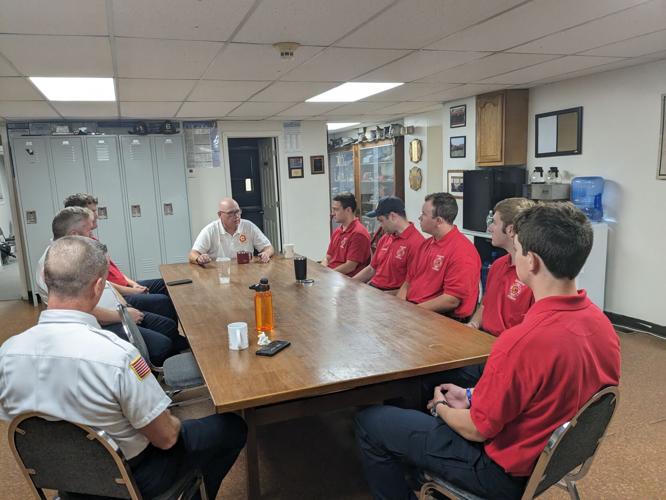
GILMANTON IRON WORKS — Monday marked the first day and first step for three Lakes Region Community College fire science students.
“This is the best job in the world,” said Gilmanton Fire Chief Paul J. Hempel at the beginning of a post-breakfast table discussion with the group, “and you guys are starting that today."
The trio of 18-year-olds arrived the previous day at the fire station, where they will literally live and breathe firefighting to get hands-on experience in the field.
Joining the group were Nashua Fire Chief Steve Buxton and Deputy Chief Mark Wholey, who offered a view of both present and potential future for the students.
“What I think is important today is to show you guys where you can start and where you can end up,” Hempel said. “If you do what you're told here thorough your time, that if you follow the dotted lines, you can be successful.”
Buxton and Wholey attended the same program in 1991 and 1997, respectively. Now the pair lead the Nashua Fire Department full-time.
“It's nerve-wracking the first day you walk into the firehouse,” Buxton said. “It's new to you. You're meeting people that you've probably never met before, and you're trying to form a bond and head in a direction for the rest of your life, so there's a lot of things going on at that time.”
The program has been running since 1981, and is a full, hands-on experience for students pursuing an associate degree in fire science. Those in the program live at the firehouse during the week doing chores, learning firehouse culture and technical skills, in addition to attending classes.
“What we do is we give them real-life application here in the firehouse,” Hempel said. “They live with us, serve with us as part of the community and learn the trade in those two years.”
During the roundtable discussion, Hempel stressed the importance of routine and consistency before ceding the floor to Buxton and Wholey to reflect on their learning experiences three decades ago. After their time of reflection, students were asked why they were there.
“My dad's a fire chief and my uncle's a fire chief as well, so it's kind of in my family history,” said Brenden McQuillen of Portsmouth. “I just want to help people as well, so I feel it's a pretty good job for me to do.”
Seth Boden of Henniker had a similarly fiery pedigree that drove his decision to join.
“My father was an EMT in Anne Arundel County, Maryland, for about 26 years. Then he came up here to become a state inspector, and I just want to follow in his footsteps,” Boden explained.
“I just kind of wanted to help people,” said Bailey Landsteiner of Nashua. “I didn't really want to get in to the medical field, but this was kind of a happy medium."
All three senior members noted the firefighting profession is quickly becoming more and more medical service-oriented as incidents of fire become less common.
“I've sat on the initial round of interviews in Nashua for the past three years, and we get these conversations where we ask, 'Why do you want to wok in Nashua?' And they go, 'I want to come here because you guys don't have an ambulance,” Wholey said. “Seven thousand or 8,000 of our emergencies are medical-related in some way, shape or form. It is 100% the future of our profession. It's already here.”
Wholey explained that emergency medical services are “all encompassing,” and included medical calls, lifting assistance, medical alarms and car accidents.
“Historically, medical and EMS are a majority of what we do here,” Hempel said. “That training is very intense, anywhere from an EMT, to and advanced EMT, to paramedic skills. When we have advanced skills, we're able to offer that back to the community. There's a lot of pre-hospital care that our paramedics can do.”
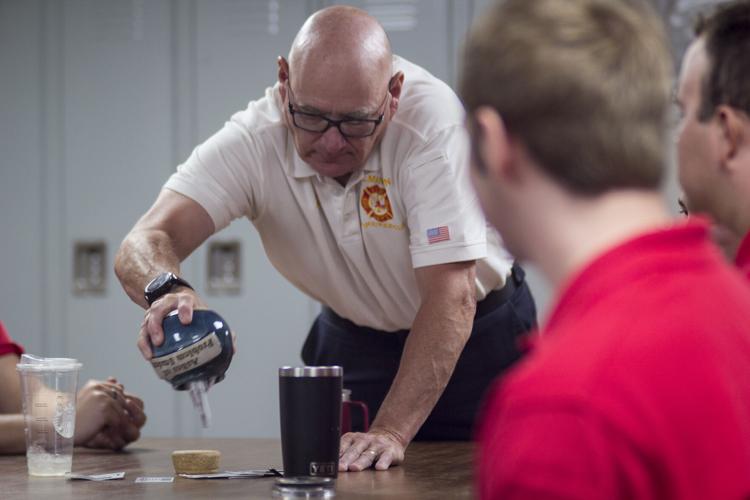
Near the end of the discussion, Hempel pointed out a ceramic urn with the label “ashes of problem students.” Once he had their attention, the chief opened the lid and sprinkled its contents on the table. A plethora of identification cards of failed former students clattered down.
“Some of these guys didn't make it a week, some made it a year, some made it almost to the end,” Hempel said. “But something prevented them from making it to the finish line, and I don't want to see you in there,” Hempel continued. “We don't like putting students in there. We hate it, but we do it. Just use that as a reminder.”


(0) comments
Welcome to the discussion.
Log In
Keep it Clean. Please avoid obscene, vulgar, lewd, racist or sexually-oriented language.
PLEASE TURN OFF YOUR CAPS LOCK.
Don't Threaten. Threats of harming another person will not be tolerated.
Be Truthful. Don't knowingly lie about anyone or anything.
Be Nice. No racism, sexism or any sort of -ism that is degrading to another person.
Be Proactive. Use the 'Report' link on each comment to let us know of abusive posts.
Share with Us. We'd love to hear eyewitness accounts, the history behind an article.