


PLYMOUTH — With all the money that is becoming available to extend broadband internet to areas without high-speed service, everyone is looking forward to the day when attending a Zoom meeting or streaming a favorite movie is as simple as turning on the lights.
The New Hampshire Electric Cooperative sees it in those terms, with its legacy built upon the Rural Electrification Administration, which President Franklin Delano Roosevelt signed into law on May 11, 1935. The REA sought to bring electricity to rural areas, where nine out of 10 homes had no electricity — similar to the situation with internet in some communities. Unable to get the electric power companies of the day interested in serving so few customers in low-density communities, the REA drafted the Electric Cooperative Corporation Act, allowing states to form and operate not-for-profit, consumer-owned electric cooperatives.
Leo Dwyer, a board member of the NH Electric Cooperative and executive chair of NH Broadband LLC, explained, “If you think about it, almost by definition, we serve the most expensive-to-serve areas, because if they weren’t, for-profits would have gotten there with the electricity. It turns out there’s a pretty good correlation between the folks that needed Co-op help getting electricity and folks that need help getting broadband...
“People tend to think about, ‘How can I get internet, because I didn’t have any internet?’ but now you’ve got to think about, because there’s all this money, not just, ‘How can I get it?’ because you are going to be able to get it because this money is going to fund it. You need to think about who’s going to own it, because you’re going to be wedded to them for 30 or 40 years.”
For Dwyer, the answer is simple: NHEC, through its subsidiary, NH Broadband, which aims to deliver “affordable, reliable, high-speed internet service, regardless of where they live.”
The company, he said, has the advantage of having a series of utility poles in place, and experience in aerial reticulation, so “it’s sort of a natural fit.” Co-op members overwhelmingly voted in favor of installing fiber for broadband service, “and so that’s what we’re doing,” Dwyer said.
The Co-op started in its most underserved areas — Lempster, Colebrook, Stewartstown, and Clarksville — completing 86 miles of broadband in 100 days.
“There was CARES funding,” Dwyer said, “and, because they had very tight time constraints for when you had to complete construction and start service, we hit that timeline and started service in December 2020.”
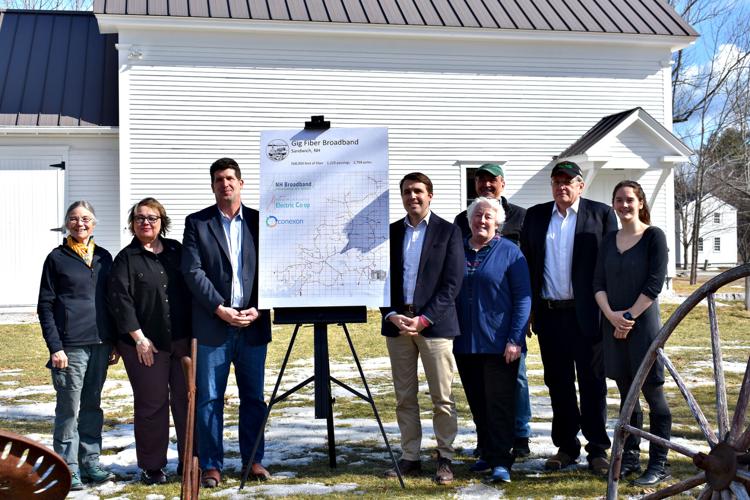
Since then, NH Broadband has been building lines in Acworth and Sandwich, and has plans to extend service to members in 32 towns across Grafton County.
When Bristol set out to improve broadband coverage to fill a void in that community, where 300 Co-op members reside, NHEC made the fiber it had installed between Plymouth and Bristol available to the town.
Bristol’s success in bringing in fiber internet led to the formation of the Grafton County Broadband Committee, which is aiming to take that model to other Grafton County towns. The committee recently received a $3.7 million American Rescue Plan grant to engineer the “middle-mile” and “last-mile” fiber network to serve those towns.
Dwyer said NH Broadband hopes to coordinate with the Grafton County Broadband Committee, noting that the Co-op serves 50% of Grafton County residents, but he contends that the middle-mile approach is wrong. The middle mile refers to running fiber along the major routes, but Dwyer believes it makes more sense to use the existing transmission lines, which do not always follow the highways.
“Really, what we’re trying to say is, let’s coordinate this so we utilize the money most efficiently,” he said. By running the fiber along the existing utility poles, rather than building a new route along the highways, the work can move along at a much faster pace. “On our current schedule, we’ll start turning people on in six months, and probably get the last folks in the fall,” he said.
By way of contrast, Nik Coates, Bristol Town administrator and chair of the Grafton County Broadband Committee, expects to get the engineering for the middle mile and last mile done by November, but the actual installation would occur later — as long as five years out. On the other hand, the Grafton County plan would serve the entire population, not just Co-op members.
NH Broadband’s long-term plans address customers beyond the Co-op’s membership, but first the company wants to focus on service to all its members. That allows a faster buildout, after which it can focus on other areas.
After completing work in Grafton County, NH Broadband’s plan calls for turning to Carroll County, where most NHEC members reside and where many are unserved by broadband; then completing the buildout in Coos County; then Belknap County and the remainder of the NHEC service area. Before going into non-NHEC areas, the company plans to extend fiber to “off-system RDOF areas” and difficult-to-build areas such as islands.
RDOF stands for Rural Digital Opportunity Fund, an initiative that identified under-served areas based on the census, and offered targeted state subsidies. The Co-op was awarded 85% of those subsidies.
The last phase of the fiber buildout would target non-NHEC areas, “in cooperation with counties and municipalities,” according to a presentation that NH Broadband prepared for county representatives.
The Grafton County Broadband Committee also plans to work in cooperation with the towns, sending committee members to explain how they might tap local ARPA funds and grants from the state to bring in broadband without the costs being borne by taxpayers. Joining them will be Katelyn Robinson, a grant writer from the Northern Community Investment Corporation, who will suggest funding sources, and a technical team from eX², the project’s contractor.
While Coates said the goal is to provide broadband to every household in Grafton County, he acknowledged that some towns will not go along with the plan, saying, “We’re not here to force it down your throat.”
Dwyer supports a regional approach, rather than a town-by-town one.
“The architecture of the poles doesn’t lend itself to that,” he said. “The wires don’t get to the town line and stop, right? And how do you explain to somebody that’s over the border in Haverhill from Benton that, well, Benton served its members, but we’re not going to extend the next 200 feet to get to you. It just doesn’t make sense. There’s reasons that this kind of infrastructure is regional.”
While the company will be seeking grants, Dwyer said they are not waiting for the final rules on those funds, but are already at work on the extension of broadband service from Plymouth north. Once the northern section is complete, they will work on service from Plymouth south.
“It’s really exciting,” Dwyer said. “I just met up with a contractor who talked about how he’s never had a job that’s more satisfying because people are just so happy when you deliver the service. And that’s really why we’re doing it.”


(0) comments
Welcome to the discussion.
Log In
Keep it Clean. Please avoid obscene, vulgar, lewd, racist or sexually-oriented language.
PLEASE TURN OFF YOUR CAPS LOCK.
Don't Threaten. Threats of harming another person will not be tolerated.
Be Truthful. Don't knowingly lie about anyone or anything.
Be Nice. No racism, sexism or any sort of -ism that is degrading to another person.
Be Proactive. Use the 'Report' link on each comment to let us know of abusive posts.
Share with Us. We'd love to hear eyewitness accounts, the history behind an article.