


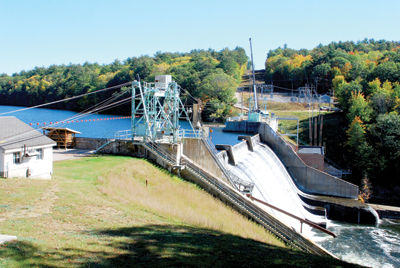
MANCHESTER — Eversource has announced a $258.3 million purchase-and-sales agreement with two companies wishing to buy the utility’s electrical power generating facilities, including the hydroelectric dam at Ayers Island in Bristol-New Hampton and Eastman Falls Dam in Franklin.
The sale, if approved by the state Public Utilities Commission, would lead to lower electric rates in the future, according to Martin Murray, Eversource’s media relations manager.
Eversource expects the sale, which would complete New Hampshire’s electric deregulation, to be finalized in late December, or early in 2018, which would make rate adjustments possible in either the first or second quarter of 2018, Murray said.
Hull Street Energy, LLC, of Bethesda, Maryland, is purchasing Eversource’s nine hydroelectric facilities. The Hull Street Energy team owns and operates other North American hydroelectric facilities and recently acquired five power generation plants in western Massachusetts.
Ayers Island Station, which has an 8.4 megawatt generating capacity, is selling for $10,500,000, while Eastman Falls Station, with a capacity of 6.4 megawatts, is selling for $6,150,000, according to the agreement.
In addition to Ayers Island and Eastman Falls, Hull Street Energy is acquiring Amoskeag Hydro in Manchester, Canaan Hydro in West Stewartstown, Garvins Falls in Bow, Gorham Hydro in Gorham, Hooksett Hydro in Hooksett, Jackman Hydro in Hillsborough, and Smith Hydro in Berlin. Together, the plants have a 68.2 megawatt generating capacity.
Granite Shore Power LLC, a newly formed partnership between Atlas Holdings and Castleton Commodities International of Connecticut, is purchasing Eversource’s fossil fuel plants: Merrimack Station in Bow, Newington Station in Newington, Schiller Station in Portsmouth, Lost Nation in Groveton, and White Lake in Tamworth. Those plants have a combined generating capacity of 1,130.1 megawatts.
The sales are necessary under New Hampshire’s electric restructuring law, initiated by current Sen. Jeb Bradley (R-Wolfeboro) in 1996. Other utility-owned plants were sold about 15 years ago, leaving Eversource as the only electric utility in New England that still owns coal, wood, oil and gas generation plants.
Murray said Eversource was working on divestiture of its plants when the state legislature halted the process in 2014. The following year, Eversource, along with a dozen other parties, including senators Bradley and Dan Feltes, the state Office of Energy and Planning, the Office of Consumer Advocate, staff members of the Public Utilities Commission, the International Brotherhood of Electrical Workers Local 1837, the Conservation Law Foundation, TransCanada Hydro Northeast, Inc., TransCanada Power Marketing, Inc., and the New Hampshire Sustainable Energy Association, signed the 2015 Public Service Company of New Hampshire Restructuring and Rate Stabilization Agreement to sell the power plants.
The Public Utilities Commission selected J.P. Morgan Securities LLC to oversee the auction process, with the goal of achieving the highest possible price for the assets in order to minimize any stranded costs — the value of capital investments that are unrecovered in the sale.
Murray said there will be significant reductions in electric rates going forward, because they no longer will include the ongoing costs of owning and operating the power generation plants.
He explained that current rates are inflated by the guaranteed recovery of the costs associated with a regulated utility.
“These plants were built under the old order,” Murray said, “when regulators told them what to build and guaranteed they’d recover those costs. Because of a series of events and concerns, we continued to own them and recover costs under the old regulated model. Over time, that became more expensive that the costs on the open market.”
He said Eversource’s plants are the only generating plants in New England that are owned and operated by a regulated company. Unregulated plants are better able to adjust to market conditions, he said.
Eversource anticipates that purchasing its electricity on the wholesale market will bring additional savings that will translate into lower electric rates.
The agreement includes foregoing the recovery of $25 million associated with the emission-reducing “scrubber” at the Merrimack Station, but the company will continue to charge customers — both those purchasing energy from Eversource and those who buy power from other suppliers but use Eversource transmission lines — to recover the stranded costs. However, the agreement with state government leaders allows the company to purchase low-cost bonds that customers will repay over a 12-year period, softening the impact.
Anticipating that the sale also will have an impact on the communities where the plants are located, Eversource agreed to provide three years of tax stabilization payments.
Murray explained that the property tax assessment is likely to change, and “Eversource is seeking to provide a soft landing, assuming there’s a possibility that the new assessment may be less than the old.”
Once the municipality establishes an assessment for the new owner, Eversource agreed to cover taxes for the difference between the old and new assessment for the first year, two-thirds of that amount in the second year, and one-third in the third year.
Ayers Island Dam sits at the border of Bristol and New Hampton. (Adam Drapho/Laconia Daily Sun)


(0) comments
Welcome to the discussion.
Log In
Keep it Clean. Please avoid obscene, vulgar, lewd, racist or sexually-oriented language.
PLEASE TURN OFF YOUR CAPS LOCK.
Don't Threaten. Threats of harming another person will not be tolerated.
Be Truthful. Don't knowingly lie about anyone or anything.
Be Nice. No racism, sexism or any sort of -ism that is degrading to another person.
Be Proactive. Use the 'Report' link on each comment to let us know of abusive posts.
Share with Us. We'd love to hear eyewitness accounts, the history behind an article.