


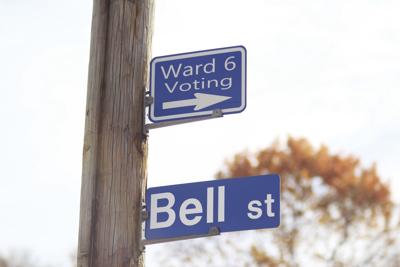
LACONIA — When the city's Ward 6 moderator resigned in September after the findings of a state investigation, the city advertised to find his replacement.
Not a single application was submitted.
A temporary moderator volunteered and was officially appointed less than 12 hours before polls opened on primary election day in September. That temporary moderator worked with the guidance of state election monitors to pull off the primary and since has agreed to stay on as the moderator for Ward 6.
Election officials and their training, obligations and responsibilities are often overlooked by voter, and the incident and its aftermath opened many residents' eyes to how little they knew about how their elections were run and who runs them.
“People need to know the people running their elections,” said Mark Sisti, who has served as moderator for the town of Gilmanton since 2004. The function of such officials is to ensure and be accountable that elections "are run well and with integrity.”
The moderator in each ward is in charge of the polls on Election Day. Moderators supervise and support poll workers and are responsible for ensuring the polls are open and equipped at the right time, that counting procedures are correctly executed and that the vote is tallied accurately. The role is an elected position that serves under the city clerk, who provides them, and other election officials, with support and training. All voting machines are checked by election officials and the clerk’s office for accuracy before each election.
On Election Day itself, moderators help keep order at polling stations. Sometimes that means working with voters who are frustrated, confused or disgruntled.
As a trial lawyer, Sisti said he enjoys this part of the job.
“I like working with people. I don’t mind dealing with the occasional conflict and I get a lot of pleasure out of helping people resolve it,” he said.
Moderators also are responsible for finding solutions to unexpected problems that arise at polls.
“One year we had a machine malfunction because one of the ballots was wet. We had to get a spare voting machine brought over by the state,” Sisti said. Another year, “there was a power outage and we were up into the night literally counting ballots by candlelight.”
Any municipality’s goal is to find officials who can and will stay in their positions for the long haul, and having a deep and experienced roster of election workers and officials can be a key asset for town and city clerks.
This year, the city experienced unusually high vacancy levels, having to find new or temporary replacement officials for posts in several wards.
Wards 1, 5 and 6 needed temporary or permanent moderators. Ward 4 had no selectpeople and no ward clerk. In Ward 5, the ward clerk is a candidate for Statehouse on the ballot and is not allowed to serve his post on Election Day. Additional poll workers were needed in Wards 4 and 5.
Gargano, a former city clerk in Franklin, remembered that the city had successfully used flashing road signs to advertise open positions for city election workers and officials.
Last month, Gargano brought that strategy to Laconia. It was largely successful: 18 people reached out to her office, seven of whom were eligible to fill the advertised vacancies in Wards 4 and 5. Others were connected with the election officials in their ward.
Having an abundance of experienced moderators and other officials can be a key resource for municipalities and for the statewide voting system.
The monitor sent by the state to oversee Laconia’s Ward 6 primary election, Bonnie Winona Mackinnon, was the moderator in Nottingham for over a decade. During the primary, a former moderator stepped into Ward 1 when the moderator there fell ill. Another former moderator will step in to temporarily fill the role after a resignation, but is not willing to resume the duties long term, according to Gargano.
“You hope to get a good group in and train them, keep them around as long as possible,” Gargano said.
There are obstacles to that, however, that may have compounded for the city this year.
Poll workers tend to be retired. During the pandemic, many nationwide left their posts because of health risks at the polls. Though pandemic risks are more subdued and managed now, many former workers did not return, or still feel unsafe doing so.
This year in the city, several poll workers in one ward left their posts after the primary because they caught COVID-19 at the polls.
One moderator resigned because they felt the workload was too much. Another was redistricted into another ward.
Safety could also play a role. As concerns and conspiracies about the validity of elections become more widespread, poll workers are put under increasing pressure and scrutiny.
Gargano said safety “is definitely a growing concern for some,” adding that she asked the police department to have a stronger presence at the polls this year.
Overall in Laconia, she said, safety hasn’t been a major issue.
“People were nervous, with all the publicity we received because of the investigation” in Ward 6, she said. In Windham, another city with a state monitor at the primary, NHPR reported a crowd of people recording the counting process and leaning over a tape line, watching for mistakes.
“But we actually saw the opposite” in Ward 6, Gargano said: Voters were actually more patient and friendly to poll workers and expressed more gratitude than she had noticed before, especially toward the new moderator.
The job of an election official is also strenuous.
According to the city clerk, those officials who hold elected positions — moderators, selectpeople, ward clerks and supervisors of the checklist — receive a flat rate from the city of $150 per day. Election days are typically 15- to 17-hour days. There is around 15 to 20 hours of training in addition.
Talks in the city about raising the stipend for poll workers to help attract and retain haven’t progressed since an October City Council meeting when the idea was raised by Mayor Andrew Hosmer.
“That’s a real concern going forward,” Hosmer said of the spike in vacancies, adding that it seemed such officials are “Woefully underpaid for what’s required of them.”
“The key,” to getting people to stick around, according to Sisti “is to find people that enjoy it and see value in it.”
When asked about why he had stayed at his post so long, he chuckled that “Either people think I’m doing a great job, or nobody else wants to do it.”


(0) comments
Welcome to the discussion.
Log In
Keep it Clean. Please avoid obscene, vulgar, lewd, racist or sexually-oriented language.
PLEASE TURN OFF YOUR CAPS LOCK.
Don't Threaten. Threats of harming another person will not be tolerated.
Be Truthful. Don't knowingly lie about anyone or anything.
Be Nice. No racism, sexism or any sort of -ism that is degrading to another person.
Be Proactive. Use the 'Report' link on each comment to let us know of abusive posts.
Share with Us. We'd love to hear eyewitness accounts, the history behind an article.