


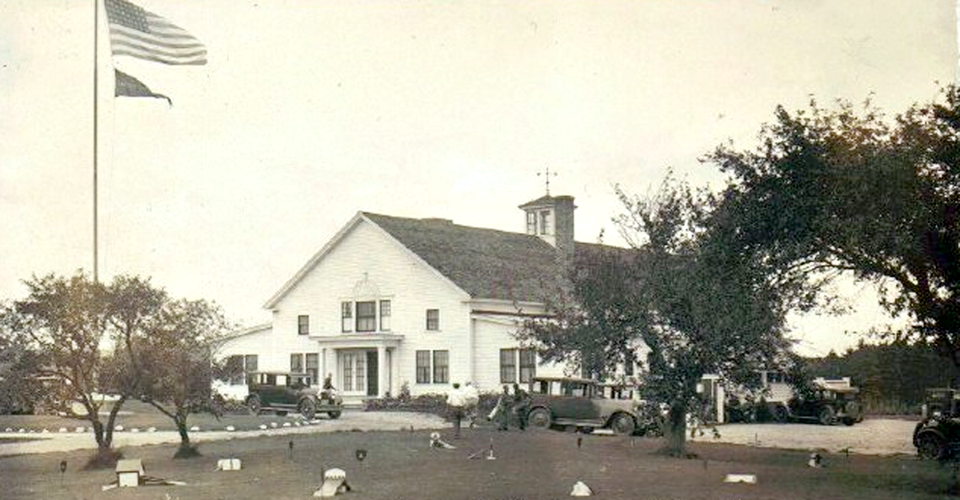
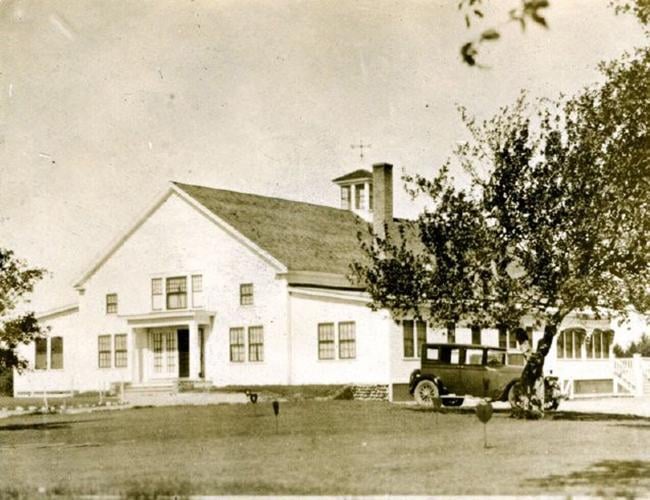
LACONIA — The two most important days in the history of Laconia Country Club are the day in 1922 that the founders got together to plan the club, and Nov. 9, 1965, when a fire destroyed the club’s main building. Because of the events of that second date, much of the history that preceded it is a mystery to current members.
A committee at the club is hoping that members of the public might have some missing pieces of the puzzle stored in an old box somewhere. Their desire isn’t purely academic, as the committee, working in partnership with the Laconia Historical and Museum Society, is compiling a history of the club to celebrate its centennial next year.
“It burned to the ground,” said Ruth McLaughlin of the 1965 disaster. “Before the '60s, there’s no documents at the country club itself.”
The researchers have been able to start a history from other sources, though, particularly from newspaper archives and from anecdotal accounts.
The Country Club was conceived on Jan. 16, 1922, in a meeting held at the Laconia Tavern. McLaughlin’s draft history report lists the original incorporators as Harry S. Chase, Edmund Fitzgerald, Charles Haybord and Thomas P. Cheney. Officers elected were Robert H. Murray, president; Clarence E. Rowe, vice president; Hayford, treasurer and Cheney, clerk. Arthur O’Shea, Elmer Tilton, Dr. Armand Normandin, Oscar Lougee, Edgar Prescott, George Quimby, William Dixon, Ellsworth Rollins and W.J. Follet were directors.
The course was built on land that was formerly the Herbert Sanborn Farm, with the original tract covering 250 acres from the shores of Paugus Bay (then known as Lake Paugus) to Lake Opechee. Philip Avery, architect from Boston, was hired to convert the large farmhouse into the clubhouse. Wayne Stiles designed the original nine-hole course, which opened that year. The club also had two tennis courts. Four years later, another nine holes were added; they were designed by local resident Ralph Barton.
Laconia Country Club’s history shows marks from outside events. During World War II, for example, the club filed for bankruptcy due to a lack of gasoline, members, and golf balls. Motorized carts were added in 1960, and automatic irrigation in 1964. Membership had rebounded by 1961 to its 400-member limit, with names on the waiting list.
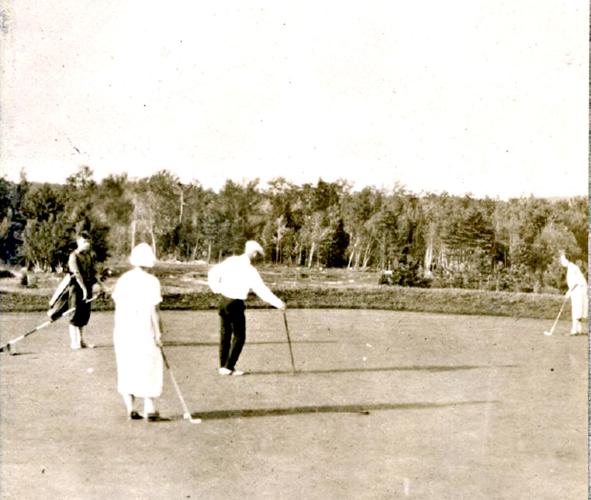
Judging by old photos, women have been part of the activities at the club for all of its history. For the first half, though, they were kept out of its leadership.
The first suggestion that women should be included on the board of directors was floated in 1963 — and with the rationale that she could be in charge of tidying up in the clubhouse and locker rooms. Although several women were nominated, they failed to win support of the board. In 1973 — a decade later — a motion succeeded to make the president of the Ladies Twilight League an ex-officio member, and so CeCe McCubrey was the first woman to sit on the board. Three years later, Sue Irwin was the first elected woman on the board, and the club saw its first female board president, Virginia Wakeman, in 1984.
McLaughlin and her committee, with a lot of help from the Historical and Museum Society, have put together a rich timeline of significant developments, including land transactions, investments in the facility, and changes in membership. But they don’t know what they don’t know, and that’s why they are reaching out to the general public.
Tara Shore, of the Historical and Museum Society, said they are specifically interested in “people stories.” “We know there are families that have been involved in the Country Club for years and years and years,” Shore said. Photos, such as from weddings or class reunions, are also sought. “If people are out there and know that their dad was a caddy, their mom was a first player, they should reach out.”
Those with stories to tell should call the country club at 603-524-1274 and ask to speak with the general manager. Interviews with people who have country club histories are being conducted now through June. Celebration events at the club are expected to take place next summer and fall, and a book about the club will be published through local company Give a Salute! in time for holiday orders.
This project marks a new initiative for the Laconia Historical and Museum Society, which is now willing to offer archive services for significant organizations such as the country club. In exchange, the club will provide support for the nonprofit LHMS.
“We’re really excited to take on this project,” Shore said. “We expect that we will find stuff that no one else knows about. We’re going to dig, we’re going to find, we are going to create a history archive for them.”


(0) comments
Welcome to the discussion.
Log In
Keep it Clean. Please avoid obscene, vulgar, lewd, racist or sexually-oriented language.
PLEASE TURN OFF YOUR CAPS LOCK.
Don't Threaten. Threats of harming another person will not be tolerated.
Be Truthful. Don't knowingly lie about anyone or anything.
Be Nice. No racism, sexism or any sort of -ism that is degrading to another person.
Be Proactive. Use the 'Report' link on each comment to let us know of abusive posts.
Share with Us. We'd love to hear eyewitness accounts, the history behind an article.