


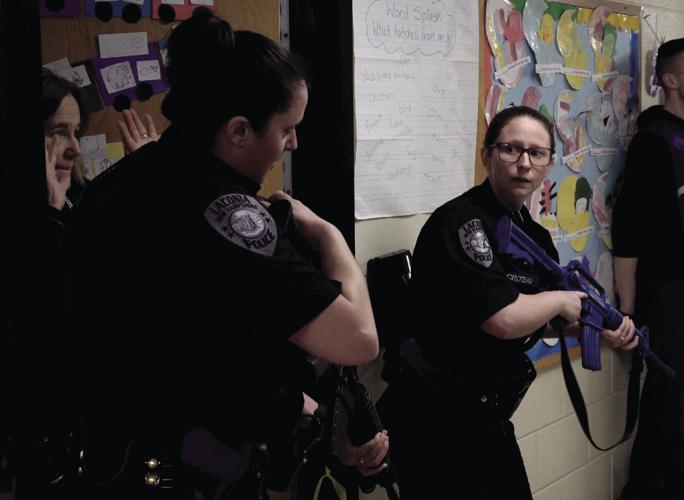
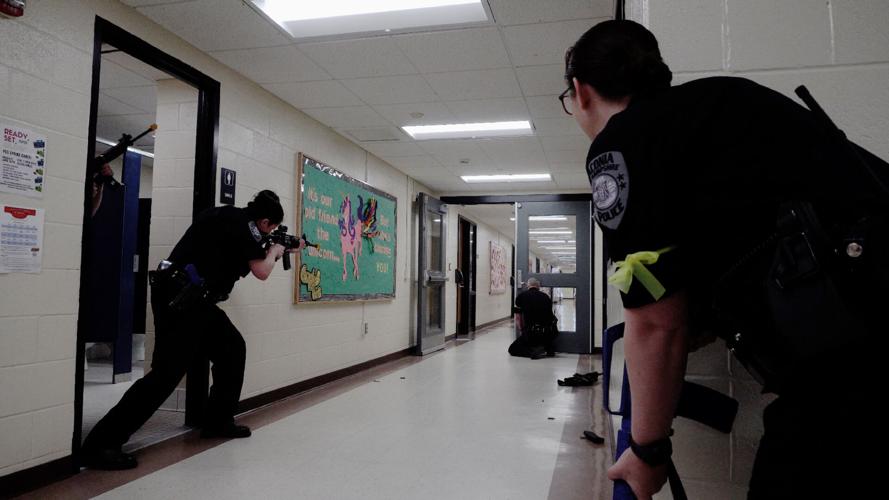
LACONIA — With the continuing increase in school shootings nationwide, the Laconia police and fire departments joined forces with neighboring agencies Saturday for an active shooter drill at Pleasant Street School led by the New Hampshire Division of Homeland Security and Emergency Management.
"Nationwide, these types of trainings are certainly on the rise because tactics are needing to be improved. Law enforcement learns, fire departments learn, we all learn," said Robert Christensen, the NH Department of Safety's chief of training exercises, who acted as safety officer this past weekend.
The exercise comes less than a month after a shooter killed six people, three of them children, at The Covenant School in Nashville. Last week, a man threatened gun violence at Portsmouth High School. Police discovered an AR-15-style rifle, ammunition and a ballistic vest in his car.
As of April 10, there have been 146 mass shootings in 2023. According to Education Week, there have been 14 school shootings that have resulted in injury or death this year.
Firearms surpassed motor vehicle accidents as the leading cause of death for American children in 2020.
"Certainly, this is a priority of ours to be adequately trained and prepared," Laconia Police Chief Matt Canfield said. "However, the full-scale exercise brings all the components of this and tests all our responses to an active shooter event. Everything from the initial responding officers, initial responding supervisors, actively coordinating the response while a shooting is going on, and certainly the follow-up with EMS personnel once the hot zone is diminished."
The exercise focused on patrol officers, not SWAT teams, to clear the school building of the shooter as quickly as possible. To make the drill realistic, a free-standing door to breach, weapons that fire blanks, and civilian role-players were included.
Each scenario began with officers rushing the sturdy metal breaching door placed in front of the building and knocking it open with a battering ram before entering the school.
As officers swept classrooms and hallways, observers followed with clipboards, grading movement, tactics and communication.
Afterward, responders were given feedback both from the exercise organizers and the person who played the shooter.
Each scenario had differing threat placement and wrenches thrown in to challenge participants.
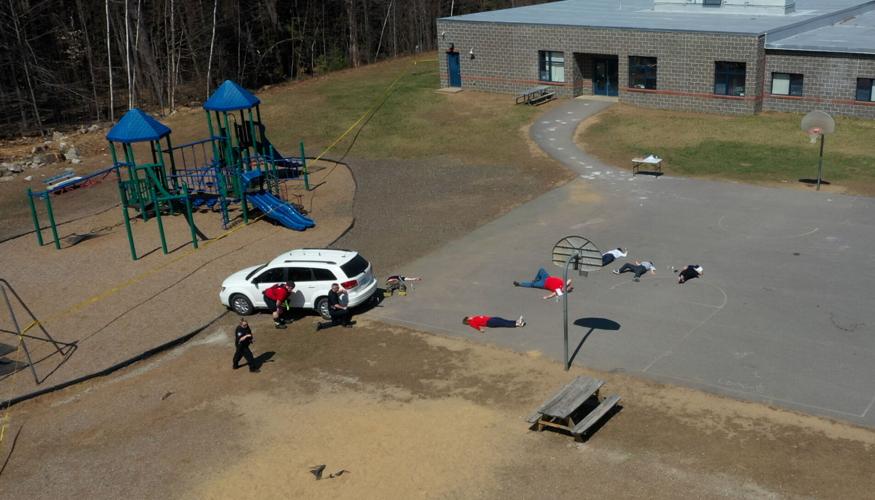
During the second and third scenario, the school's fire alarm was activated, adding additional stress and distraction into the mix. In the final scenario, the shooter used wounded civilians in the school's outdoor basketball court as bait and opened fire at medical staff when they approached, pinning them behind a car.
Among the civilian participants was Pleasant Street School Principal Elisa Guerriero. This was her first year as principal after 24 years working as a teacher.
"I feel really bad for students and children these days," Guerriero said. "When I grew up, we didn't have to worry about these types of things. I'm sure the threat was there, but not like it is today. It's more common now."
"When I first started working in a school, we didn't think about school shootings. Then there were some incidents, most notably Columbine, where everything changed after that," said Laconia School District Superintendent Steve Tucker. "I grew up in a small town in Vermont where it was pretty typical that kids went hunting before school and had guns in the back of their pickup truck, and nobody gave that a second thought. Obviously, now we're in a different time, and we have to constantly be thinking about school safety."
Tucker wasn't sure what has changed to make these events commonplace.
"That's a tough one," Tucker said. "I don't really have an answer to that. It saddens me."
The growing number of mass shootings each year sparks discourse, but the U.S. has yet to agree on a tangible solution. Those on the political left say firearms and the ease at which many people can access them are to blame. Those on the right argue that mass shootings are a mental health issue, and further regulation on American gun ownership will not curb the problem.
“Weapons, certainly that is a threat. It’s a big threat we face, but using these same tactics, these same incident command procedures we're able to apply whether it's a flood, whether its a large fire ... we’re very aware firearms are a threat, but so are a lot of things,” Christiansen said. “These are about walking through those command procedures.”
Like any high-stress scenario, communication is key. At Robb Elementary School in Uvalde, Texas, last May, a shooter gained access to the elementary school with an AR-15-style rifle, and officers waited more than an hour and 14 minutes to breach the classroom. Images taken from the school's security cameras showed officers, many armed with rifles, waiting in the halls after a brief exchange with the shooter.
By the time a Border Patrol tactical team arrived to kill the shooter, he had claimed the lives of 19 students and two teachers, making the incident the third-deadliest school shooting in U.S. history. Many officers on the ground blamed a lack of a clear chain of command, while members of the public chided the department for cowardice.
When asked if there were any key takeaways from the failure of Uvalde, Christensen said "nothing is done perfectly."
"When you reference Uvalde, what does that incident command look like? When we have local law enforcement, when we have state involvement, it's all about that coordination," Christensen said. "We walk through those motions so that we try never to make that mistake of not knowing who's in charge, who's calling the shots, and how do we need to escalate if need be."
In the Nashville shooting, officers did not wait for "someone in charge" to show up on the scene. Instead, they entered the building within minutes of arrival and killed the shooter. Despite their speed and decisiveness, six people still died.
Canfield previously stated that first officers arriving on the scene have autonomy to make crucial decisions in Laconia.
"We did three scenarios today. We had evaluators who are subject matter experts; they brought some critiques, and there's always room to grow. In each successive cycle, they applied what they heard and got better and better, and by the third scenario, it was really tight," Christensen said.
“Honestly, I have mixed feelings. I feel very fortunate to live in Laconia in a community where we can have partners in the [police department] and [Homeland Security] and the [fire department] where we feel like we can work with folks who are doing a great job keeping our kids safe,” Tucker said. “I’m also sad that we have to take the time to do this, because our job is to educate kids, and unfortunately, we have to take time and energy to do this.”
Editor's note: This story has been updated to clarify the name of the agency leading the drill, the New Hampshire Division of Homeland Security and Emergency Management.


(0) comments
Welcome to the discussion.
Log In
Keep it Clean. Please avoid obscene, vulgar, lewd, racist or sexually-oriented language.
PLEASE TURN OFF YOUR CAPS LOCK.
Don't Threaten. Threats of harming another person will not be tolerated.
Be Truthful. Don't knowingly lie about anyone or anything.
Be Nice. No racism, sexism or any sort of -ism that is degrading to another person.
Be Proactive. Use the 'Report' link on each comment to let us know of abusive posts.
Share with Us. We'd love to hear eyewitness accounts, the history behind an article.