


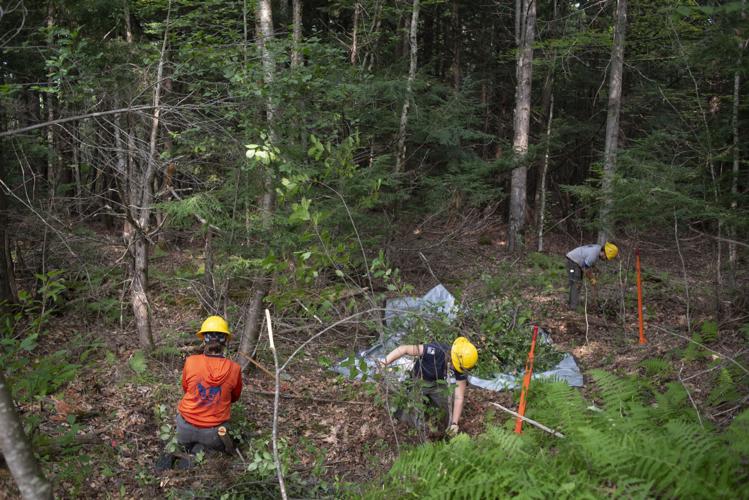
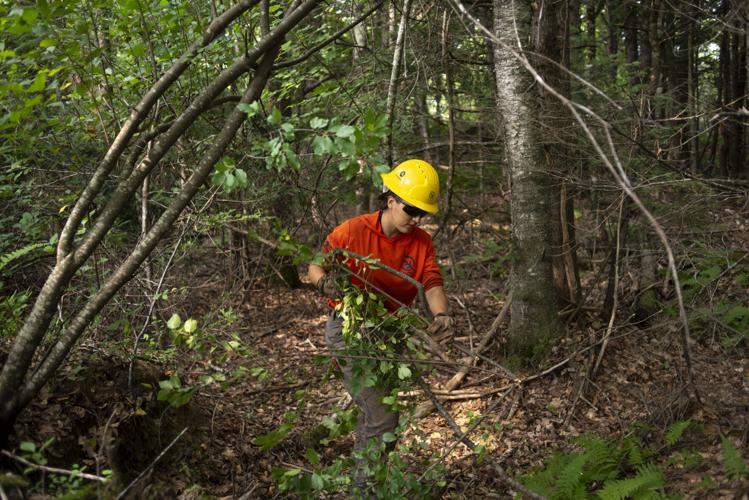
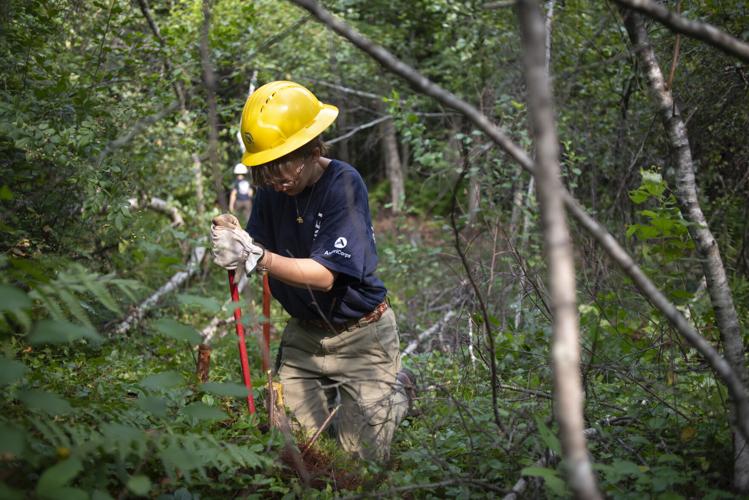
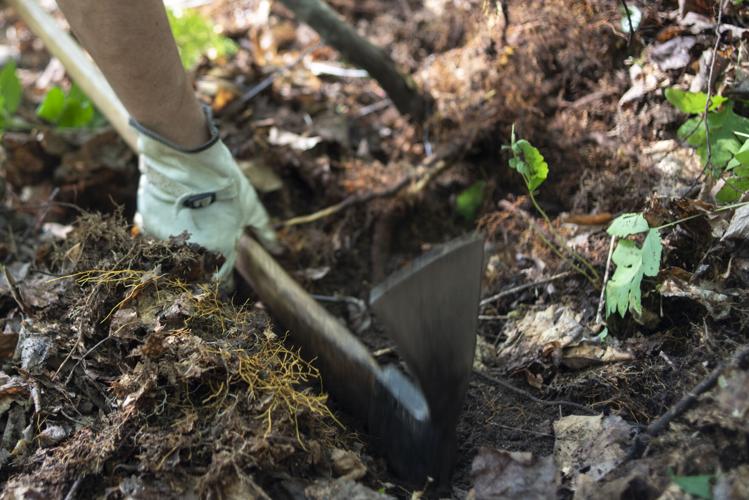
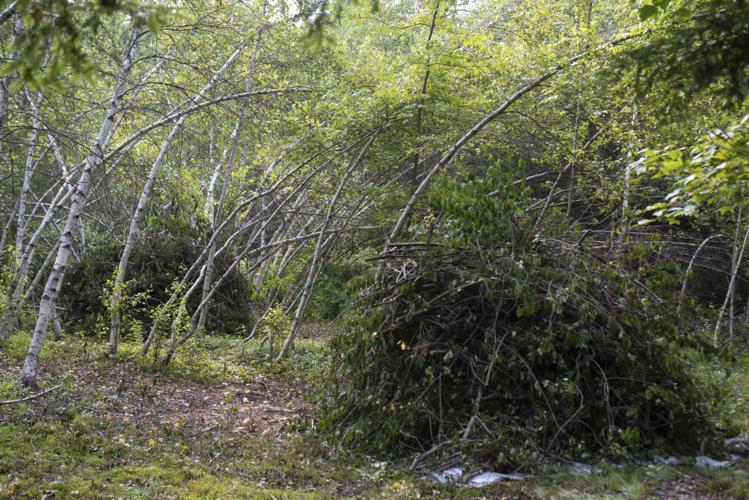
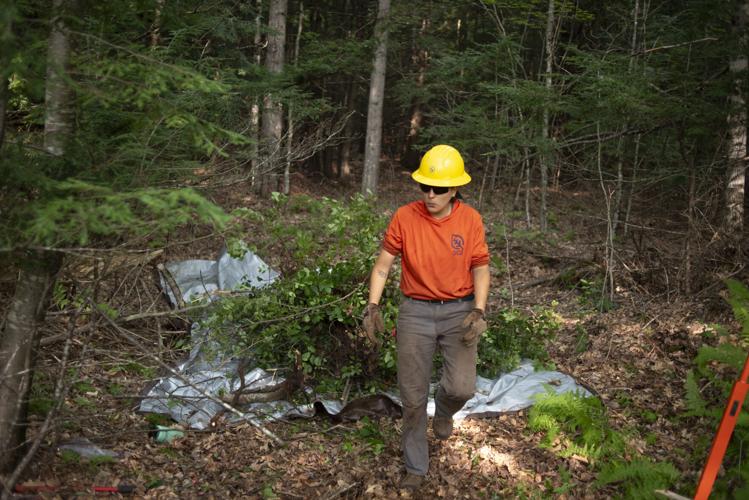
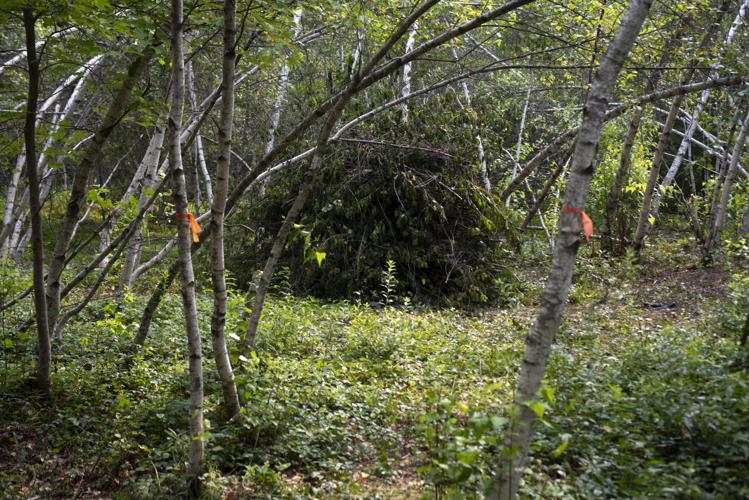
BELMONT — Members of the New Hampshire Conservation Corps travel the Granite State from April to October, assisting communities with their environmental protection efforts for 10 days at a time. Last week's stop: the Tioga River Wildlife and Conservation Area, to help remove the invasive glossy buckthorn shrub.
NH Conversation Corps is part of the Student Conservation Association, an AmeriCorps program.
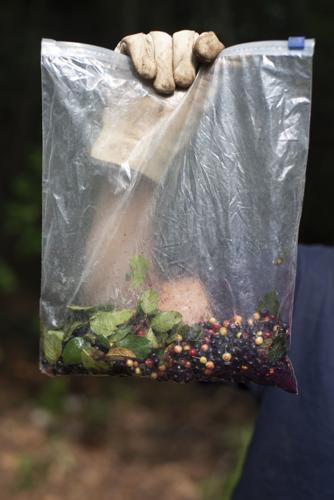
Glossy buckthorn is native to Eurasia, and was brought to North America in the 18th century to be planted in home gardens. It grows and spreads quickly, sprouting leaves before native plants, shading them out from receiving necessary sunshine, and preventing healthy biodiversity. Its berries are eaten by birds, then spread through their droppings.
Belmont Conservation Commission Chair Pauline Tessier said the shrub grows wherever the droppings land.
“I actually even have some on my property, and I've been working on trying to get it under control,” she said.
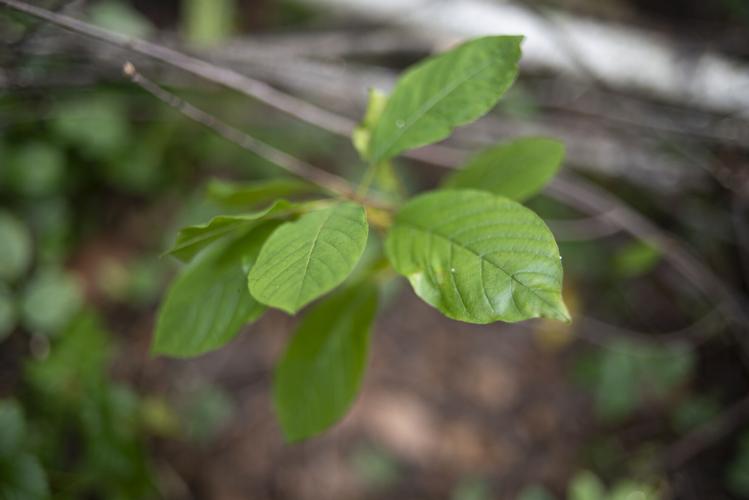
Glossy buckthorn is identified by rounded leaves with pointed ends with a glossy texture, and can grow up to 20 feet. It's found mostly in densely forested areas in the Northeast and Midwest.
This is the second year a crew has come to help remove glossy buckthorn. The group is funded by a grant from the Belknap County Conservation District, through the National Fish and Wildlife Foundation. Tessier said she is grateful to have extra help, as there are not enough local volunteers.
“I did get five people that signed up to work three hours on Saturday,” she said. “But these kids work 10 days stretches, wherever they go, to help out with conservation issues.”
Crew leader Harrison Devoe, 21, said the location was picked for a section of old hemlocks which are diseased and being eaten by insects.
“If those start to struggle, the buckthorn can come in and just take over,” he said.
Beyond the invasive plant removal, crew members can also do projects including carpentry and stonework. The crew receives specialized training, certifications to perform required work, and learns from experienced people in the field. SCA Program Assistant Riley Holzhuter takes care of the facilities and food for the crew, and assists in any field work. She started as a crew member in 2022, and said anyone is welcome.
“You come into this program, and you don't have to have any prior experience at all,” she said. “You don't even have to have touched a tool in your life.”
Crew members come from diverse backgrounds and locations, from Montana to Pennsylvania. Devoe, like the rest of the crew, comes from outside New Hampshire. He is from Salem, Massachusetts, going into his final year at Salem State University, studying environmental biology. He was looking for a summer internship, but stumbled upon the NH Conservation Corps.
“I kind of found the SCA and saw the New Hampshire Conservation Corps, which seemed pretty appealing to me because the wide range of work. And I enjoy hiking in New Hampshire,” he said.
Kate Bertrand, a 27-year-old from Coudersport, Pennsylvania, got a music degree from the College of Worcester, in Ohio. She then played as a drummer in bands in Philadelphia, and worked in food service to make ends meet. She was looking for something new, and when she was accepted into the NH Conservation Corps, she found a passion for working outdoors. She liked doing stonework for steps on a trail on Mount Monadnock, and received a certification in rigging.
“Just trying to find a job outside that could get me on a new career path,” she said.
Funds from the grant which supports this work will expire in October. The Belknap County Conservation District received the grant for three years, and used it to support invasive plant removal for two. Grants like this one are essential to the work of the BCCD, historically having a budget of only $50,000 to help pay for one full-time staff member and a pickup truck. This May, the Belknap County Delegation cut that budget in half, against the recommendation of county commissioners. The grant helps fund town forest plan projects in Alton, Belmont, Gilmanton and Meredith, as well as stream restoration programs in Meredith and Sanbornton. Former BCCD Board Chair Donna Hepp, who helped secure the grant, said the cut poses a challenge.
“That county funding helps us with match [funds], and it shows funders that we've got local support for what we do,” Hepp said.
In a media release, current BCCD Chair Jamie Irving spoke to the importance of these collaborations.
“Working with conservation commissions and conservation partners like SCA is how we can help make a difference in our environment and communities” Irving said.


(0) comments
Welcome to the discussion.
Log In
Keep it Clean. Please avoid obscene, vulgar, lewd, racist or sexually-oriented language.
PLEASE TURN OFF YOUR CAPS LOCK.
Don't Threaten. Threats of harming another person will not be tolerated.
Be Truthful. Don't knowingly lie about anyone or anything.
Be Nice. No racism, sexism or any sort of -ism that is degrading to another person.
Be Proactive. Use the 'Report' link on each comment to let us know of abusive posts.
Share with Us. We'd love to hear eyewitness accounts, the history behind an article.