


LACONIA — Winnipesaukee Mobile Health, a program piloted by the city’s fire department, Partnership for Public Health and Concord Hospital, has already made a significant impact. Now, they’ve got data to back it up.
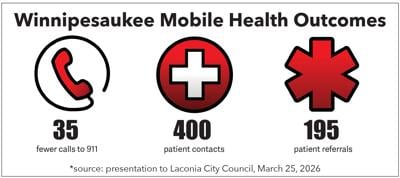
Between July and December 2025, the program has successfully prevented at least 35 calls to 911, according to Winnie Tunstall, the community paramedic for the fire department. They’ve had more than 400 patient contacts in the first year, with more than 90 individual patients, and connected more than 20 to primary care. They’ve also made 195 referrals to help patients address barriers to care.
“Community paramedicine expands the role of paramedics beyond emergency response,” she said. “We are focusing on preventive and proactive health care in the moment.”
In Tunstall's clinical role, she’s been busy since jumping on board last year. Community paramedics provide free, in-home support for people managing health issues, and work to reduce avoidable emergency room visits.
Tunstall provided program updates to the city council during their regular meeting on March 23.
The initiative, funded for three years through a Health Resources and Services Administration grant, supports a community paramedic and a community health worker, who provide services across the Lakes Region.
The goals are relatively straightforward: improve patient care, reduce unnecessary ambulance transports, ensure continuity of care, and assist community members in accessing and navigating the health care system. Through this program, professionals deliver care directly to patients, often in their own homes.
The effort involves assisting individuals with various medical diagnoses, like diabetes, hypertension or congestive heart failure, and also addresses social and environmental factors like unstable housing, transportation barriers or food insecurity. Preventive and transitional care is a third pillar of the program.
Community health workers are navigators — they connect clients with health care services, educational resources and supportive services. Faith Pakasuk and Denise Eaton of PPH are the program’s community health workers, and Emma Petersen, also of PPH, is the project’s director.
“Physical assessments and monitoring, we’re doing that by monitoring vital signs at home. We’re identifying early changes in conditions and intervening before issues escalate into emergencies. Providing non-urgent care, we treat low-acuity concerns in the home,” Tunstall said. “Chronic disease management, we’re reinforcing medication compliance, monitoring symptoms and helping them stay on track with their care plans."
Educating patients on their conditions and medications helps empower them to make informed decisions, she said, and they address social determinants of health — barriers to care — like health insurance coverage, transportation challenges and financial instability “that directly impact health outcomes.”
“This program is tremendous for our community. [Fire Department] Chief [Tim] Joubert and I spoke about it last year, and I was really, really impressed. And I think, at that time, other communities, other cities — larger cities — were looking at mirroring Laconia’s successes,” Ward 1 Councilor Jon Hildreth said.
Tunstall writes referrals to the community health worker, Pakasuk, who provides non-clinical support by helping individuals follow care plans, connect with essential resources and complete education. One patient, she told councilors, was taken to the hospital more than 40 times in 2024. In 2025, after enrollment into the program, that figure was down 75%, to 10 times.
“Moving forward, we are looking at ways to grow the program. We’re looking at all the opportunities that are possibly there,” Chief Tim Joubert said. “We work right now with the Partnership for Public Health, it’s a team effort.
“Together, we want to keep this moving forward, to try and grow and expand. Right now, Winnie can really only treat Laconia residents, where other parts of that can go outside of Laconia,” he said. “Working together with PPH and other avenues, we can definitely grow this program, because there is a need for it, for sure.”
Joubert said Tunstall is an effective advocate for her patients, one of her biggest strengths. Ward 2 Councilor Bob Soucy said he strongly supports growing the program.
“I’ve seen it in action with a couple of people I know, and I think it’s awesome, and I wanted to thank you very much,” Soucy said.
Across the state, there are five active programs, Tunstall said, and other towns and counties are inquiring about how to start programs of their own.
“We are bridging gaps in primary care, specialists and community resources to ensure continuity of care,” Tunstall said.
In addition to providing better care for patients, reducing ambulance trips helps relieve the medical system of the burdens associated with high usage. Ambulance transport is expensive.
Deputy Chief Scott Lewandowski, who oversees emergency medical services, told councilors that in 2025, the department experienced a net loss of $77,722 on ambulance billing, across 3,627 calls. That’s actually an improvement of 83% over the five-year average loss of $222,237.
Billing lags. The department is still collecting revenue from 2022, Lewandowski said. Current data trends show revenue is steadily increasing at the same time the budget gap is narrowing, significantly. And in 2025, it was the first time that projected revenue closely matched actual income, which he said indicates improved billing accuracy and collections. The 2025 projected income totals $1.36 million, 35% higher over 2024.
“We’re still trying to close that gap and make it even, but we’re the closest yet, at $77,000 and change,” Lewandowski.
In 2025, total patient contacts were 3,626, an 8% increase over 2024. Of those contacts, firefighters performed 2,398 patient transports, an 11% increase. Mutual aid calls increased 124% — Belmont and Gilford account for 90% of those calls, largely because Belmont was down to one ambulance.
“Medicare is our biggest client at 50%, Medicaid, 18%, commercial is at 16 [%],” Lewandowski said.


(0) comments
Welcome to the discussion.
Log In
Keep it Clean. Please avoid obscene, vulgar, lewd, racist or sexually-oriented language.
PLEASE TURN OFF YOUR CAPS LOCK.
Don't Threaten. Threats of harming another person will not be tolerated.
Be Truthful. Don't knowingly lie about anyone or anything.
Be Nice. No racism, sexism or any sort of -ism that is degrading to another person.
Be Proactive. Use the 'Report' link on each comment to let us know of abusive posts.
Share with Us. We'd love to hear eyewitness accounts, the history behind an article.