


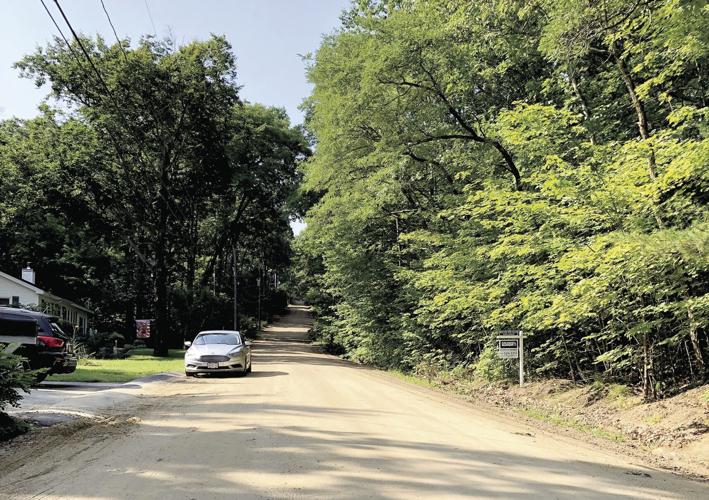
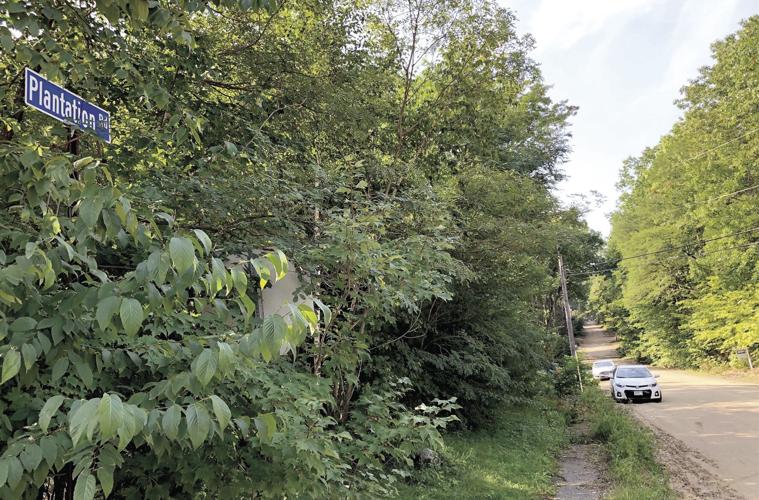
LACONIA — Residents along two unpaved streets in Weirs Beach who over the years have understood that the city maintained the roads have found out that while that is true, it is true only up to a point.
On Monday about a dozen people with houses on Plantation Road and Colonial Drive showed up for a public hearing before the City Council to object to the city’s proposal to end all Public Works maintenance on the streets in three years unless the roads are brought up to city standards, a project that could cost more than $2 million.
During a public hearing, many of them told the council that when they purchased their house they were told by real estate agents that the city took care of the streets.
Fifty years ago the developer was plowing the streets during the winter, but asked the city to sand them, according to a memo prepared by Public Works Director Wes Anderson. Then, in 1977, the city took on the job of plowing the streets after the City Council informally directed Public Works to plow private streets which had year-round residents.
The city says that arrangement is contrary to a state law that prohibits using public funds to maintain private roads.
Plantation Road and Colonial Drive are off Route 11B, about three-quarters of a mile from Pendleton Beach on Lake Winnipesaukee.
Anderson said Plantation Road in particular is subject to serious erosion during heavy rainstorms. The muddy runoff flows downhill and is dumped onto Route 11B at the bottom of the hill. Public Works crews then have to remove the silt — which is sometimes several inches deep — from the highway.
City officials met the area’s residents in October 2018 to explain their options and told them that the City would continue to plow and perform some basic maintenance until June 2020. That 20-month period was intended to give the residents time either to form a homeowner’s association which would be responsible for maintaining the road, or to initiate the process to have the roads accepted through a betterment assessment. However, the June 2020 deadline occurred during the height of the COVID crisis. So further action was deferred until it was prudent to hold another large, in-person gathering.
City Manager Scott Myers told the residents and the council that city officials want to hold another meeting.
“We need to have an open and realistic conversation about this,” he said.
In his staff report, Anderson recommended that the Plantation and Colonial be declared emergency lanes until June 1, 2024, after which the streets would become the property owners’ responsibility or steps would be taken to bring the streets up to city standards. During the emergency lane period Public Works would do plowing and sanding and other “minimal maintenance,” Anderson said.
To meet city standards Plantation and Colonial would need to be paved, and more importantly have storm drains, which include a water-quality system, installed, Anderson explained.
Mayor Andrew Hosmer acknowledged the residents — some year-round, some seasonal — are in a predicament that is not of their own making.
“The homeowners are in a tough position,” he said. “The city has kicked the can down the road for some time. It shouldn’t be an A or B option,” the mayor added, referring to the homeowner association or full-scale upgrade choices.
Myers said one other alternative would be for the city to accept the roads as is, but that would require that everyone living along the roads agree to that solution. He said the city has in recent years used that approach in dealing with some of the narrow, dead-end side streets that run off Centenary Avenue in Weirs Beach.
Anderson is wary of that approach, however.
“Public Works continues to recommend that the city not accept these two roads ‘as is’ due to the liability associated with the poor design, the lack of a drainage system and the costs associated with bringing the roads in this development up to a standard that reduces the City’s liability,” he said.
Some homeowners told the council that they are worried what ramifications there might be to their mortgages because of the situation. Others said that they now feel that they would be unable to sell their homes or wondered if utility crews such as Eversource would come into the neighborhood to repair storm damage.
One area homeowner, John DeWaele, told the hearing that the city may have in effect accepted the two streets because it has been providing snow removal and other minimal maintenance for almost 50 years, and referred to guidance on the issue from the New Hampshire Municipal Association.
“... a municipality that provides these services runs the risk of accidentally accepting the road as a new public road — with the result that the municipality will be responsible not only for plowing, but for all repair and maintenance,” according to an article published 2009 in Town and City Magazine by the Municipal Association.
But Anderson cautioned that the legal interpretations in these kinds of road cases are complicated because a great deal depends on the specifics of each situation.


(0) comments
Welcome to the discussion.
Log In
Keep it Clean. Please avoid obscene, vulgar, lewd, racist or sexually-oriented language.
PLEASE TURN OFF YOUR CAPS LOCK.
Don't Threaten. Threats of harming another person will not be tolerated.
Be Truthful. Don't knowingly lie about anyone or anything.
Be Nice. No racism, sexism or any sort of -ism that is degrading to another person.
Be Proactive. Use the 'Report' link on each comment to let us know of abusive posts.
Share with Us. We'd love to hear eyewitness accounts, the history behind an article.