


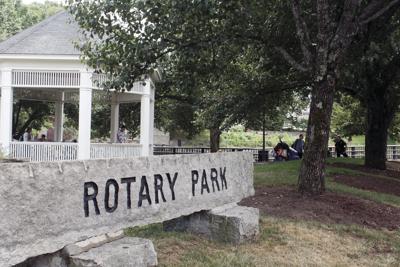
LACONIA — Since the onset of summer, large numbers of individuals experiencing homelessness have taken to congregating in Rotary Park in the heart of downtown. The close proximity of charities, rehabilitation centers, the county courthouse and other services has long been a draw for homeless people to the area. Their presence, especially when combined with open drug use, outbursts, drinking and urination, has attracted the ire of local businesses and the public. Several weeks ago, the Belknap Mill Society announced a “Take Back the Park” initiative, but the event was canceled.
"The gazebo offers a shelter, there are electric outlets out there. There’s an opportunity if you’re close to the mill to log on to the internet, and it's a beautiful park let's face it," Mayor Andrew Hosmer said. "I’m afraid that 20, 30 or 40 people are preventing others from feeling comfortable and utilizing a public service.”
For the past few months, citizens have complained online about the state of the park, posting photos and videos on Facebook of homeless people occupying the area. In early July, the Belknap Mill Society posted on their page that there would be a "Take Back Back the Park" meeting to address these concerns.
“There was such a positive response to our online post,” said Jill Desruisseaux, marketing manager of the Belknap Mill Society, “a ton of organizations reached out and wanted to participate.”
Despite the positive response, the event seems to have fallen through. Before its cancellation, The Mill Society is hoped to organize outreach groups, the mayor, police, and citizens to address the homeless occupation of the park.
According to the Belknap Mill Society's director Cheryl Avery, the situation at the park has improved since police stepped up patrols around the area, but homelessness throughout the city remains a nagging and complicated issue, negatively effecting tourism, business, and the public perception.
So far, authorities and the city have been caught in a game of whack-a-mole with the homeless population, a situation that neither Hosmer nor Laconia Police Chief Matt Canfield find sustainable.
“You can move them from one part and all these folks move to another part,” Hosmer said.
For the first half of the summer, it wasn't rare to see people gathered under the Rotary Park gazebo with carts, plastic bags and cigarettes. Police increased patrols to keep watch for illegal drug use, public intoxication and urination. However, as Canfield stressed, the homeless do have a right to be in the space as long as they are not breaking the law. Although it's not illegal to be homeless in a public space, as police increase their presence, it's common for people to move on to other areas until the cycle restarts.
"It migrates to different places," Canfield said. "Earlier in the summer, we had issues with them hanging out in the Meredith Bridge Cemetery. They were camping, urinating and disturbing some of the grave sites."
In response, police stepped up patrols and set up a camera, all of which helped push people out of the cemetery to Bartlett Beach. After Bartlett, they moved on to Rotary Park, a more visible location. Tensions reached an all-time high during one of the weekly Friday night concerts held in the park.
“Stemming from our Friday night concert where there were people openly intoxicated or using drugs, we put a heavy police presence in Rotary Park not to remove them, because they have rights like everyone else, but we put police there to specifically address anyone breaking the law, drinking, drugs, urinating in public, any violation like that, we’re not gonna tolerate it," Canfield said.
The city recently granted an extra $20,000 to the department to develop a plan to help address the issue. Canfield said he hopes to present a plan to the city council in late August.
“I’ve heard homeless referred to as the visible tip of an iceberg of problems in our country and community,” Hosmer said. “This is a manifestation of housing instability, addiction, mental illness, poverty, so responding to this homelessness without looking at the whole continuum of how people got there isn’t effective.”
There’s a wide array of factors that push individuals into homelessness. Some choose the lifestyle, but many find themselves living on the streets after addiction and mental health problems derail their lives. Others simply fall on the wrong side of the economy and can lose their jobs and homes to factors outside of their control.
According to a May 22 survey by the LendingClub company, 64% of Americans are living paycheck to paycheck. In the wealthiest country in the world, many citizens are just one accident, bill or other unforeseen expense away from living on the streets. When significant numbers of homeless appear, their presence alone can negatively impact local economies by discouraging commerce and recreation.
Despite the wide array of people who find themselves homeless, it's easy for the public to place them in one group.
“The drugs and stuff, I think that’s just a stereotype,” said Beth, a homeless single mother who visits Rotary Park. “If someone saw me sitting here writing, they wouldn’t assume I’m homeless because I don’t do drugs or look a certain way or act a certain way, but I am homeless.”
According to Beth, mental health is the largest contributing factor to homelessness, and is often a factor in drug abuse and financial problems.
“Substance abuse always leads back to mental health,” Beth said. “I’m not an abuser, but I know a lot of people that are homeless, so I’d say mental health and I’d also say a lack of education.”
Beth hails from outside Belknap County, and lost her housing during the COVID-19 pandemic.
“I became homeless because I was unaware of my rights as a tenant,” Beth said. “That comes down to a lack of education, because I didn’t understand my rights during the pandemic and things to do to prevent becoming homeless in our situation.”
From Beth’s perspective, this lack of education, and mental health support are two of the biggest driving factors behind homelessness in New Hampshire. She has also struggled with finding out what services are available to her.
“Honestly, it was the only shelter that had space at the time,” Beth said of her choice to come to Laconia. Since her arrival, Beth recently found a job as a breakfast attendant and housekeeper at a business near downtown. Her children in the meantime have been living with relatives while she tries to get back on her feet.
Other than that, Beth has the same concerns of any working parent with a roof over their head.
“I wouldn’t mind the area,” Beth said of relocating to Laconia. “I just want to find a good place for them [my children] to be school wise, school districts, is it a kid friendly place?”
Beth added that the shelter is a good place to sleep, but she’s been ultimately unaware of other resources available to her, like job services. Beth found her most recent position via personal networking, without outside help.
Laconia is home to several organizations that offer a variety of services, but navigating and properly utilizing them can be difficult.
“We need to reach out to our many nonprofit partners and break down the salvos,” said Hosmer. “There’s a number of groups with similar missions that overlap. How do we connect these groups so we’re rowing in the same direction?”
Hosmer stated that Laconia Police Det. Eric Adams will start hosting ward-wide community discussions regarding homeless this summer, starting in late July or early August as part of the city's homelessness task force.


(0) comments
Welcome to the discussion.
Log In
Keep it Clean. Please avoid obscene, vulgar, lewd, racist or sexually-oriented language.
PLEASE TURN OFF YOUR CAPS LOCK.
Don't Threaten. Threats of harming another person will not be tolerated.
Be Truthful. Don't knowingly lie about anyone or anything.
Be Nice. No racism, sexism or any sort of -ism that is degrading to another person.
Be Proactive. Use the 'Report' link on each comment to let us know of abusive posts.
Share with Us. We'd love to hear eyewitness accounts, the history behind an article.